
⭐️
ROAS
ROAS Is Lying to You,Why D2C Fashion Brands Hit Their Targets And Still Lose Money
Trusted by 235+ brands






When Performance Isn’t What It Seems
Imagine logging into your ad dashboard and seeing a ROAS of 4x. The numbers are green. The campaigns are humming. You feel good — maybe even great. Then your accountant calls.
Your contribution margin has shrunk. Cash flow is tighter than last quarter. And somehow, despite growing ad spend and strong ROAS, the business feels more stressed than ever.
This isn’t a hypothetical. This is what we’re seeing across D2C fashion brands right now — and it’s one of the most dangerous blind spots in performance marketing today.
| Why is my ROAS good but I’m not profitable?
This question has become the defining pain point of 2026–27 for D2C fashion founders. The answer lies in understanding what ROAS actually measures — and what it completely ignores. |
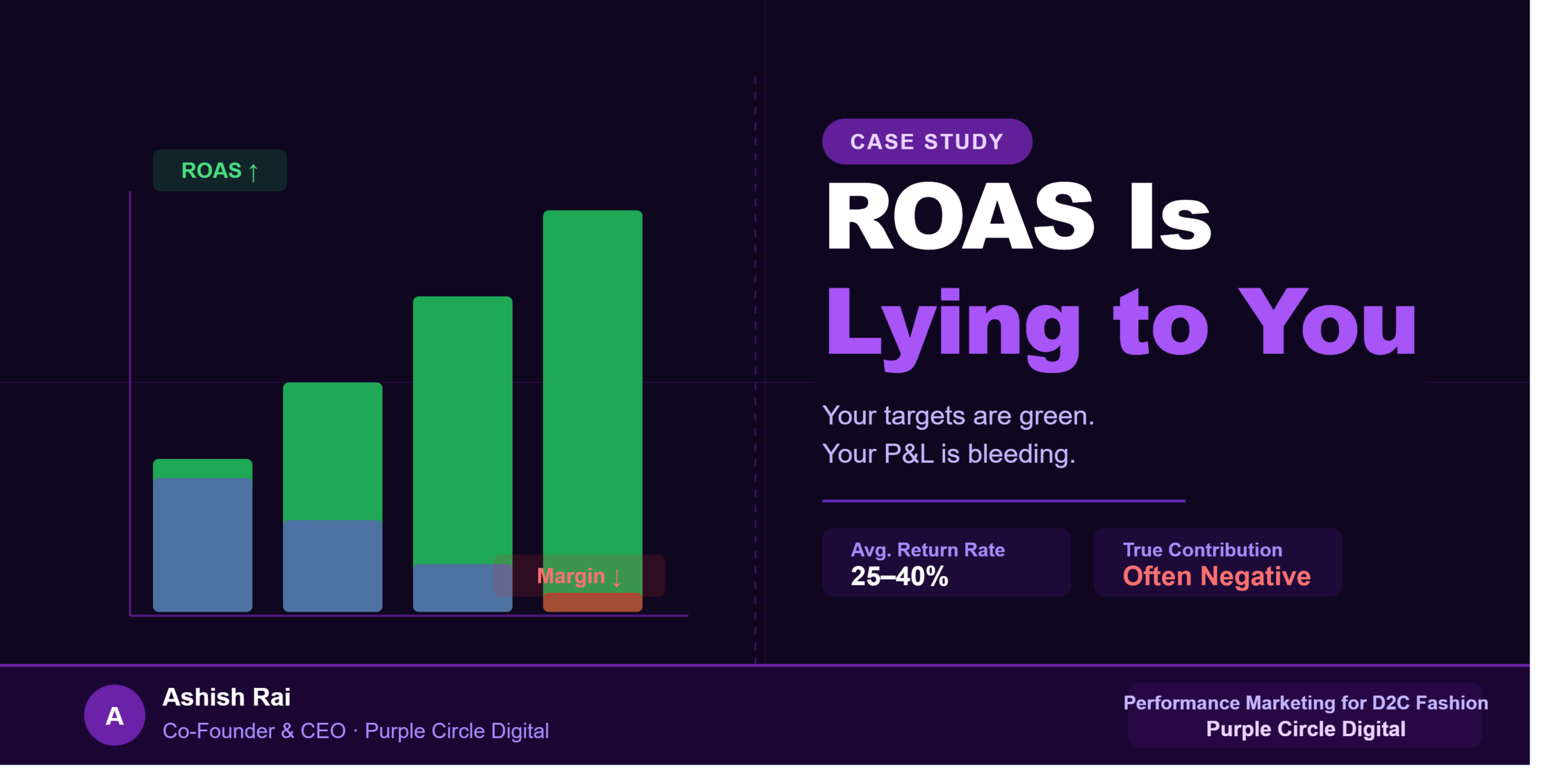
What ROAS Actually Measures (And What It Doesn’t)
ROAS — Return on Ad Spend — is calculated as:
| ROAS = Revenue Generated ÷ Ad Spend
Example: ₹4,00,000 revenue from ₹1,00,000 ad spend = 4x ROAS |
Sounds healthy, right? But here’s what that formula never accounts for:
- Cost of Goods Sold (COGS)
- Return & refund rates (D2C fashion averages 20–35%)
- Shipping & fulfillment costs
- Platform fees and payment gateway charges
- Customer acquisition cost amortized over LTV
- Agency or in-house team overheads
Strip all of that away and a 4x ROAS can quickly translate into a negative contribution margin. You are literally paying to acquire customers who cost you money.
A Real-World Snapshot: The Numbers That Told Two Stories
One of our clients — a fast-growing D2C fashion label with strong Instagram presence — came to us proud of their Meta performance. Their channel ROAS was sitting at 3.8x.
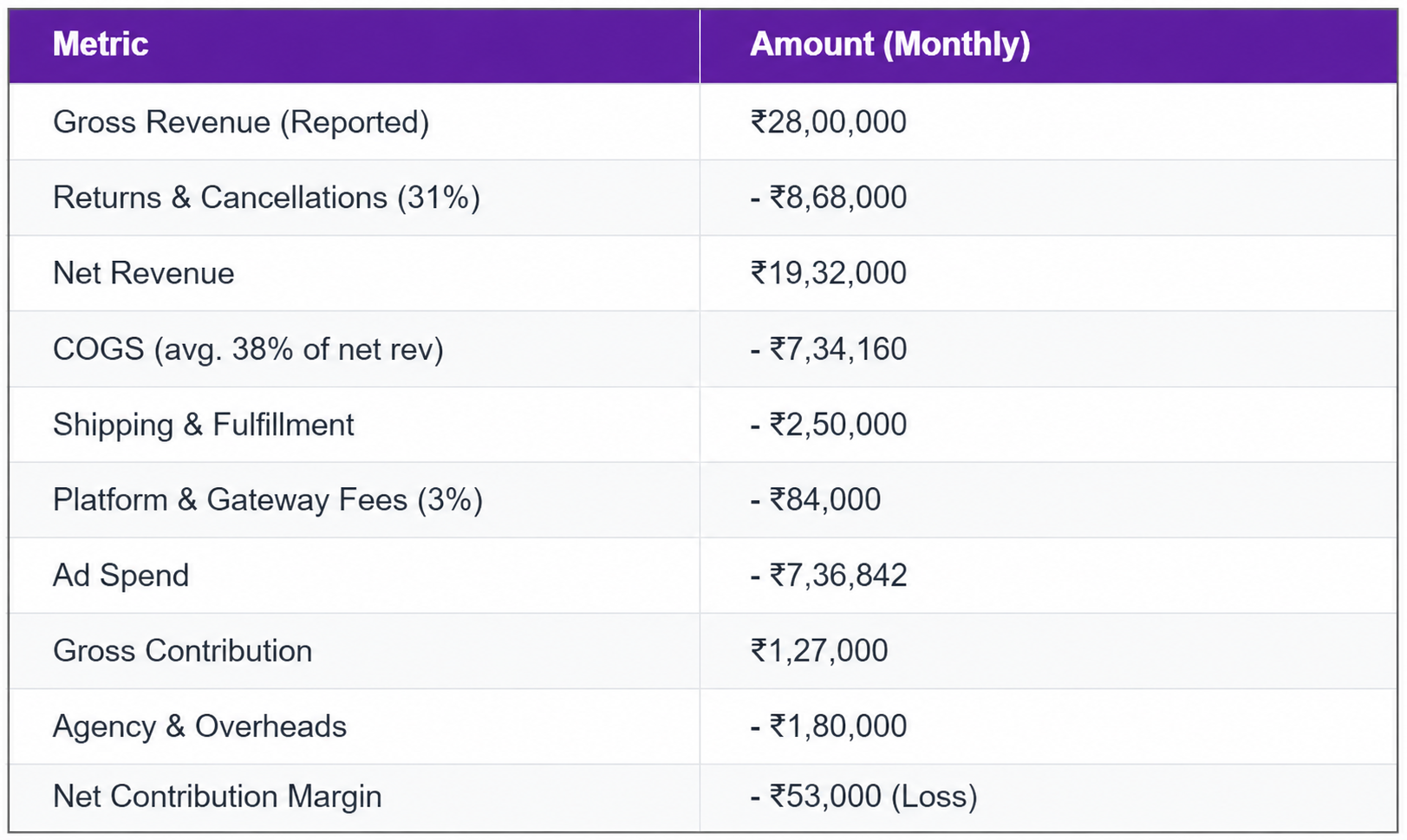
When we audited their full P&L against their ad data, here’s what the picture looked like:
| Channel ROAS: 3.8x | True Contribution Margin: NEGATIVE
The dashboard was green. The bank account was bleeding. |
Channel ROAS vs. Blended ROAS
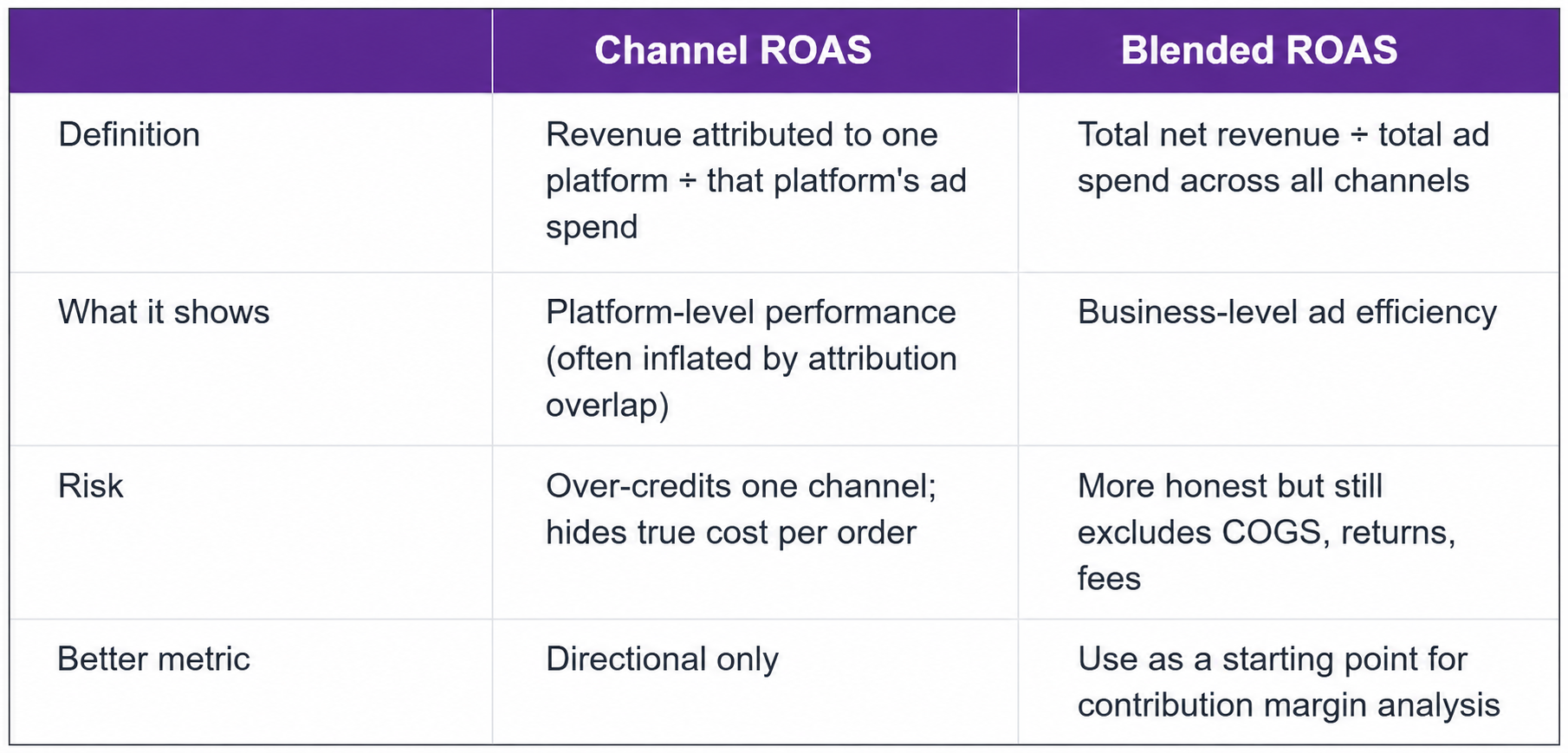
Most brands (and many agencies) optimize for channel ROAS — the return attributed to a specific platform like Meta or Google. This is not the same as blended ROAS, and confusing the two is where the trouble starts.
The real calculation you need is True ROAS — or more accurately, what we call Net Contribution ROAS:
| True ROAS = (Net Revenue − COGS − Returns − Fulfillment − Fees) ÷ Ad Spend
This is the only version of ROAS that tells you whether ads are actually growing your business. |
Why This Is a D2C Fashion Problem in Particular
Fashion is uniquely punishing when it comes to vanity metrics. Here’s why the ROAS gap hits harder here than almost any other category:
- Return rates are structurally high — sizing uncertainty, try-at-home behaviour, and trend chasing mean 25– 40% of orders come back.
- AOV is often inflated — bundles and discounts spike revenue but compress margin.
- Seasonality creates false peaks — a Diwali ROAS spike looks great until you account for the markdown inventory clearing that follows.
- Attribution is messier — fashion customers browse Instagram, compare on Google, and convert on the app. Multi-touch attribution rarely tells the whole story.
- New customer ROAS looks strong — but repeat purchase rates in fashion are low, meaning LTV rarely saves the unit economics.
What We Changed: The Purple Circle Framework
At Purple Circle Digital, we shifted this client’s entire performance lens from channel ROAS to contribution margin per campaign. Here’s the framework we applied:
Step 1: Build the True Unit Economics Dashboard
We mapped every cost layer against actual shipped & kept orders — not gross orders. This became the single source of truth for all media decisions.
Step 2: Segment Campaigns by Contribution, Not Just ROAS
Campaigns were re-tagged by product category, average margin band, and historical return rate. A kurta campaign with 4.2x ROAS but 38% returns was paused. A co-ord set campaign with 2.9x ROAS but 12% returns was scaled.
Step 3: Introduce Blended MER (Marketing Efficiency Ratio)
We moved the weekly reporting KPI from channel ROAS to Marketing Efficiency Ratio — total net revenue (post-returns) divided by total marketing spend. This gave the founder a number that actually correlated with their bank balance.
Step 4: Set ROAS Floors by Margin Band
Every product category got its own minimum ROAS threshold based on net margin. A 60% gross margin product can survive a 2.5x ROAS. A 35% gross margin product needs at least 4.5x — or it destroys value at scale.
| 90-Day Outcome
Ad spend reduced by 18%. Net contribution margin turned positive at +₹2.1L/month. Blended MER improved from 2.1x to 3.4x. The founder finally had a P&L that matched the dashboard. |
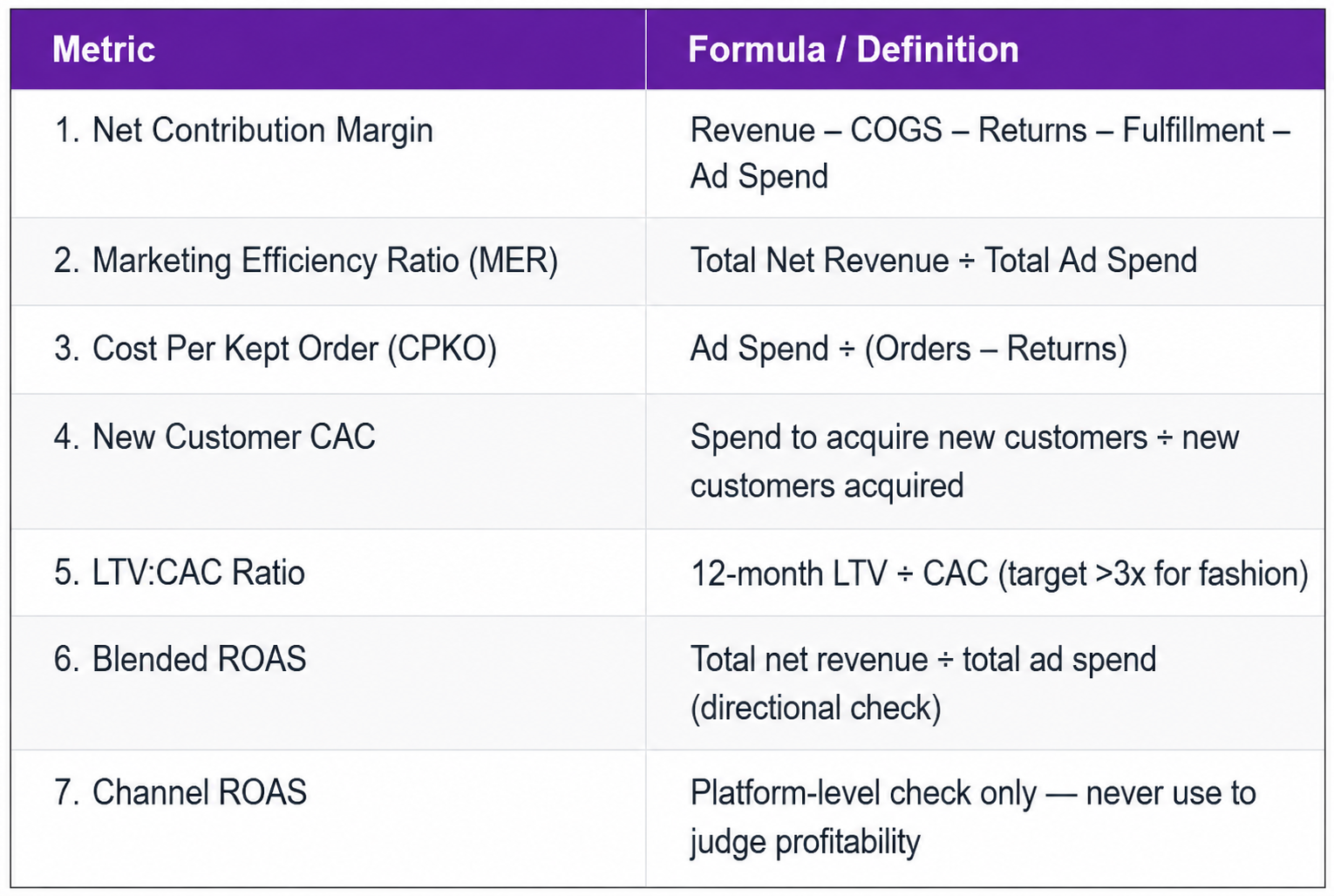
The Metrics That Actually Matter
If ROAS is no longer enough, what should you be tracking? Here’s the hierarchy we recommend:
What Founders Need to Do Right Now
If you’re reading this and your ROAS is healthy but your P&L looks different — here are the first three things to do this week:
- Pull your actual return rate for the last 90 days and apply it against your reported ad revenue. The gap will be eye-opening.
- Calculate your blended MER: take your total net revenue (post-returns) and divide by every rupee you spent on marketing. That’s your real efficiency number.
- Segment your campaigns by product margin band. Stop optimising everything toward the same ROAS target — different margin products need different performance floors.
Conclusion
ROAS is not a profitability metric. It never was. It’s a directional signal — useful, but not sufficient. For D2C fashion brands running at scale, optimising for ROAS without understanding contribution margin is the fastest way to grow a business that’s losing money efficiently.
The brands that will win in the next 24 months are the ones building performance infrastructure around real unit economics — not the ones chasing the most flattering dashboard number.
| ROAS tells you how much revenue your ads drove.
Contribution margin tells you whether that revenue was worth driving. Only one of these tells you if your business is growing. |
Written by
| Ashish Rai
Co-Founder and CEO |