
Why Most D2C Fashion Brands Can’t Scale on Meta — And What Actually Fixes It
Why Most D2C Fashion Brands Can’t Scale on Meta — And What Actually Fixes It
Most D2C fashion brands hit a wall on Meta. They scale, ROAS collapses. They pull back, revenue drops. It’s a loop that kills growth — and it’s almost always caused by the same three fixable mistakes.
The Common Scaling Pitfall Most Brands Face
Scaling a fashion brand on Meta is genuinely hard. CPMs are high, creatives burn out in days, and the moment you push budget up, your efficiency numbers start sliding. Most brands respond by either cutting spend or leaning on discounts — both of which make the problem worse, not better.
The real issue isn’t budget size. It’s architecture. Without a structured system behind the ads, you’re just burning money faster at higher spend levels.
Mistake #1 — Running cold and warm audiences together
This is the most common and most damaging mistake. When prospecting and retargeting campaigns share audiences, they compete for the same budget and cannibalise each other’s performance.
- Retargeting audiences get served prospecting ads — wasted spend.
- Cold audiences get hit with “you left something in your cart” messaging — irrelevant and off-putting.
- Both campaigns underperform and the brand blames “Meta not working”.
The fix is total separation. Dedicated campaigns for each stage, dedicated budgets, dedicated creatives. This single structural change routinely produces a 15–20% improvement in checkout completions.
Mistake #2 — Creative fatigue killing performance quietly
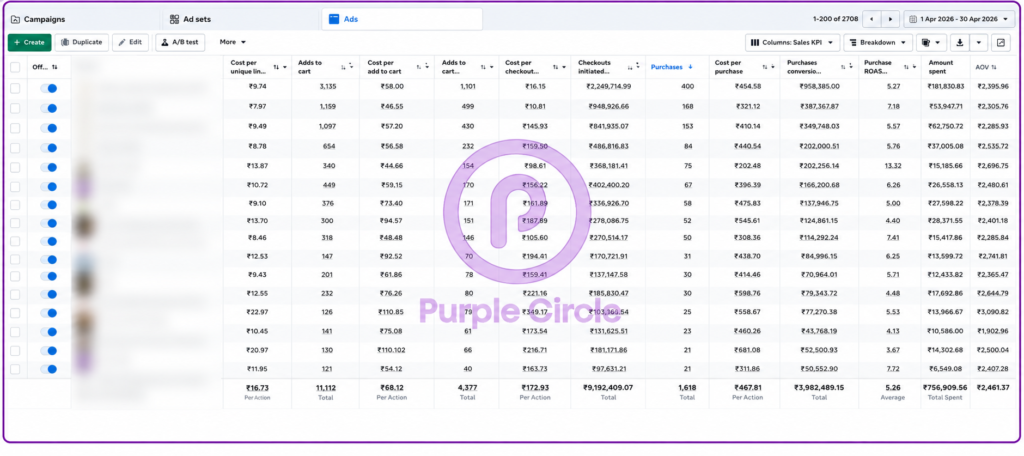
Most fashion brands run 3–5 creatives and wonder why results deteriorate after a few weeks. Meta’s algorithm needs variety to find the right audiences. When the same ads keep running, frequency rises, CPCs climb, and ROAS slowly bleeds out.
- Creative fatigue sets in much faster in fashion than in most other categories.
- High-frequency ads actively hurt brand perception — people scroll past or mark as spam.
- Without fresh variants, the algorithm has nothing new to optimise against.
The solution is a continuous creative testing pipeline — not batch launches. Top performers should be identified within 72 hours, scaled immediately, and replaced before fatigue sets in. Volume is the strategy.
Mistake #3 — Using discounts as a conversion tool
Discounting feels like a quick fix when conversions drop. It isn’t. It trains your audience to wait for offers, erodes your brand positioning, and compresses margins at exactly the moment when ad costs are highest.
- Discount-driven buyers have lower lifetime value and higher return rates.
- Full-price conversion is possible with the right retargeting message and funnel structure.
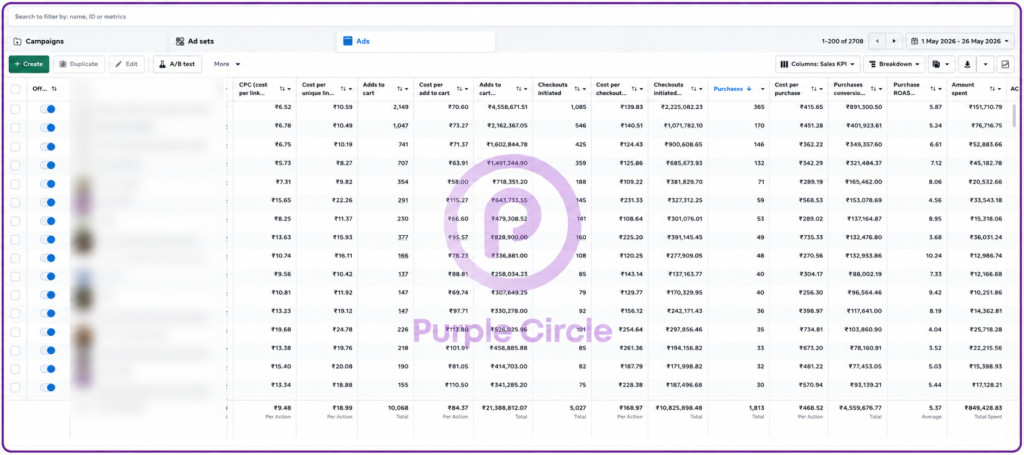
- AOV stays stable — or grows — when creative messaging leads with aspiration, not price.
Premium D2C fashion brands can and should convert at full price. The funnel just needs to be built for it.
What a scalable Meta system actually looks like
At Purple Circle, an ecommerce marketing agency in India focused on D2C growth, we build Meta ad systems around three non-negotiables:
- Full-funnel separation — prospecting, retargeting, and win-back all run independently.
- Continuous creative testing — new variants weekly, winners identified within 72 hours.
- Data-driven budget reallocation — spend shifts toward efficiency, not just volume.
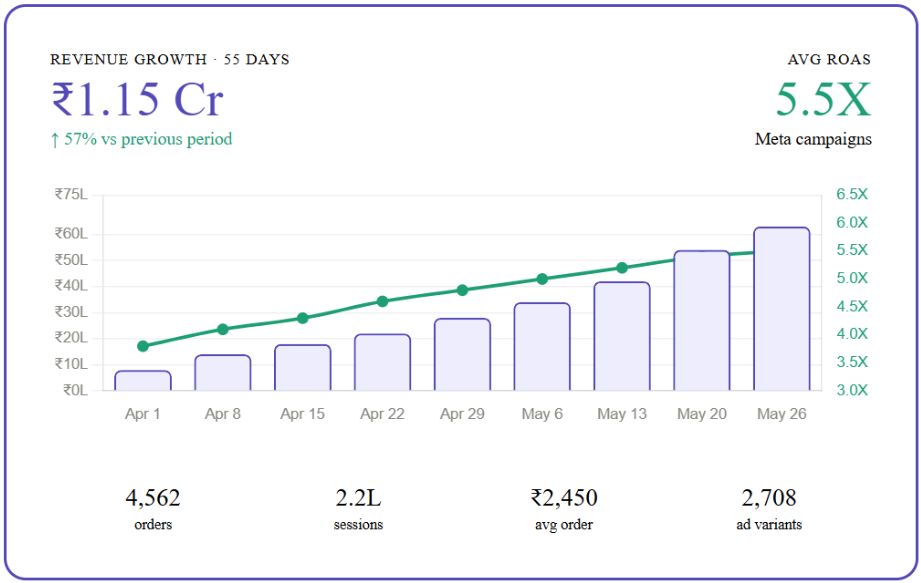
When these three systems work together, scaling spend stops compressing ROAS. In fact, done right, efficiency improves as spend increases — because the algorithm has more data, more creative options, and a cleaner funnel to optimize against.
The number brands should actually obsess over
Most brands obsess over ROAS as a single number. That’s incomplete. The real signal is ROAS at scale — can your 3X ROAS hold when you double the budget? Can your 5X hold at ₹5L/month spend?
That’s the test that separates a lucky week from a real system. And it’s the standard Purple Circle builds toward for every brand we work with.
Conclusion
Scaling on Meta without losing ROAS is not a myth — it’s a systems problem. Separate your funnels, build a creative testing machine, stop relying on discounts, and let data drive every budget decision. These aren’t advanced tactics. They’re fundamentals that most agencies skip in the rush to launch. Get them right, and profitable growth on Meta becomes repeatable — not a lucky month.
Frequently asked questions
How long does it take to see results with a restructured Meta setup?
Most brands see meaningful ROAS improvement within 2–3 weeks of funnel separation and creative refresh. Stable, scalable performance typically takes 6–8 weeks as the algorithm accumulates learning on clean data.
Do I need a large budget to make Meta work for D2C fashion?
No — but you need a structured budget. Even ₹50K–₹1L/month can deliver strong ROAS if separated correctly between prospecting and retargeting. The mistake is putting all spend into cold audiences or running everything in one campaign.
Is discounting ever the right move on Meta?
Occasionally — for clearance, new product launches, or seasonal peaks. But it should never be the default conversion mechanism. If you need a discount to close every sale, the funnel architecture needs fixing, not the pricing.
What makes Purple Circle different from other Meta ads agencies?
As an ecommerce marketing agency in India that works exclusively in D2C and performance marketing, Purple Circle builds systems, not campaigns. Creative testing pipelines, real-time Shopify data integration, and weekly budget reallocation are built into how we operate — not added as extras.

Why Most D2C Fashion Brands Can’t Scale on Meta — And What Actually Fixes It
Trusted by 235+ brands