
⭐️
How
How do US D2C brands scale Meta ads 10x while keeping ROAS profitable?
Trusted by 235+ brands





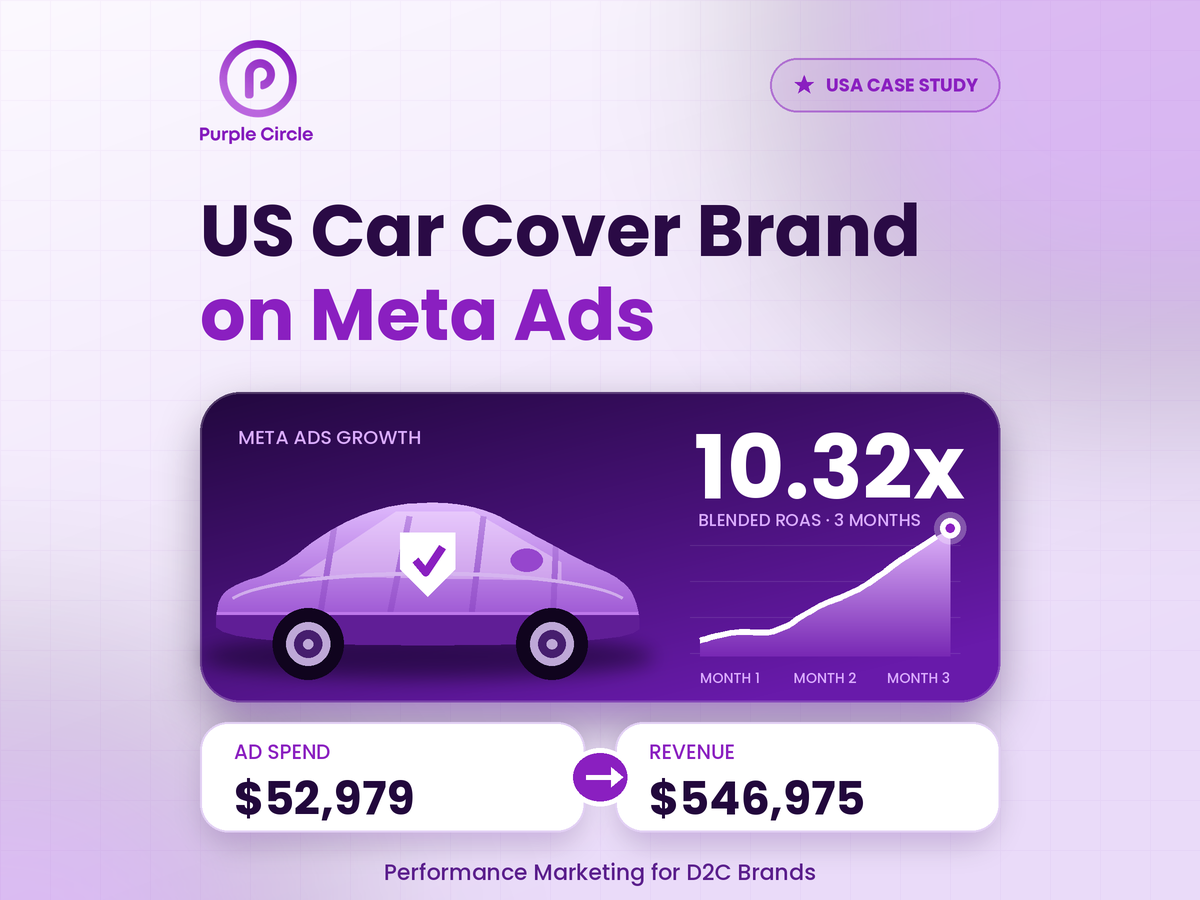
US D2C brands scale Meta ads 10x by increasing budgets in controlled steps of 20-30% while testing new creatives weekly to fight fatigue. They separate prospecting from retargeting, track contribution margin instead of ROAS alone, and use Advantage+ alongside manual campaigns. As the best social media agency in US for D2C growth, Purple Circle follows this system. You can check the growth in the screenshot below.
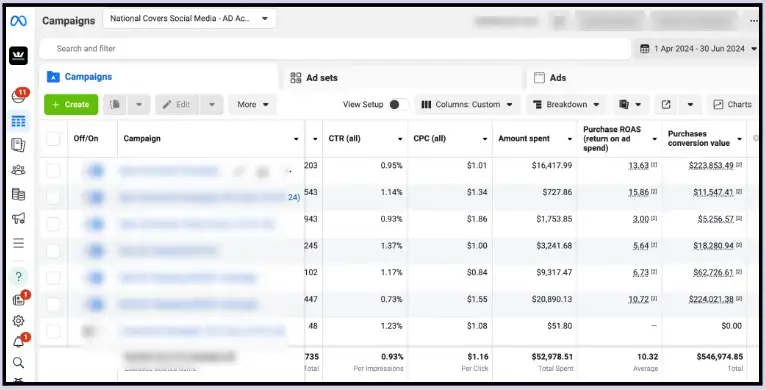
The Starting Point
National Covers already had a strong paid social engine. Spend averaged about $17K a month and the account returned roughly 10x. The question was not how to fix it, but how to scale it without the ROAS collapsing, and how to stop renting every visitor from Meta.
What the Data Told Us
| Campaign (by spend) | Spend | ROAS | Purchase value |
|---|---|---|---|
| Top scaler A | $20,890 | 10.72x | $224,021 |
| Top scaler B | $16,418 | 13.63x | $223,854 |
| Mid-funnel campaign | $9,317 | 6.73x | $62,727 |
| Low-return campaign | $3,241 | 5.64x | $18,281 |
| Underperformer | $1,754 | 3.00x | $5,257 |
| Small test | $728 | 15.86x | $11,548 |
ROAS by campaign (account average: 10.32x)
Purple = above average. Violet = mid range. Amber = needs a fix or cut.
Where the $546,975 came from
Three findings. First, two campaigns generate about 82% of revenue, so the account depends on a narrow set of winners. Second, the small test at 15.86x was starved of budget and is a scaling candidate. Third, around $5K of spend sat in campaigns returning 3x to 5.6x, well below the account average.
The Purple Circle Growth Plan
Protect and scale the winners
We raise budgets on the two 10x+ campaigns in 15–20% steps every 3–4 days rather than doubling overnight, which keeps Meta’s learning stable. Winning ad sets are duplicated into new audiences (broad, lookalikes from purchasers and high-AOV buyers) instead of stacking spend on one audience.
Promote the 15.86x test
We move it from test budget to a structured scale campaign and reuse its angle (hook, offer, creative style) across the other campaigns.
Fix or cut the drag
We rebuild or pause the 3x campaign and refresh creative on the 5.6x one. Freed budget goes to proven campaigns first.
Build a creative engine
Car covers sell on proof. We test weekly: hail and sun damage demos, before/after paint under a cover, bird-dropping and tree-sap protection, “fits your exact model” vehicle-specific ads, UGC unboxing and install videos, and seasonal hooks such as hail season, winter and road trips. Each concept is tested against the current control, and winners feed the scale campaigns.
Tighten tracking
We run the Meta Conversions API alongside the pixel with clean event deduplication, and use value-based optimization by product line so Meta learns which buyers are worth the most.
Lift conversion rate and AOV
We add a year/make/model fitment selector, bundles (cover + microfiber cloth + lock), free-shipping thresholds and review-rich product pages. Higher AOV and conversion let Meta bid more competitively at the same ROAS target.
Retarget and retain
Dynamic product retargeting, email and SMS flows (cart abandonment, post-purchase accessory upsell, seasonal replenishment) and lookalikes built from customer lists.
How We Build Free Google Traffic on Top of Meta
Paid social captures people who did not know they needed a cover. Search captures people who already know. We add an SEO and content layer aimed at US buyers, so a growing share of revenue is not tied to ad spend.
Vehicle-and-problem landing pages
One page per high-volume make/model and per problem (hail, UV, snow, rain, sap, dust, garage storage). Each has fitment information, materials, a comparison table and a focused FAQ block.
FAQs
1. What is a good ROAS for a car cover ecommerce brand on Meta?
It depends on your margins, but this account averaged 10.32x, with top campaigns at 10.72x and 13.63x. Campaigns below roughly 5-6x were refreshed or cut, and a 3x campaign was rebuilt or paused. Always judge ROAS against contribution margin, not the number alone.
2. What type of Meta ad creative works best for car covers?
Car covers sell on proof. The best-performing concepts to test include hail and sun damage demos, before/after paint under a cover, bird-dropping and tree-sap protection, “fits your exact model” vehicle-specific ads, UGC unboxing and install videos, and seasonal hooks like hail season, winter and road trips. Test weekly against your current control, and feed winners into scale campaigns.
3. How can a car cover brand get less dependent on Meta ads?
Add SEO on top of paid social. Build landing pages per make/model and per problem (hail, UV, snow, sap), each with fitment info and an FAQ.
4. How do you increase AOV and conversion rate for a car cover store?
Add a year/make/model fitment selector, bundles (cover + cloth + lock), free-shipping thresholds, and review-rich product pages.
Targets for the Next 90 Days
These are goals, not results. They are based on the baseline above and would be confirmed once we have full account access.
| Metric | Baseline | 90-day target |
|---|---|---|
| Monthly Meta spend | ~$17.6K | $28K–$35K |
| Blended ROAS | 10.3x | Hold 8.5x–10x while scaling |
| Spend in campaigns under 6x | ~$5K of $53K | Under 5% of spend |
| Creative concepts tested | Not tracked | 8–12 per month |
| Organic search sessions | Baseline TBD | Steady monthly growth from 40+ new pages |
| Email/SMS share of revenue | Baseline TBD | 15%–20% |
The Takeaway
A 10x ROAS shows the offer, product and audience fit. Purple Circle’s job is to protect that efficiency while widening the base: more winners, more creative, better tracking, a stronger site and a search channel that keeps sending buyers when ad costs rise. Explore the full details and see how this approach translates into measurable growth and stronger performance.
Baseline figures come from the client’s Meta Ads Manager view for 1 Apr – 30 Jun 2024. Campaign names are generalized.