

Size-Wise Dead Stock: The Margin Leak in Fashion D2C
By Ashish Rai, CEO, Purple Circle · September 2026 · 7 min read
Size-wise dead stock is inventory left over in the sizes that didn’t sell, usually S, XL and XXL, after the core sizes (M and L) sell out. For Indian D2C fashion brands it quietly cuts style-level margin by 25–40%, because your dashboard only reports margin on the units that sold, not on the units you paid for. The fix: buy to your own size curve, place a smaller first order with fast reorders, and judge every style on margin per unit bought.
Most founders I speak with know their ROAS. Very few know what their leftover sizes cost them last season. That gap is where a lot of fashion brands lose their profit.
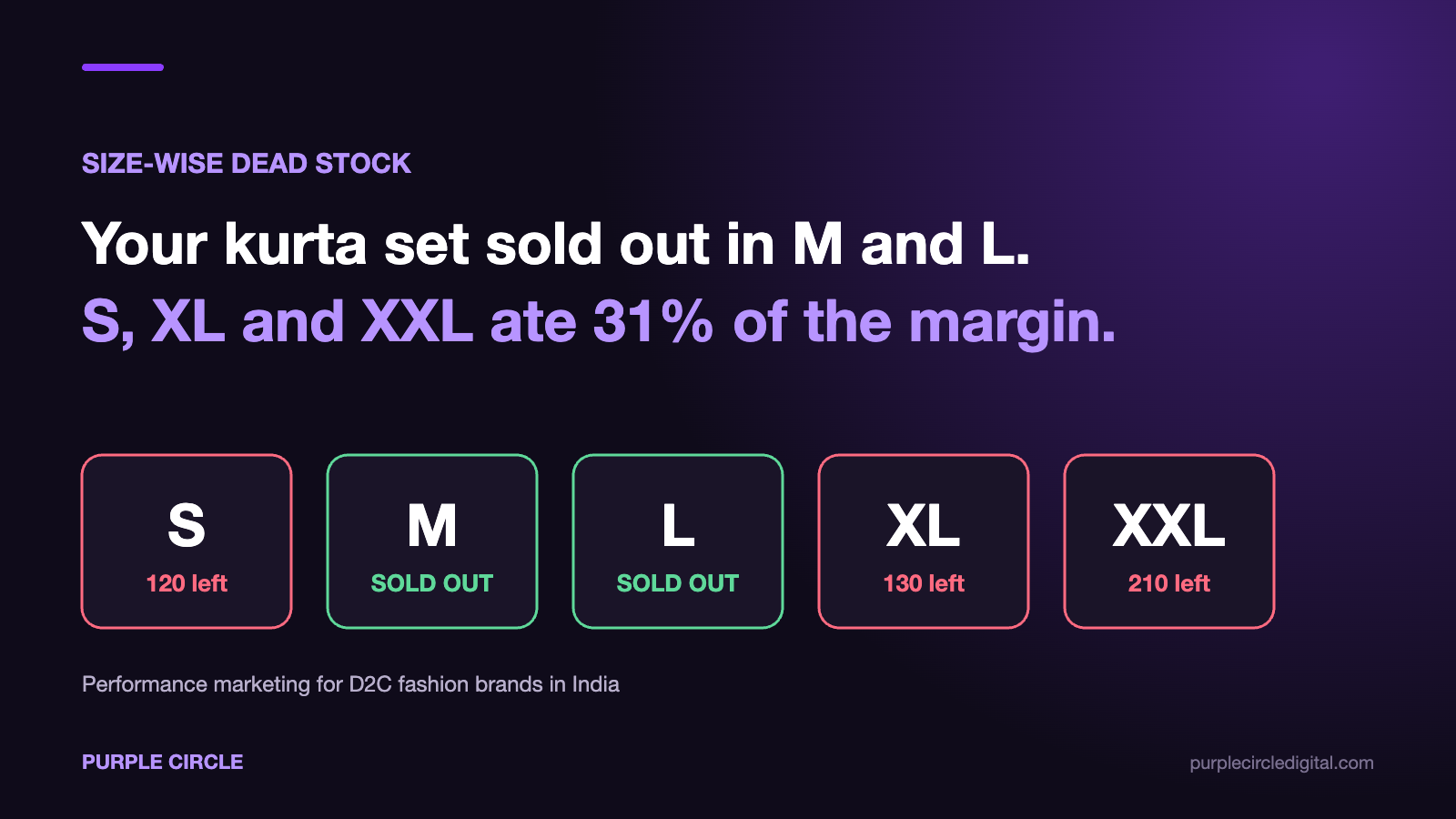
Why size-wise dead stock is a fashion-specific problem
A supplement brand sells one SKU in one size. A fashion brand sells one style in five or six sizes, and demand is never spread evenly across them.
In most Indian apparel, M and L carry a large share of volume. S, XL and XXL sell slower, and the curve changes by category. Ethnic wear, fitted women’s wear and oversized streetwear all behave differently.
When a brand places a flat order across sizes, three things happen:
- The core sizes sell out early, often right in the middle of the festive season.
- The extreme sizes sit in the warehouse, holding cash.
- The ads keep running on a product page where most visitors can’t find their size.
None of this appears in Meta Ads Manager. It appears in your bank balance three to six months later.
The math: one kurta set, 1,500 units
Take an illustrative women’s ethnic wear brand launching one kurta set before the festive season. These numbers are examples, kept round so you can follow them. All prices are net of GST.
The buy
- 1,500 units at ₹550 cost per unit
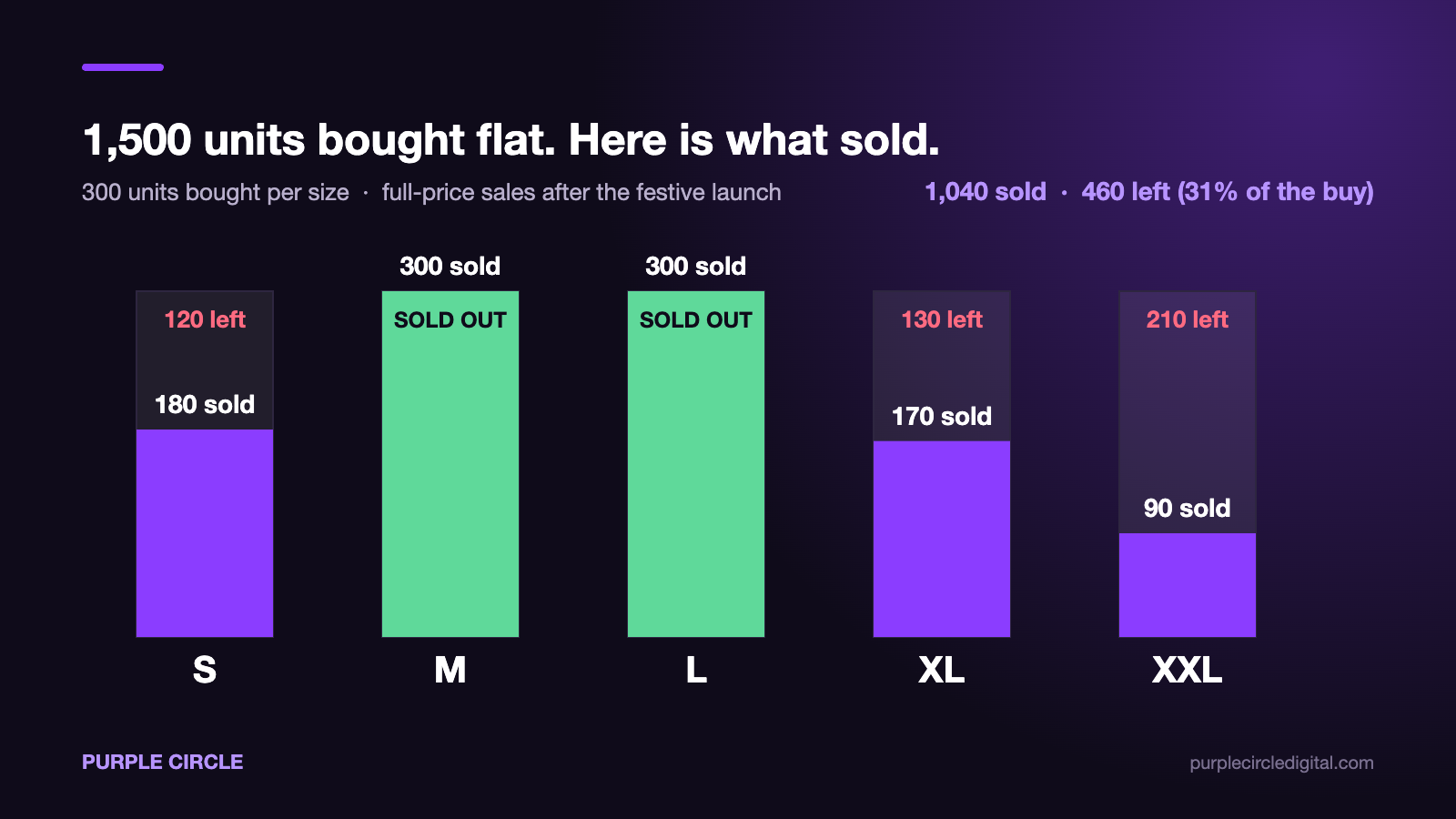
- Flat split: 300 each of S, M, L, XL, XXL
- Cash out before the first ad goes live: ₹8,25,000
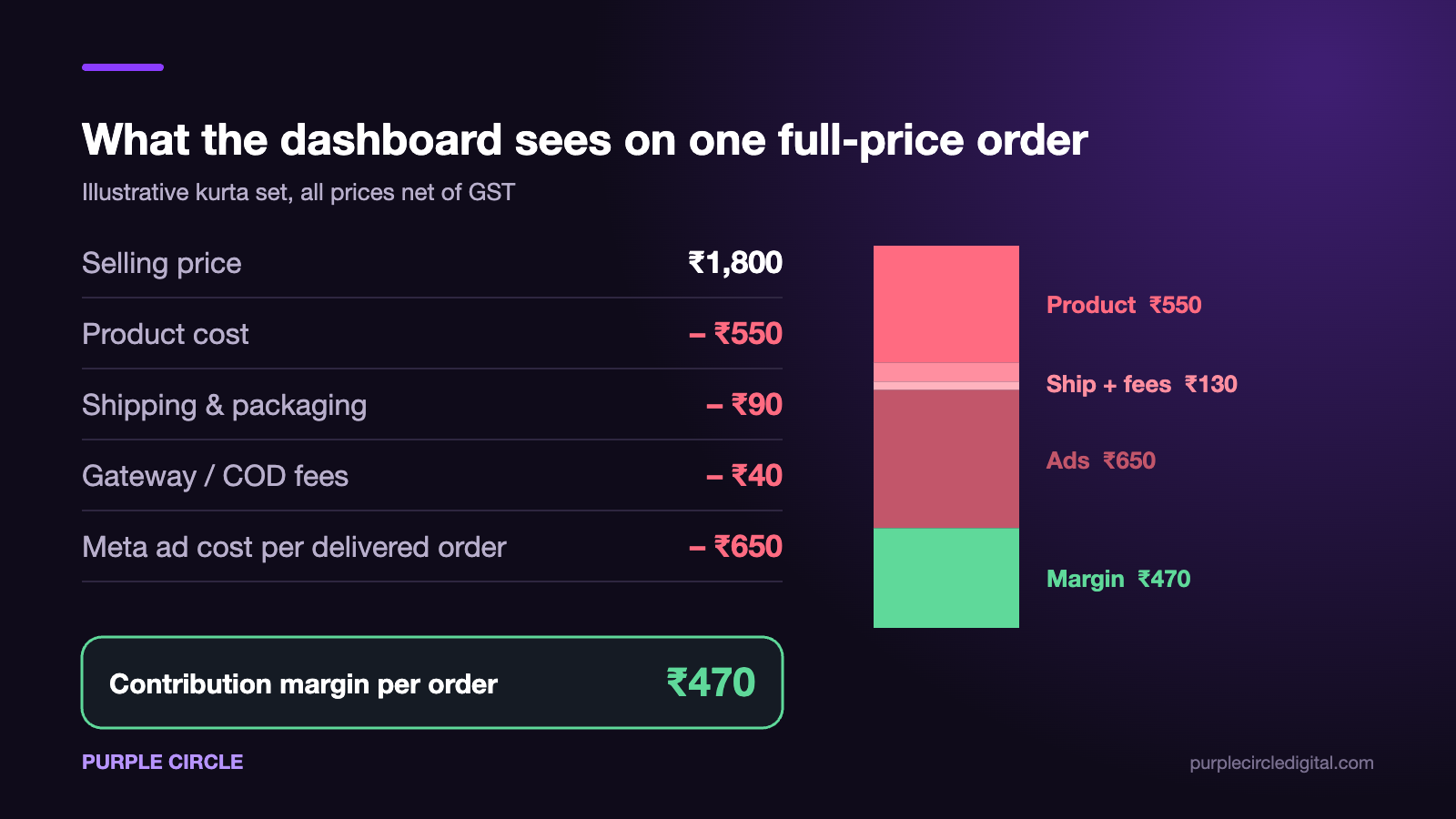
What the dashboard sees on every full-price order
| Line | Per order |
|---|---|
| Selling price (net of GST) | ₹1,800 |
| Product cost | – ₹550 |
| Shipping and packaging | – ₹90 |
| Payment gateway / COD fees (blended) | – ₹40 |
| Meta ad cost per delivered order | – ₹650 |
| Contribution margin per order | ₹470 |
What actually sold at full price
M and L sold out in three weeks: 600 units. S sold 180, XL sold 170 and XXL sold 90.
Total sold at full price: 1,040 units. Contribution margin: 1,040 × ₹470 = ₹4,88,800.
What those 460 leftover units cost you
S: 120, XL: 130, XXL: 210. That’s ₹2,53,000 of product cost still unrecovered.
| Line | Amount |
|---|---|
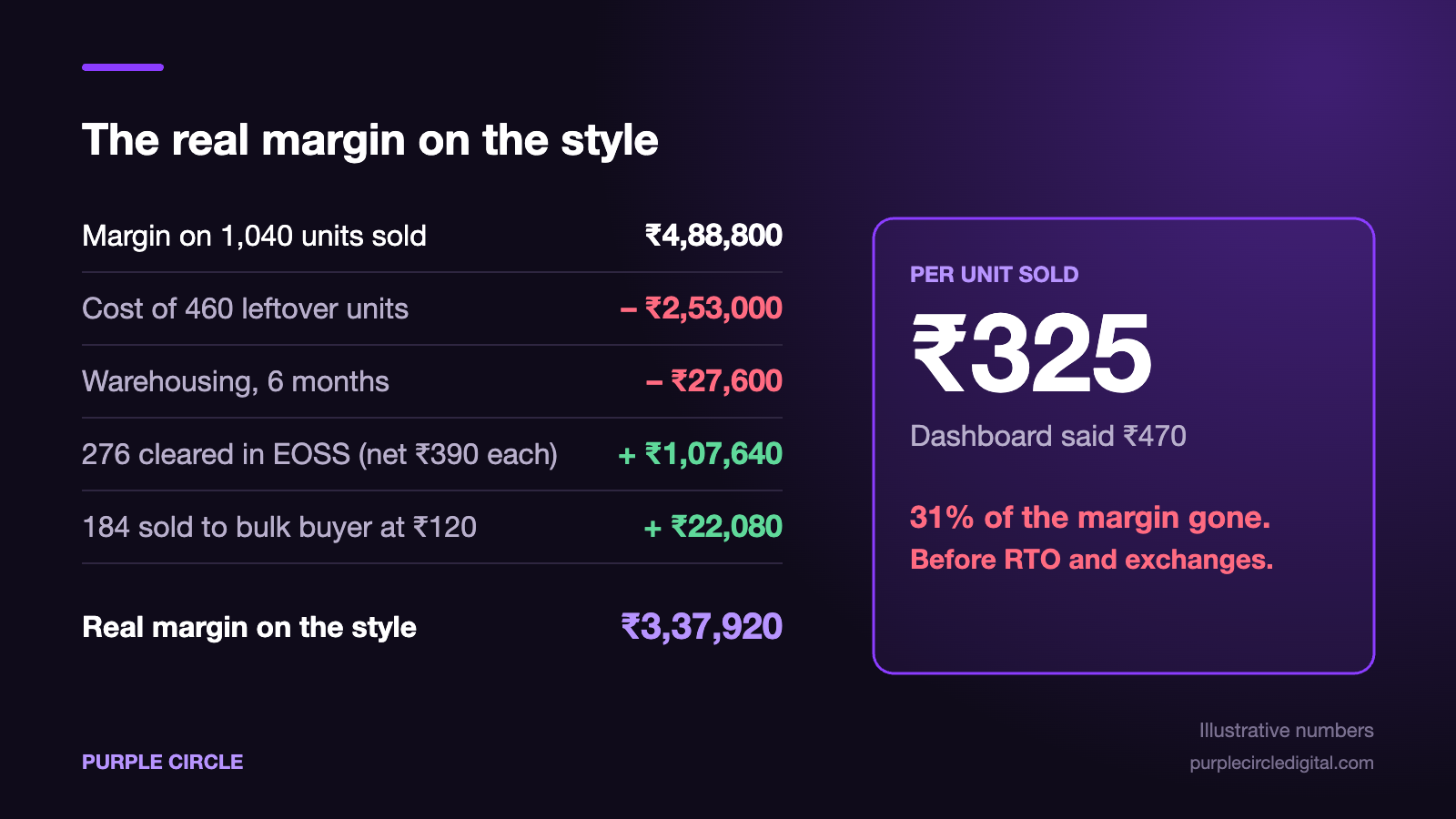
| Product cost of leftover units | – ₹2,53,000 |
| Warehousing for 6 months at ₹10 per unit per month | – ₹27,600 |
| 276 units cleared in EOSS at 60% off (₹720 price, net ₹390 each after shipping, fees and ₹200 ad cost) | + ₹1,07,640 |
| 184 units sold to a bulk buyer at ₹120 each | + ₹22,080 |
| Net loss from leftover sizes | – ₹1,50,880 |
The real result for the style
Margin on units sold: ₹4,88,800
Loss from leftover sizes: – ₹1,50,880
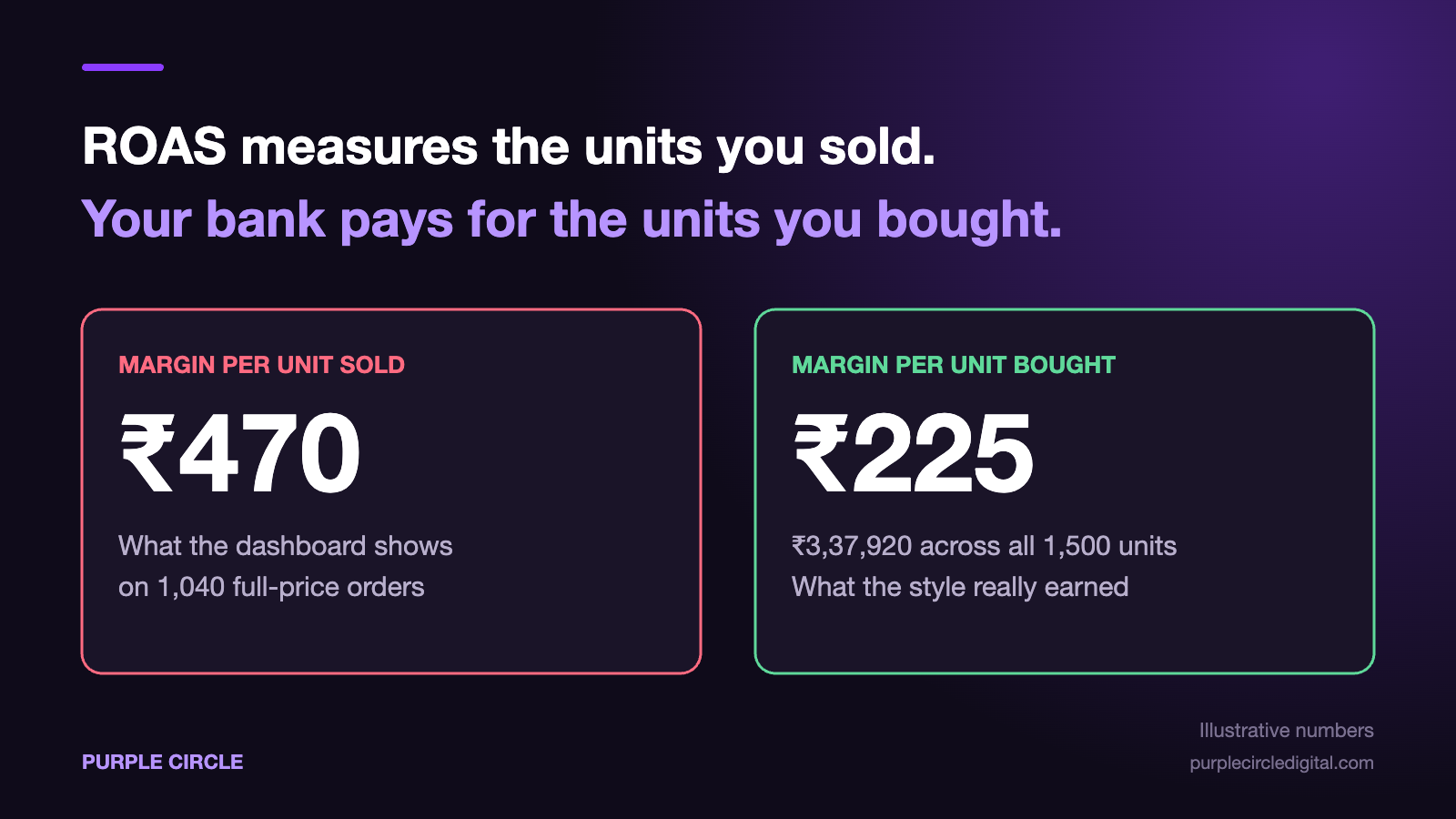
Real margin on the style: ₹3,37,920
Illustrative numbers. Before RTO and size exchanges.
That’s ₹325 per unit sold, not ₹470. Almost 31% of the margin is gone, and this is before RTO and size exchanges, which hit ethnic wear harder than most categories.
There’s also a cash cost. ₹2,53,000 sat in the warehouse for six months. For a brand doing ₹30–40 lakh a month, that’s money that could have paid for the next festive collection.
The hidden second loss: stock-outs break your ads
When M and L sell out, most brands keep the ads running. The creative is still performing, so nobody wants to pause it.
But now every click lands on a product page where most visitors can’t buy their size. Conversion rate drops. Cost per purchase rises. The team calls it “creative fatigue” and starts producing new ads.
It wasn’t the creative. It was the stock.
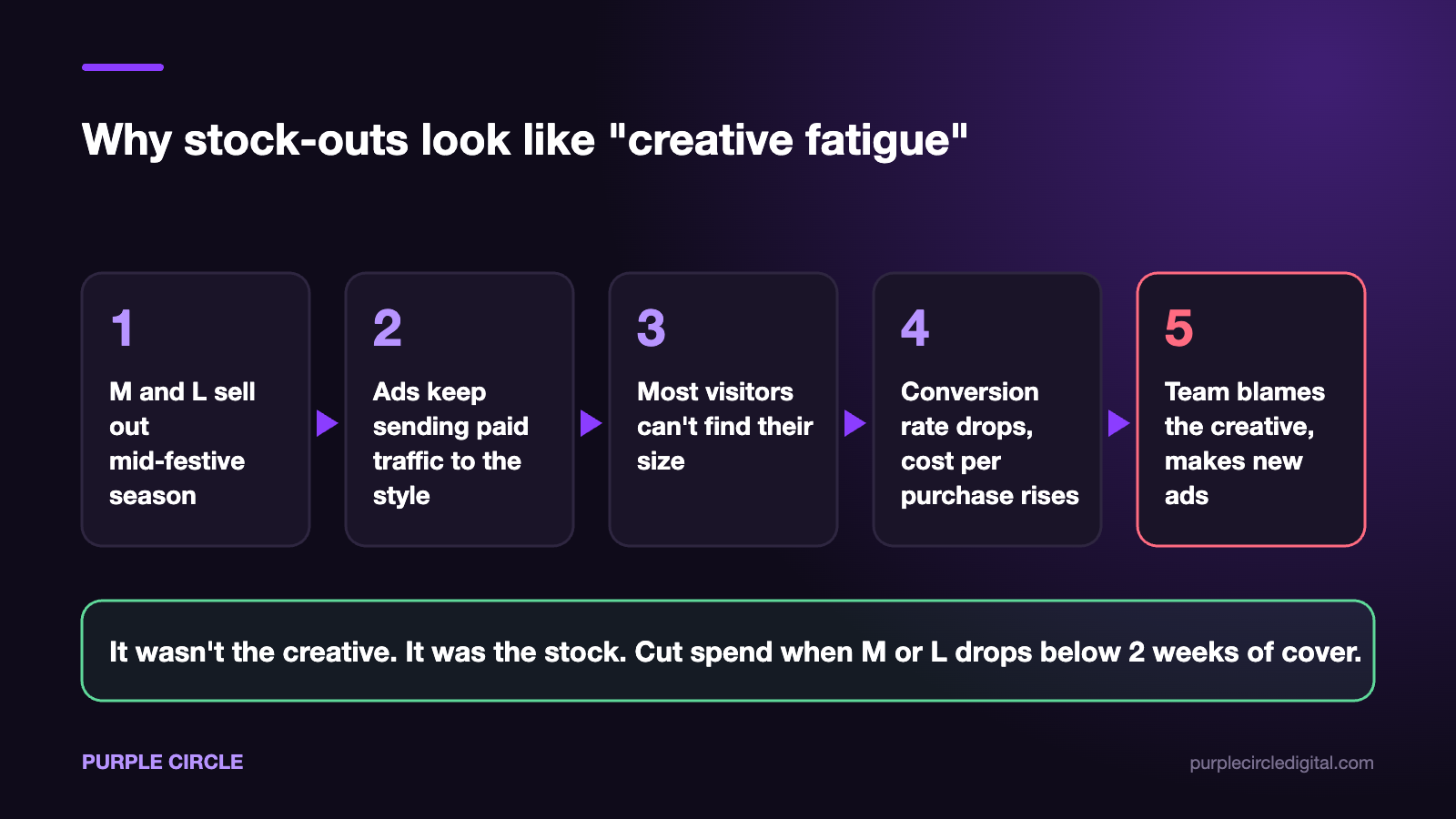
This is why the same ROAS can mean profit on one style and a loss on the next. ROAS measures the units you sold. Your bank pays for the units you bought.
How to fix size-wise dead stock: a 6-step checklist
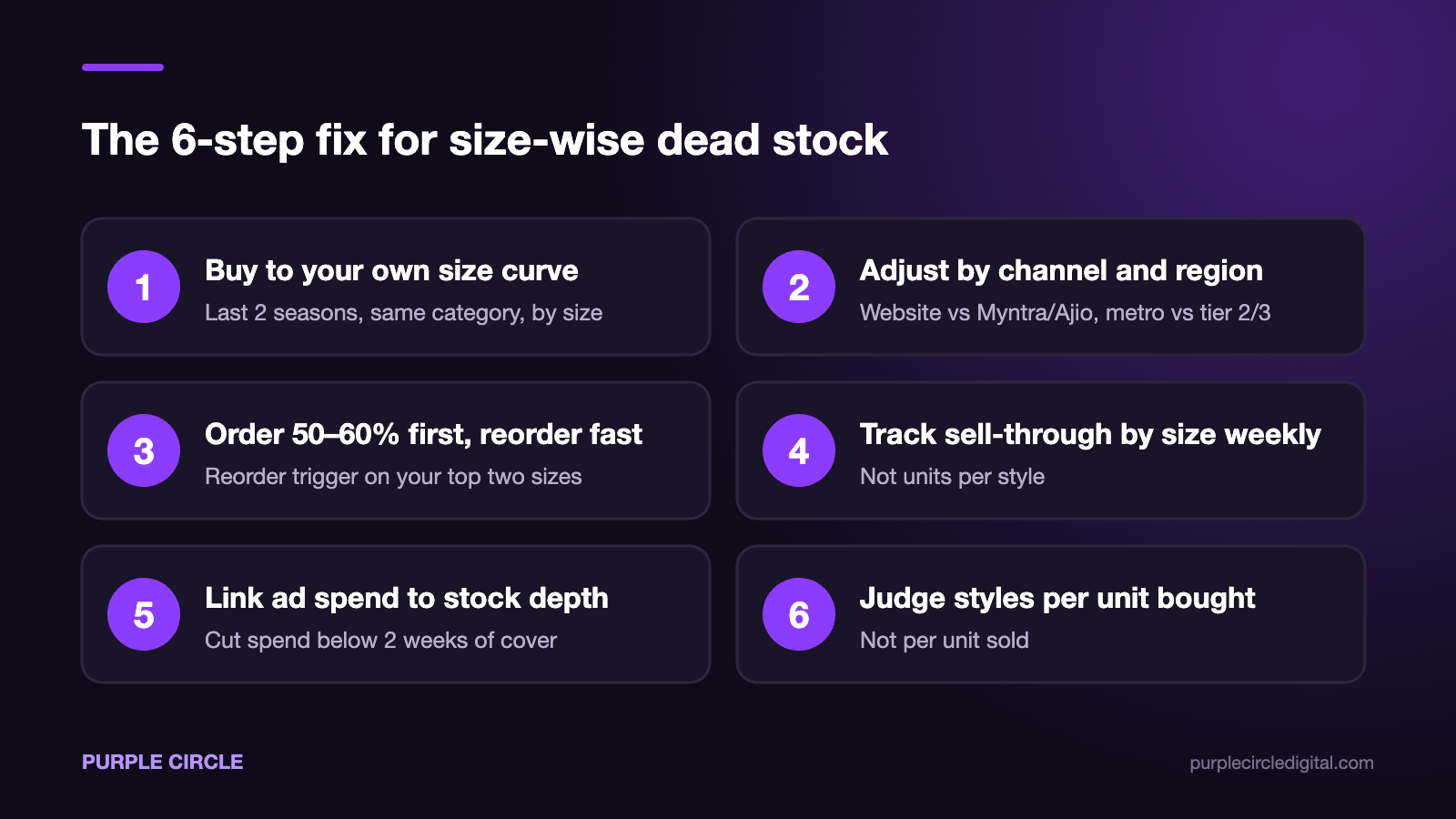
1. Build every buy from your own size curve
Pull the last two seasons of sales by size for the same category: kurta sets with kurta sets, co-ords with co-ords. Calculate the share each size contributed and buy in that ratio. A flat split is a guess that feels safe.
2. Adjust the curve by channel and region
Your website, Myntra and Ajio often show different size mixes. So do metro and tier 2/3 pin codes. If one channel drives most of your volume, weight the curve toward it.
3. Place a smaller first order, then reorder fast
Order 50–60% of your planned quantity first, with a reorder trigger on your top two sizes. Your per-unit cost might rise slightly with a smaller job-work run. That’s still far cheaper than 460 units sitting in a warehouse. Agree on reorder lead times with your manufacturer before the festive season, not during it.
4. Track sell-through by size every week
Stop tracking “units sold per style”. Track sell-through per size per week. If M is 70% sold and XXL is 15% sold in week two, you already know the next six months.
5. Connect your ad spend to stock depth
Set a written rule with whoever runs your ads: when M or L drops below two weeks of cover, cut spend on that style and move budget to a style with full size depth. Performance marketing for fashion brands has to be run alongside your inventory, not separately from it.
6. Judge every style on margin per unit bought
At the end of every season, calculate each style’s margin as: margin on units sold, minus the loss on leftover units. Rank styles on margin per unit bought. Your “bestsellers” list will look different, and your next buy will be better.
What this means for your P&L
Most fashion brands don’t lose money on the styles that fail. They lose it on the styles that “succeed” but were bought wrong. A sold-out style with a flat size split can quietly return less margin than a slower style bought to the right curve.
If your revenue is growing but your bank balance isn’t, check your warehouse by size before you check your ad account. You can see how we approach profitability with fashion brands in our case studies.
Frequently asked questions
What is size-wise dead stock in fashion?
It’s unsold inventory in specific sizes, usually S, XL or XXL, left after the core sizes of a style sell out. The style looks like a bestseller, but the leftover sizes hold cash and are later cleared at a loss.
How much dead stock is normal for a D2C clothing brand in India?
There’s no single healthy number, because it varies by category and season. The better question is how much margin your leftover sizes cost you per style. Track it by size every season and push it down each time.
How do I calculate the right size ratio for my next production run?
Use your last two seasons of sales for the same category, split by size, and buy in that ratio. Adjust for channel (website vs Myntra/Ajio) and region, and keep a reorder buffer for your top two sizes.
Should I stop Meta ads when a size sells out?
If a core size like M or L sells out, reduce spend on that style or move budget to a style with full size availability. Paying for traffic that can’t buy raises your cost per purchase for the whole account.
Is it better to clear dead stock in EOSS or sell it to a bulk buyer?
EOSS usually recovers more per unit, but it costs ad spend, shipping and some brand discounting. Bulk buyers pay less but clear stock fast with no extra cost. Compare the net amount per unit for both, not just the selling price.
Does dead stock affect cash flow even if the business is profitable?
Yes. Money spent on unsold sizes is locked in the warehouse until it’s cleared. A brand can show profit on paper and still struggle to fund its next festive collection.
If you want someone to look at your size-wise sell-through and unit economics before your next festive buy, Purple Circle is happy to review it with you.
— Ashish Rai, CEO, Purple Circle