

Why Your Breakeven ROAS Is Higher Than Your US Competitors’, and What to Do About It
By Ashish Rai, CEO, Purple Circle · August 2026 · 4 min read
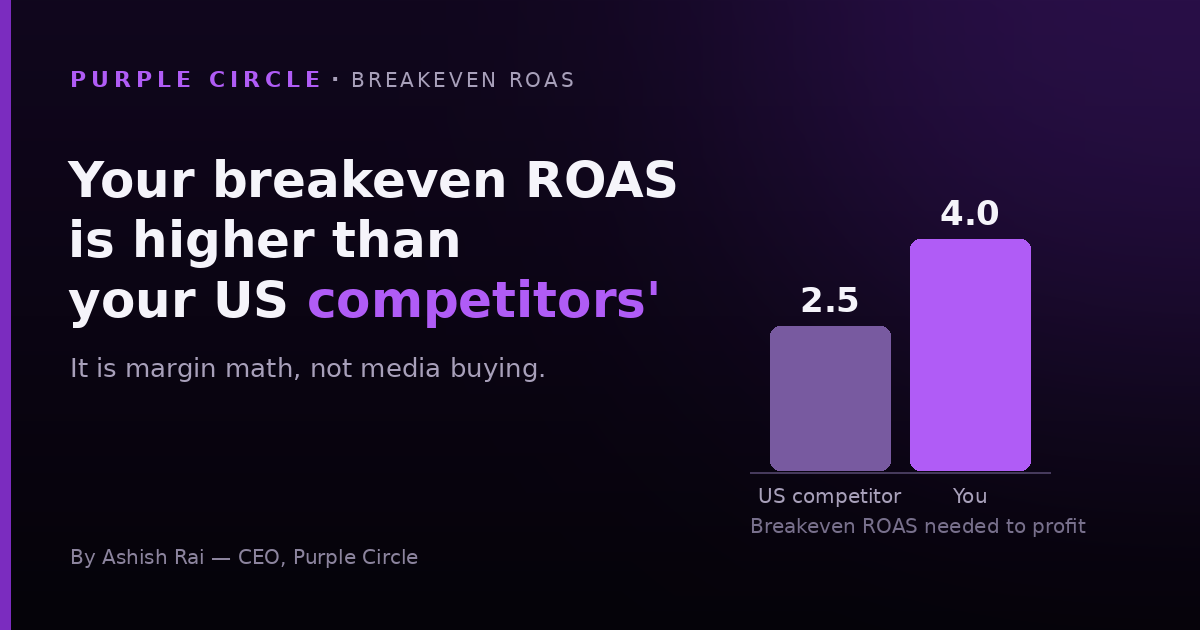
Founders love comparing their ROAS to US brands they follow online. A US store scales at 2.5 ROAS and looks fine. You hit 2.5 and lose money. Same number, different outcome. The reason is not your media buying. It is your margin math.
Your breakeven ROAS is just margin math
Your breakeven ROAS is one divided by your contribution margin percentage. Contribution margin is what survives from each order after product cost, shipping, payment fees, discounts and returns. If 40 percent of your revenue survives, you break even at 2.5 ROAS. If only 25 percent survives, you need 4.0 just to stand still. The number on the dashboard is downstream of the structure underneath it.
| Contribution margin | Breakeven ROAS |
|---|---|
| 40% | 2.50 |
| 35% | 2.85 |
| 30% | 3.33 |
| 25% | 4.00 |
| 20% | 5.00 |
Why US competitors sit on a lower number
Their advantage has almost nothing to do with ads. Their average order value is higher, so fixed shipping and packaging eat a smaller share of each order. Almost every order is prepaid on card, so there is no cash collection cost and no return to origin. Returns are expensive but predictable and usually priced in. The result is a fatter contribution margin, a lower breakeven ROAS, and room to spend more aggressively than you while still making money.
Where your margin leaks
Lower AOV means shipping is a bigger percentage of every order. A large COD share brings collection fees and an RTO problem, where you pay to ship out, pay to ship back, and recover nothing. RTO alone can quietly turn a healthy looking account into a loss. Add thinner sourcing margins and your contribution margin lands several points below the US benchmark, which pushes your breakeven ROAS well above theirs.
The four levers that bring it down
- Push prepaid share up. Make prepaid the cheaper and faster option, and add small friction or a fee to COD.
- Raise AOV. Use bundles and free shipping thresholds so fixed costs spread across a larger order.
- Attack RTO directly. Add address confirmation, order verification and better delivery partners in weak pincodes.
- Negotiate COGS and shipping. Once volume gives you leverage, take it.
Run the math before and after. Move contribution margin from 25 percent to 35 percent and your breakeven ROAS drops from 4.0 to about 2.85. Nothing changed in your ad account, but you just gave yourself room to scale that you did not have this morning.
Benchmark margin, not ROAS
You cannot out buy a brand that keeps more of every order than you do. So stop chasing their ROAS target. Benchmark your contribution margin, fix the leaks, and let the ROAS number take care of itself.
Frequently asked questions
What is breakeven ROAS?
Breakeven ROAS is the return on ad spend at which an order neither makes nor loses money. It equals one divided by your contribution margin percentage, so a 33 percent contribution margin gives a breakeven ROAS of about 3.0.
Why is my breakeven ROAS higher than a US brand’s?
Because your contribution margin is lower. Lower AOV, a large COD and RTO share, and thinner sourcing margins all shrink what survives from each order, which raises the ROAS you need just to break even.
How do I lower my breakeven ROAS?
Raise your contribution margin. Increase prepaid share, lift AOV with bundles and shipping thresholds, cut RTO, and negotiate product and shipping costs. As contribution margin rises, breakeven ROAS falls.
Ashish Rai — CEO, Purple Circle
Ashish has spent over eight years helping D2C brands scale profitably, working on the side of the business most agencies never open: contribution margin, cash cycle, and what actually reaches the bank. Purple Circle is a performance marketing agency built around profit rather than reported ROAS.
Why Your Breakeven ROAS Is Higher Than Your US Competitors’, and What to Do About It
Trusted by 235+ brands