
⭐️
How
How Purple Circle Scaled a Pet Food E-Commerce Business to 7x ROAS with Google Ads
Trusted by 235+ brands





Overview
Scaling a pet food and pet snacks e-commerce business profitably requires more than simply increasing ad spend. With rising competition, expensive clicks, changing customer behavior, and the need to maintain healthy margins, every advertising dollar needs to work harder.
Purple Circle approached this challenge with a profit-focused Google Ads strategy designed to capture high-intent customers, reduce wasted spend, improve conversion efficiency, and scale campaigns without sacrificing performance.
The result was a consistently strong 7x average ROAS, with approximately $15,000 in average monthly ad spend and a scalable acquisition system built around profitable growth.
Key Results
- Average Monthly Ad Spend: $15,000
- Average ROAS: 7x
- Estimated Revenue Generated at 7x ROAS: ~$105,000/month
- Primary Channel: Google Ads
- Industry: Pet Food & Pet Snacks
- Focus: Profitability, conversion efficiency and scalable growth
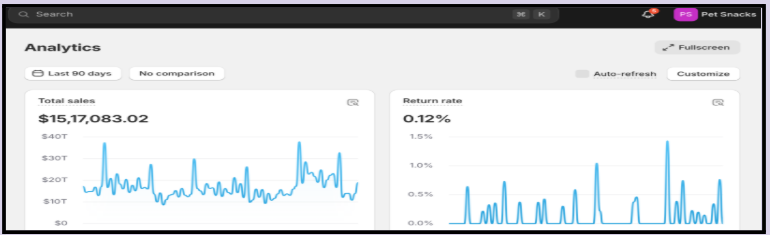
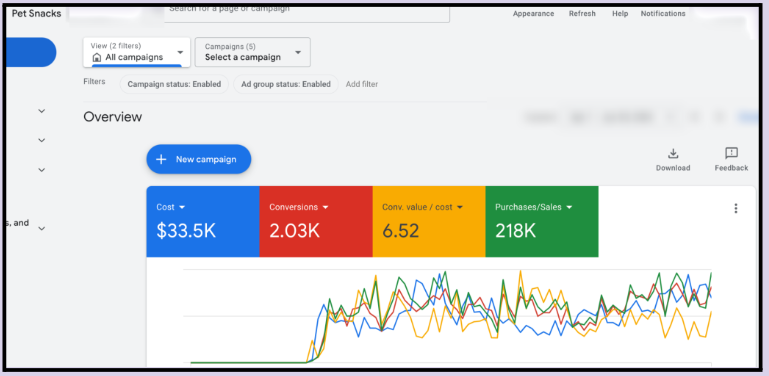
The supporting campaign data also shows a 6.52 conversion value/cost in the selected Google Ads view, with $33.5K in cost, 2.03K conversions and $218K in purchase/sales value. The analytics data additionally shows strong sales performance with a very low 0.12% return rate.
The Challenge
The business was operating in a competitive pet food market where customers often compare products, prices, ingredients, reviews, and alternatives before making a purchase.
The main challenge wasn’t simply generating traffic. It was generating high-quality, purchase-ready traffic at a cost that supported profitability.
Some of the key challenges included:
- Avoiding wasted spend on low-intent searches
- Identifying keywords that could drive actual purchases
- Maintaining strong ROAS while increasing spend
- Separating high-performing campaigns from inefficient ones
- Improving conversion efficiency across Google Ads
- Building a predictable acquisition channel for long-term growth
A common mistake in e-commerce advertising is optimizing campaigns purely for clicks or conversions. Purple Circle instead focused on the commercial value of every conversion.
Our Google Ads Strategy
1. High-Intent Keyword Targeting
We focused on search terms that indicated stronger buying intent rather than chasing traffic volume alone.
Campaigns were structured around relevant product categories, specific product searches, and purchase-focused queries.
This helped direct the budget toward users who were already searching for pet food and related products.
2. Campaign and Search-Term Optimization
Google Ads performance was monitored continuously to identify:
- High-performing search terms
- Expensive keywords with weak conversion value
- Wasted search queries
- Strong product categories
- Campaigns generating higher revenue per dollar spent
Underperforming traffic was reduced or excluded while more budget was allocated toward profitable opportunities.
3. Conversion-Focused Optimization
Instead of optimizing purely for the number of conversions, the strategy prioritized conversion value and ROAS.
This meant the account was evaluated based on questions such as:
Which campaigns generate revenue?
Which keywords bring profitable customers?
Where can we increase spend without damaging ROAS?
This shift from volume-based optimization to value-based optimization helped create a more sustainable acquisition model.
4. Budget Allocation Based on Performance
Not every campaign deserves the same budget.
Purple Circle continuously identified campaigns and product groups capable of generating stronger returns and redirected spending toward those opportunities.
The goal was simple:
Scale what works. Cut what doesn’t. Protect profitability.
5. Continuous Testing
Google Ads performance can change quickly due to competition, seasonality, product demand, and search behavior.
We therefore treated the account as an ongoing optimization process rather than a one-time setup.
Campaign structures, keywords, bidding strategies, search terms, and budget allocation were regularly reviewed to maintain efficiency.
How We Focused on Profitability
A high revenue number doesn’t automatically mean a profitable e-commerce business.
That’s why the strategy was built around efficient revenue generation rather than revenue at any cost.
At an average $15K monthly ad spend and 7x ROAS, the advertising channel can attribute approximately $105K in monthly revenue.
The important factor is that the business was not required to spend aggressively just to increase sales. Instead, the focus was on generating more revenue from the existing advertising investment.
Purple Circle’s profitability framework focused on:
- Controlling acquisition costs
- Improving ROAS
- Eliminating inefficient search traffic
- Increasing conversion value
- Scaling proven campaigns
- Monitoring return on advertising spend before increasing budgets
This approach helps create room for other business costs such as product costs, fulfillment, shipping, platform fees, and operational expenses.
The objective was not simply to spend more—it was to make every dollar of advertising spend more productive.
The Impact
The Google Ads strategy created a strong and scalable acquisition engine for the pet food e-commerce business.
With:
$15K average monthly ad spend → 7x average ROAS → ~$105K attributed monthly revenue
the business was able to use paid search as a predictable growth channel.
The campaign data also demonstrates strong conversion activity, with 2.03K conversions and 6.52 conversion value/cost in the selected reporting view.
Meanwhile, the accompanying analytics data recorded $1.517M in total sales over the displayed 90-day period and a 0.12% return rate, reinforcing the strength of the overall sales performance.
Why This Strategy Worked
The success came from combining three principles:
Intent + Data + Profitability
Intent: Target customers actively searching for relevant pet products.
Data: Continuously analyze campaigns, keywords, conversions, and revenue.
Profitability: Scale based on return rather than simply increasing traffic or sales volume.
This combination allowed Purple Circle to build a Google Ads system that could scale while maintaining strong efficiency.
Conclusion
This case study demonstrates that profitable e-commerce growth doesn’t necessarily require an unlimited advertising budget.
With the right Google Ads structure, high-intent targeting, continuous optimization, and disciplined budget allocation, a pet food and pet snacks business can turn paid search into a reliable revenue engine.
Purple Circle achieved an average 7x ROAS on approximately $15K in monthly ad spend, translating to roughly $105K in attributed monthly revenue at that average performance level.
The biggest takeaway is simple:
Profitable scaling comes from putting more money behind what already works—not simply spending more money.
For e-commerce brands, the goal should always be to build a system where revenue grows, advertising efficiency remains strong, and profitability stays at the center of every optimization decision.
Frequently Asked Questions
1. What was the average Google Ads spend?
The average advertising investment was approximately $15,000 per month.
2. What ROAS did the campaign achieve?
The campaign achieved an average 7x ROAS, meaning approximately $7 in attributed revenue was generated for every $1 spent on Google Ads.
3. How much revenue can $15K in ad spend generate at 7x ROAS?
At a consistent 7x ROAS, $15,000 in advertising spend can generate approximately $105,000 in attributed revenue. Actual revenue can vary based on demand, product mix, seasonality, and campaign performance.
4. Which advertising platform was used?
The primary paid acquisition channel was Google Ads, focusing on capturing high-intent users actively searching for relevant pet food and pet snack products.
5. How did Purple Circle improve profitability?
Profitability was supported by prioritizing high-intent searches, removing inefficient traffic, optimizing campaigns around conversion value, controlling acquisition costs, and reallocating budgets toward stronger-performing campaigns.