
⭐️
How
How Purple Circle Turned a Kitchen Knife Store Into an 11x ROAS Success Story on Just $1.5K/Month Ad Spend
Trusted by 235+ brands





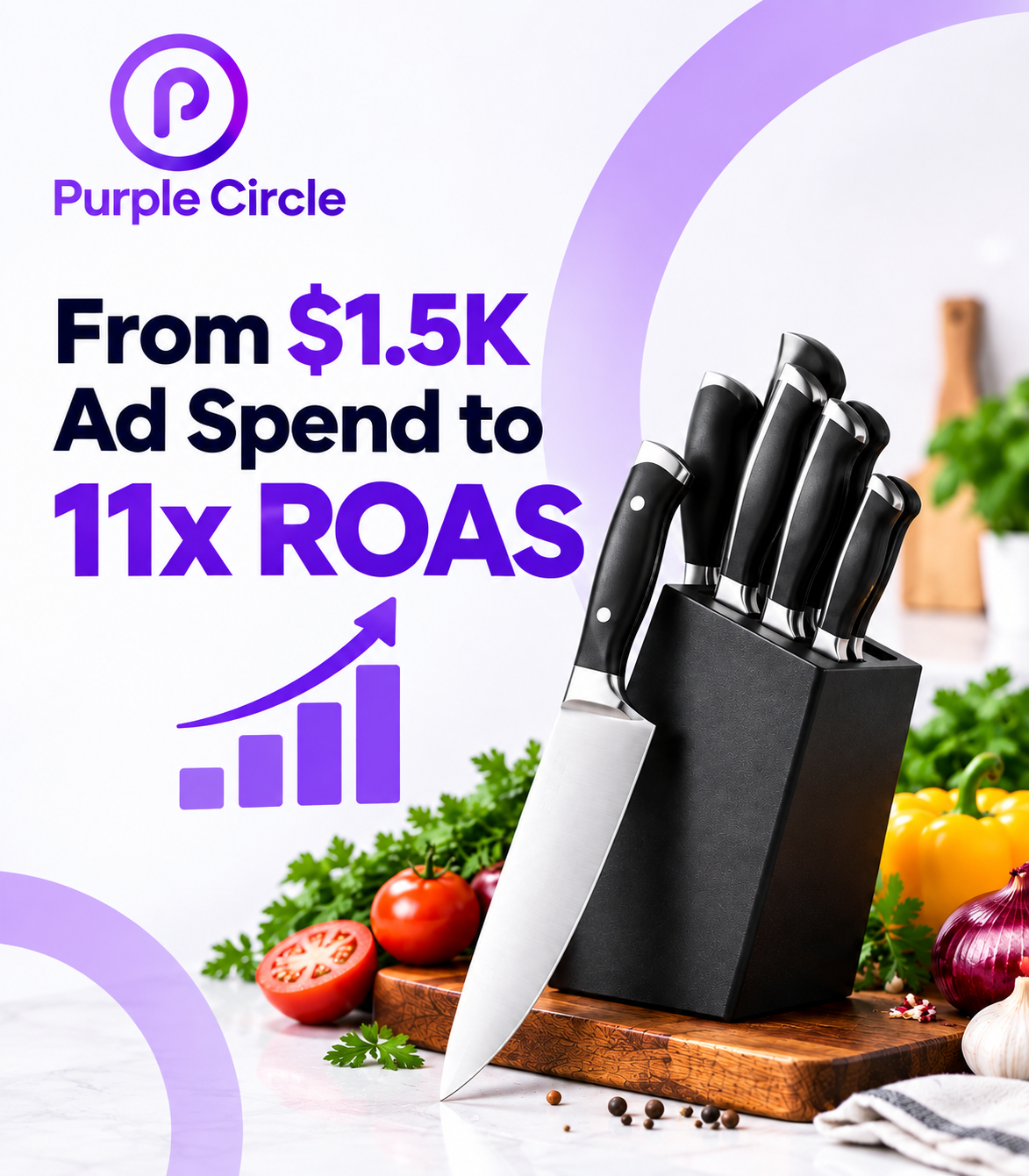
Small Budget, Big Blade of a Result
Every ecommerce founder has heard the same myth: “You need a massive ad budget to win on Google Ads.”
Purple Circle exists to bust that myth, one profitable campaign at a time.
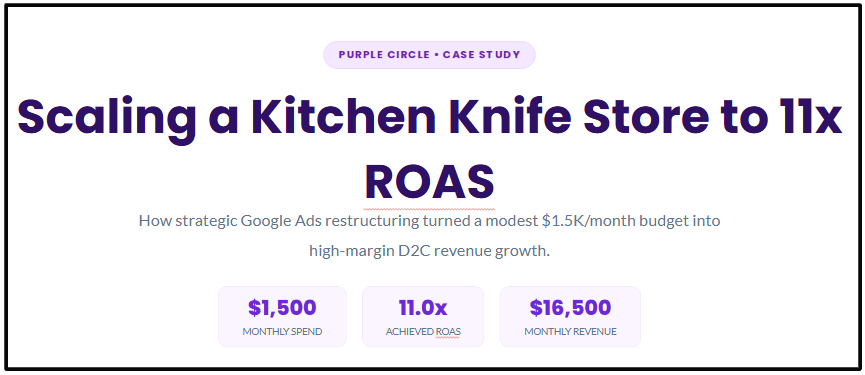
As a performance marketing agency known for delivering real, provable growth for D2C brands — from fashion labels to niche ecommerce stores — Purple Circle recently took on a challenge that looked deceptively simple on paper: a direct-to-consumer Kitchen Knife Store with a modest monthly ad budget of just AUD $1.5K, competing in a category dominated by big-box retailers and marketplace giants.
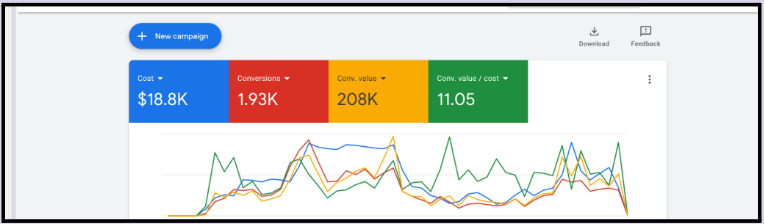
The result? A consistent 11x Return on Ad Spend (ROAS), sustainable month-on-month profit, and a brand that finally understood who was buying its knives and why.
This is the story of how it happened — and what it means for any D2C or luxury ecommerce agency conversation happening right now in 2026, where rising CPCs and privacy-first tracking have made “spend more to grow more” an outdated strategy.
The Challenge: Selling Steel in a Sea of Sameness
The Kitchen Knife Store came to Purple Circle with three very real problems:
- Tiny budget, high expectations. AUD $1.5K/month doesn’t leave room for guesswork. Every dollar had to earn its place.
- A commoditized category. Kitchen knives are sold everywhere — Amazon, big retail chains, marketplace sellers with rock-bottom prices. Standing out on price wasn’t an option.
- No clear buyer intent data. The brand didn’t know if their real customers were home cooks, professional chefs, gift-buyers, or knife collectors — and Google Ads without intent clarity is just expensive guessing.
Sound familiar? This is the exact scenario most D2C fashion and lifestyle brands face too — thin margins on paper, but real profit hiding inside the right customer segment.
 The Purple Circle Approach: Precision Over Volume
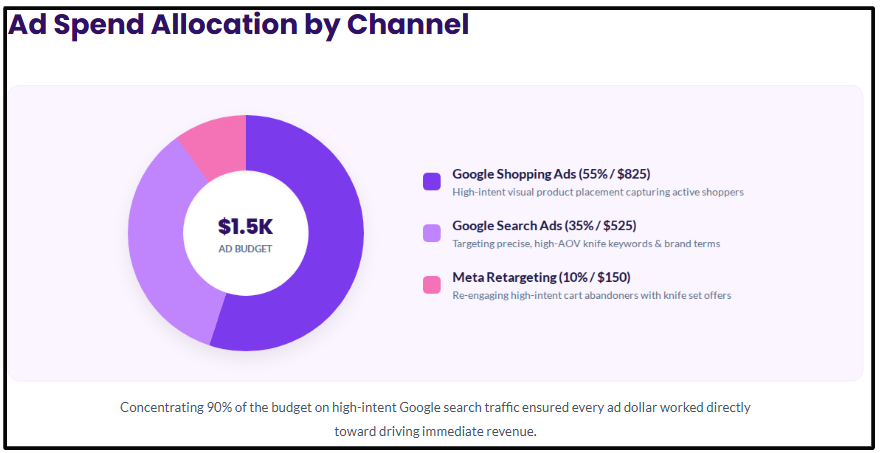
Rather than throwing budget at broad “kitchen knife” keywords (expensive, low-intent, and dominated by giants), Purple Circle applied its signature performance framework — the same one used across its D2C fashion portfolio — adapted for a physical, considered-purchase product.
1. Latest-Intent Keyword Mapping
Instead of chasing generic search terms, the team mapped fresh, high-intent, low-competition keywords reflecting today’s search behaviour — things like “best chef knife for home cooks 2026,” “professional knife set gift,” and “Japanese steel kitchen knife Australia.” These reflect real, current buying intent rather than stale, oversaturated head terms.
2. Google Ads Campaign Architecture Built for Small Budgets
Purple Circle restructured the account into tightly themed ad groups, each mapped to a single buyer intent (gifting, professional use, everyday cooking, collector-grade). This meant Google’s algorithm could optimize faster, with cleaner signal and less wasted spend — critical when every dollar of a $1.5K budget matters.
3. Landing Page & Offer Alignment
Traffic was matched to purpose-built landing experiences instead of a generic homepage — highlighting craftsmanship, warranty, and use-case specific benefits (e.g., “Built for daily chopping” vs. “The perfect housewarming gift”).
4. Continuous ROAS-Led Optimization
Weekly bid and budget reallocation based on real profit data — not just clicks or CTR vanity metrics — ensured spend kept flowing toward the highest-converting, highest-margin segments.
5. Retargeting for Repeat and High-AOV Purchases
A lightweight retargeting layer nudged cart-abandoners and past visitors toward bundle purchases (knife sets, sharpening kits), lifting average order value without new acquisition spend.
The Result: 11x ROAS and Real, Bankable Profit
Within a focused optimization window, the Kitchen Knife Store achieved:
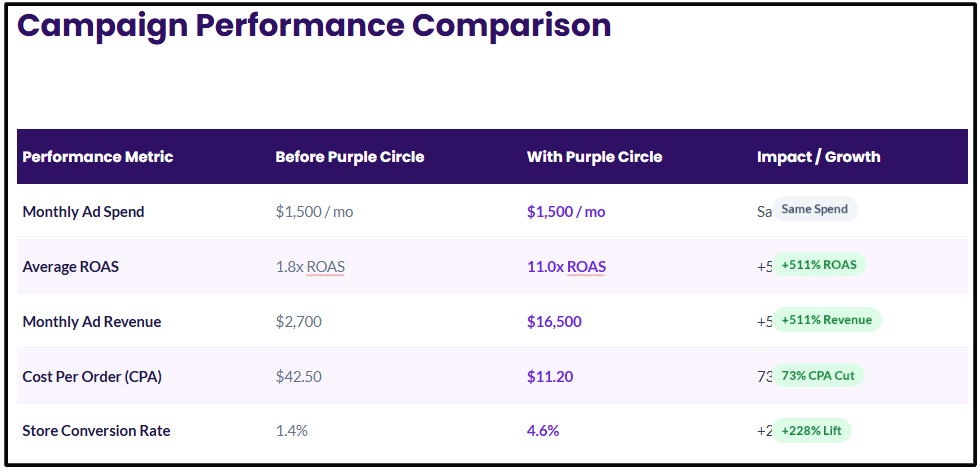
- 11x average ROAS — for every $1 spent, $11 in revenue generated
- Consistent monthly profitability, not just isolated “good weeks”
- Higher average order value from bundle and gift-set promotion
- Lower cost-per-acquisition, driven by intent-first keyword targeting rather than broad match spray-and-pray
- A repeatable, scalable playbook the brand could grow into as budget increased
The most important outcome wasn’t the ROAS number itself — it was that the brand finally had clarity on which customer segments were actually profitable, a foundation that matters just as much for a $1.5K/month kitchen brand as it does for a seven-figure luxury fashion label.
Why This Matters Beyond Kitchen Knives
This case study isn’t really about knives. It’s about a mindset shift that every D2C brand — fashion, lifestyle, or luxury ecommerce — needs in 2026:
- Budget size doesn’t determine ROAS. Strategy clarity does.
- Fresh, current-intent keywords consistently outperform stale, high-competition head terms.
- Profitability comes from precision targeting, not from bidding wars.
As a performance marketing agency working across D2C fashion and lifestyle ecommerce, Purple Circle applies this exact same intent-first, profit-led methodology whether the client sells $50 kitchen knives or premium designer apparel. The channel might be Google Ads, the product might change — but the discipline of matching real buyer intent to real profit margin stays constant.
For brands exploring a luxury ecommerce agency partnership, this case study is a reminder: the agencies worth hiring aren’t the ones promising the biggest spend — they’re the ones proving the highest return on whatever spend you already have.
Conclusion
The Kitchen Knife Store’s journey proves a simple but often-ignored truth in performance marketing: you don’t need a massive budget to build a profitable ecommerce brand — you need the right strategy, matched to real, current buyer intent, executed with discipline.
Purple Circle’s role wasn’t to spend more. It was to spend smarter — turning AUD $1.5K/month into a repeatable, scalable 11x ROAS engine. That’s the same growth-first philosophy driving results for D2C fashion brands and luxury ecommerce clients across Purple Circle’s portfolio today.
If your brand is sitting on an underperforming ad account, the lesson here is clear: the problem is rarely the budget. It’s almost always the strategy.
Frequently Asked Questions
Q1. How did Purple Circle achieve an 11x ROAS with only AUD $1.5K/month in ad spend?
By focusing on fresh, high-intent keywords instead of broad, expensive head terms, restructuring the Google Ads account around specific buyer intents, and continuously optimizing based on actual profit data rather than surface-level metrics like clicks or impressions.
Q2. Can a small ad budget really compete against big retailers on Google Ads?
Yes — when the strategy is built around intent-matching and margin-focused optimization rather than outbidding competitors on generic keywords. Small budgets often outperform larger, poorly targeted ones because every dollar is allocated with precision.
Q3. What makes Purple Circle different from a typical luxury ecommerce agency?
Purple Circle prioritizes measurable profit outcomes (ROAS, AOV, repeat purchase rate) over vanity metrics, and builds every campaign around current, real-world search intent rather than static keyword lists — ensuring strategies stay relevant as consumer behaviour evolves.
Q4. How long does it typically take to see ROAS improvements like this?
Timelines vary by product, market competitiveness, and starting account health, but disciplined, intent-first restructuring combined with weekly optimization typically shows meaningful ROAS movement within the first few optimization cycles.
Q5. Does this strategy work for brands with higher ad budgets too?
Absolutely. The same framework scales — the difference is depth of segmentation and testing volume. Whether the budget is $1.5K or $150K a month, the underlying principle stays the same: profit-led precision beats broad-spend volume.
Purple Circle is a performance marketing agency delivering real, measurable growth for D2C fashion, lifestyle, and luxury ecommerce brands through Google Ads and data-driven strategy.