
How Do I Know If My D2C Business Is Actually Profitable?
By Ashish Rai, CEO, Purple Circle · September 2026 · 7 min read
Most D2C founders think they know if their business is profitable. They’re usually wrong. They look at Shopify revenue, check the ROAS screenshot from their agency, see that orders are growing, and assume everything is working. But profitable means the business generates more cash than it consumes — consistently, measurably, and in a way that survives a bad month. By that definition, most D2C brands running between $20K and $200K/month are not actually profitable, even when they look like they are.
“My Shopify says $80K. I must be profitable.”
Shopify shows revenue. Not profit.
These are not the same number. They’re rarely even close.
The gap between them is where your business lives or dies.
The 3 fake signs founders use to measure profitability
❌ ROAS looks good
Platform ROAS ignores COGS, shipping, returns, fees, and discounts. A 4x ROAS can be a 5% net margin or a net loss. It tells you nothing about profitability. A store can have great ROAS and still lose money every month.
❌ Revenue is growing
Revenue growth with shrinking margins is the most dangerous trajectory in D2C. You can triple revenue and still make less money if costs grow faster.
❌ Cash in the account
A healthy bank balance today can be the result of a big month 60 days ago. Returns, refunds, and chargebacks clear later. $50K revenue can leave $3K in the bank.
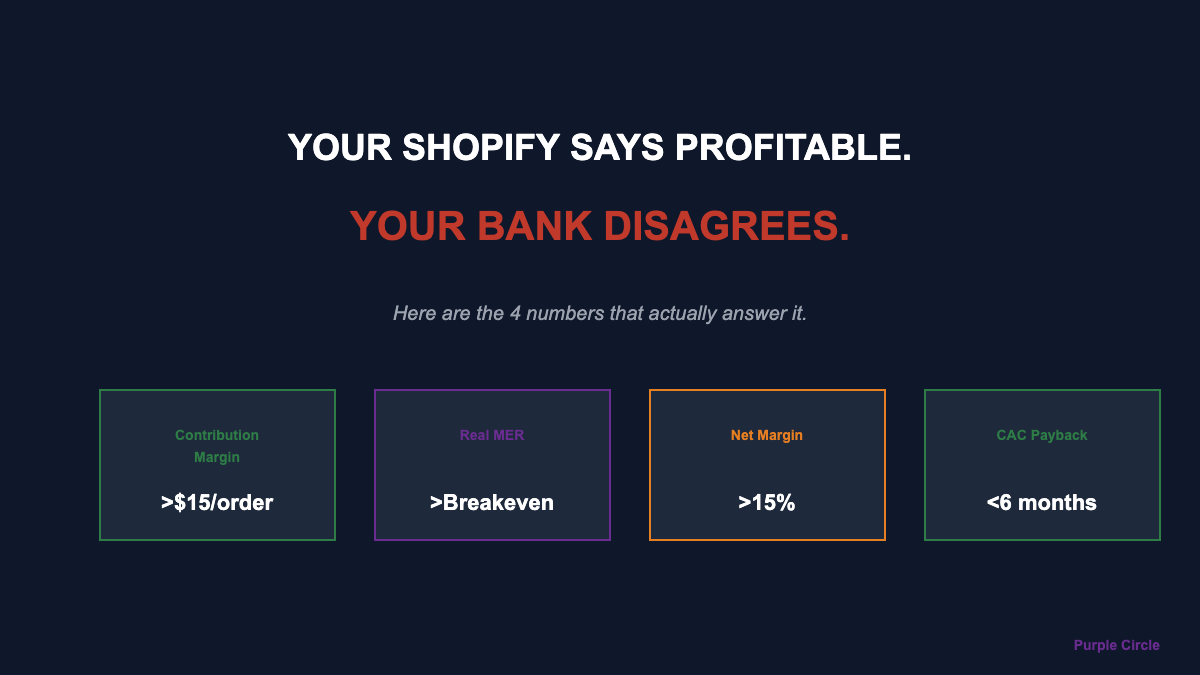
The 4 numbers that actually tell you if you’re profitable
| Metric | How to calculate it | Healthy target |
|---|---|---|
| 1. Contribution margin | Revenue minus COGS, shipping, fees, returns, ad cost, discounts | >$15–20 per order |
| 2. Real MER | Net revenue ÷ total ad spend across all channels | Above your breakeven ROAS |
| 3. Net margin % | (Revenue − all costs including fixed overhead) ÷ revenue | >15% consistently |
| 4. CAC payback period | CAC ÷ monthly contribution per customer | <3–6 months |
If all four are healthy — you’re profitable. If any one is broken, scaling is dangerous. If two or more are broken, your margin is compressing whether or not you can see it yet.
The 5-minute profitability test
Run this on your last full month. Takes 5 minutes.
STEP 1
Net revenue
Gross minus all refunds
STEP 2
Subtract variable costs
COGS + shipping + fees + ad spend + discounts
STEP 3
Subtract fixed costs
Team + software + apps + warehouse
STEP 4
Check MER
Net revenue ÷ total ad spend
RESULT
What’s left
That’s your real profit
What the numbers tell you
>15%
Net margin
Healthy. Safe to scale carefully.
8–15%
Net margin
Marginal. One bad month wipes it. Fix leaks first.
<8%
Net margin
Danger. Do not scale. Fix unit economics immediately.
Below 8%, a price increase will do more for your business than any amount of ad spend. Below 5%, scaling is actively dangerous — every dollar of ad spend is accelerating the loss. This is why your agency’s ROAS screenshot means nothing as a profitability signal.
The honest self-audit questions
Can your business survive one bad month? If a 20% drop in revenue or a 5% spike in return rate would put you in the red, your margin is too thin. Profitable businesses have a buffer. Unprofitable ones are one variable away from crisis.
Is your bank balance growing without new debt? Not from a sale that just landed. Over a trailing 90 days. If your cash position stays flat or falls despite growing revenue, you’re not profitable — you’re experiencing margin compression.
Do you know your contribution margin per order right now? Not last quarter. This week. If you can’t answer this immediately, you’re flying blind. Profitable D2C operators track contribution margin per order weekly, not revenue monthly.
Profitable doesn’t mean revenue is growing.
It means the business generates more than it consumes.
We run the 5-minute profitability test before touching your ad spend.
Get a Free Profitability Audit →
Purple Circle — Profit-First Performance Marketing for D2C Brands
FAQ
How do I know if my D2C business is profitable?
Track four numbers: contribution margin per order, real MER, net margin %, and CAC payback period. If all four are healthy, you’re profitable. If any is broken, you’re not — regardless of what your Shopify dashboard shows.
What is a good net margin for a D2C brand?
Above 15% is healthy. 8–15% is marginal — one bad month can wipe it. Below 8%, do not scale. Fix unit economics first.
Why does my Shopify revenue look good but I have no profit?
Because Shopify shows gross revenue. After COGS, shipping, ad spend, returns, payment fees, discounts, and overhead, what’s left is your actual profit — often 5–10% of the revenue number you’re looking at.
What is contribution margin and why does it matter?
Contribution margin is what each order leaves after all variable costs: COGS, shipping, fees, ad cost, and discounts. It’s the only per-order number that tells you whether growth is adding or destroying value.
Related reads
- $50K/month in revenue but no cash in the bank
- I’m getting sales but my profit margin keeps shrinking
- My Shopify store is growing but I’m making less money
- Should I raise prices or spend more on ads?
- Why your store has great ROAS but still loses money
- Why your agency’s ROAS screenshot means nothing
How Do I Know If My D2C Business Is Actually Profitable?
Trusted by 235+ brands