

My Shopify Store Is Growing But I’m Making Less Money Every Month—
By Ashish Rai, CEO, Purple Circle · September 2026 · 6 min read
Short answer: You’re scaling your costs faster than your revenue. When a Shopify store grows from $20K to $60K/month, most founders assume profit grows with it. It doesn’t — not automatically. Every growth lever you pull (more ads, more SKUs, more discounts, bigger inventory) brings a cost multiplier. If those multipliers aren’t tracked, you end up with 3x the revenue and half the profit per dollar. This is one of the most common patterns we see in D2C brands. And it’s 100% fixable once you see where the compounding happens.
Month 1: $20K revenue. $3,200 profit.
Month 6: $60K revenue. $2,100 profit.
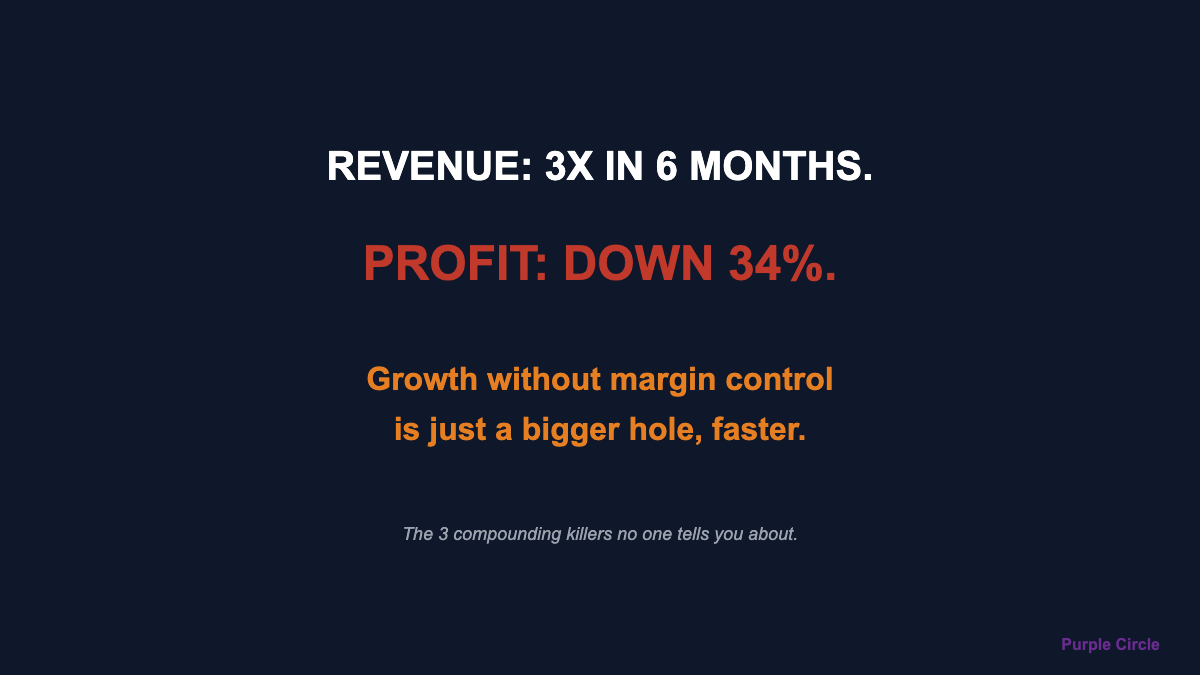
Revenue tripled. Profit went backwards.
Growth without margin optimization is just a bigger hole, faster.
Why growing revenue doesn’t mean growing profit
SCALING AD SPEND
CAC ↑
More spend = higher CPMs = more expensive customers
MORE SKUs
Inventory ↑
Cash tied up. Slow movers. Returns spike.
GROWTH DISCOUNTS
Margin ↓
15% off trains customers. Destroys LTV economics.
MORE ORDERS
Returns ↑
Return volume scales with order volume. Cost compounds.
The 6-month margin compression model
| Metric | Month 1 | Month 3 | Month 6 |
|---|---|---|---|
| Revenue | $20,000 | $38,000 | $60,000 |
| CAC (blended) | $22 | $31 | $48 |
| Return rate | 12% | 16% | 22% |
| Avg discount depth | 8% | 12% | 18% |
| Net margin | 16% | 11% | 3.5% |
| Actual profit | $3,200 | $4,180 | $2,100 |
Revenue tripled. Profit dropped 34%. This isn’t bad luck — it’s a predictable outcome of scaling without fixing unit economics first. The same pattern explains why $50K revenue leaves $3,200 in the bank.
The 3 compounding killers as you scale
1. CAC inflation. When you double your Meta budget, you don’t double your customers — you exhaust your best audience and start paying more for worse ones. CPMs rise. CVR drops. CAC goes from $22 to $48 in six months and nobody flags it because ROAS still looks okay. But CAC payback period is now 7 months instead of 3. You’re funding growth on a cash flow that can’t keep up.
2. Discount dependency. You ran a sale in month 2 that spiked revenue. So you ran another. Now customers expect it. Your email list only converts on discount days. Your repeat purchase economics are based on 18% off, not full price. You’ve trained your entire customer base to wait. The discount that felt like a growth lever is now a margin anchor you can’t remove without a revenue drop.
3. Return rate creep. More SKUs = more sizing confusion. More discounted orders = more impulse buying = more returns. More Meta scale = broader audience = less qualified buyers = more returns. Return rate went from 12% to 22% and nobody noticed because gross revenue kept climbing. Each return costs you the original shipping, return shipping, and often the product. At 22%, you’re losing $8–12 on every fifth order just in logistics.
How to diagnose which killer is hitting you hardest
The 3-question margin compression diagnostic
Q1: CAC trending?
Pull blended CAC (total ad spend ÷ new customers) for last 6 months. If it’s rising faster than AOV, you’re in CAC inflation.
Q2: Discount depth?
What % of revenue in the last 90 days came from discounted orders? If it’s over 30%, you have discount dependency.
Q3: Return rate by cohort?
Compare return rates from month 1 vs month 6 customers. If newer cohorts return more, you’ve scaled into lower-quality acquisition.
The fix: grow margin before you grow revenue
WRONG ORDER
- Scale ad spend to grow revenue
- Add more products to increase AOV
- Run sales to hit revenue targets
- Wonder why profit is falling
- Call the agency and increase budget
RIGHT ORDER
- Fix contribution margin at current volume
- Cap discount depth at a margin-safe level
- Reduce return rate before scaling new SKUs
- Know your breakeven ROAS before spending more
- Scale spend only when unit economics hold
Scaling before your margin is solid doesn’t grow your profit — it compounds your losses. The same principle we apply to every US D2C brand at Purple Circle: don’t trust ROAS screenshots, and never scale spend before you know what each order actually costs and earns.
Growth isn’t the problem.
Uncontrolled growth is.
We fix the margin compression before scaling the spend.
Purple Circle — Profit-First Performance Marketing for D2C Brands
FAQ
Why is my ecommerce store growing but profit going down?
Because scaling ad spend inflates CAC, more SKUs increase returns, and discount dependency erodes margin. Revenue grows faster than you can manage the cost multipliers attached to it.
What is margin compression in ecommerce?
Margin compression happens when your costs grow faster than your revenue. Net margin shrinks even as top-line numbers look good. It’s caused by rising CAC, higher return rates, deeper discounting, and scaling ad spend into diminishing returns.
How do I fix declining profit margins in my Shopify store?
Run a blended CAC trend analysis, audit discount depth over the last 90 days, check return rate by customer cohort. Fix the biggest leak first before scaling spend.
What is a healthy net margin for a D2C brand?
15–20% net margin is sustainable. Below 10%, you have no buffer for bad months. Below 5%, scaling will likely destroy profit faster than it builds revenue.
Related reads
- $50K/month in revenue but no cash in the bank? Here’s where it goes
- Why your store has great ROAS but still loses money
- Why your agency’s ROAS screenshot means nothing
- ROAS vs MER vs Blended ROAS
- Why your breakeven ROAS is higher than you think
My Shopify Store Is Growing But I’m Making Less Money Every Month—
Trusted by 235+ brands