

What to Do With Leftover Stock After Diwali?
By Ashish Rai, CEO, Purple Circle · October 2026 · 9 min read
Don’t hold leftover Diwali stock for a year, and don’t dump it all at 60% off either. Sort it SKU by SKU and give each group the cheapest way to turn back into cash. Push still-relevant styles into the wedding season at close to full price. Clear mid-movers through bundles and your existing customers. Send the true leftovers, usually odd sizes, to a bulk buyer before they age further. Price each clearance against the cost of selling it, not against what you paid for it, because that money is already spent. In the example below, a planned mix brings back ₹8.9 lakh in 90 days, against ₹2.8 lakh from a sitewide dump and zero from holding.
📦 The 30-second version
- Leftover stock is locked cash, and it loses value every month it sits.
- Your price floor is the cost to sell a unit, not what you paid to make it.
- Sort stock into sell at near full price, bundle, clear, or liquidate, SKU by SKU.
- Sell to existing customers first. They cost almost nothing to reach.
- Avoid one giant sitewide discount. It teaches customers to wait for your next one.
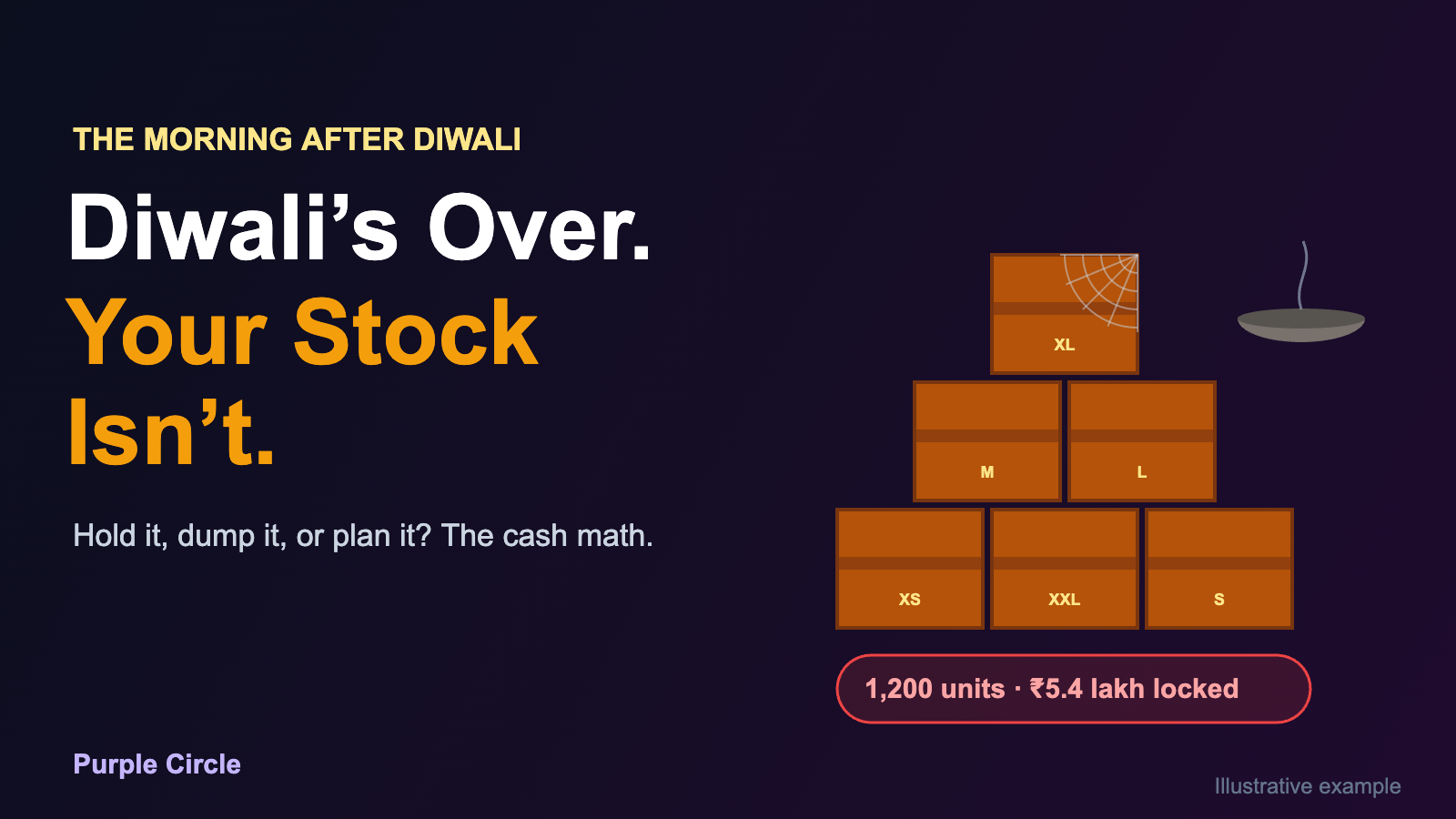
Every year, the week after Diwali feels the same. The lights come down, the sweets run out, and the warehouse is still full. Someone says “we’ll sell it next Diwali”. Someone else says “let’s just do 60% off and be done”. Both sound reasonable. Both usually cost more than they look.
Why leftover stock costs more every month
Most of it is usually the same story: the middle sizes sold out, and the edges didn’t. If that sounds familiar, the cause and the fix are in size-wise dead stock in fashion brands.
The clearance price floor most founders get wrong
Founders usually refuse to sell below what they paid for the product. It feels like losing money. But what you paid is gone either way. The only real question now is: does this sale bring back more cash than it costs to make?
Clearance price floor = cost to sell one unit
shipping + payment fees + RTO cost + ad or marketing cost per order
Anything above that floor turns dead stock back into cash. Anything below it pays the courier to move your loss around.
This doesn’t mean “sell everything cheap”. Selling to existing customers at a modest discount almost always beats a deep sitewide sale. It just means a unit that cost you ₹450 isn’t worth ₹450 today. It’s worth whatever someone will pay, minus the cost of getting it to them.
Sort every SKU into one of four groups
| If the SKU… | Do this | Where |
|---|---|---|
| Still sells and fits the next season | Sell near full price | Wedding-season edits, new photos, existing customers |
| Sold slowly, full size range left | Bundle it | “Any 2” offers, gift sets, cart add-ons |
| Barely moved during the festival | Clear it, quietly | A clearance section, email and WhatsApp to past buyers |
| Odd sizes, damaged, or clearly over | Liquidate it | Bulk buyers and stock-lot traders, before it ages further |
For apparel and ethnic wear in particular, the wedding season that usually follows Diwali is your best friend. A festive kurta set that didn’t move in October can be the wedding-guest outfit in December with the same product and a new story.
Meet three founders with the same leftover stock
Same brand, 1,200 unsold kurta sets, ₹450 landed cost each (₹5.4 lakh), regular price ₹1,499. This is an illustrative example, not client data. Shipping is ₹100 to ₹110, fees are 3%, RTO costs ₹51 per delivered order, and marketing costs depend on who you sell to.
Cash in 90 days: ₹0
Cash in 90 days: ₹2.76 lakh
Cash in 90 days: ₹8.88 lakh
Cash recovered from 1,200 leftover units in 90 days
Stock cost: ₹5.4 lakh. Illustrative.
How the Planner’s mix adds up
| Group | Units | Price | Cash per unit | Total |
|---|---|---|---|---|
| Wedding-season edit to existing customers | 400 | ₹1,349 | ₹1,008 | ₹4.03 L |
| “Any 2 for ₹1,999” bundles | 500 | ₹1,999 per 2 | ₹789 | ₹3.95 L |
| Odd sizes to a bulk buyer | 300 | ₹300 | ₹300 | ₹0.90 L |
| Total | 1,200 | ₹8.88 L |
Cash per unit is after shipping, fees, RTO and a modest marketing cost (₹150 per order to existing customers, ₹200 per bundle order). The Panic Seller’s ₹599 keeps ₹230 after costs, including ₹200 of cold-traffic ads. Bulk-buyer prices vary a lot. Illustrative.
The Panic Seller cleared every unit and still recovered about half of what the stock cost. The Planner recovered more than the stock cost, kept the brand’s prices intact, and only sold 300 units below cost, the ones nobody wanted anyway.
Your November plan
Where else leftover stock can go
So it doesn’t happen next Diwali
Leftover stock mistakes
| Mistake | What actually happens |
|---|---|
| “We’ll sell it next Diwali” | A year of locked cash and storage, for stock that’s now a year old. |
| Refusing to sell below cost | The cost is already spent. Holding out often means getting even less later. |
| One giant sitewide sale | Full-price products get dragged down with the leftovers. |
| Running cold ads for clearance | Ad costs eat the little margin left. Sell to past buyers first. |
| Reordering the same size ratio | Same leftovers, same November, next year. |
FAQ
What should I do with unsold stock after Diwali?
Sort it SKU by SKU. Sell still-relevant styles into wedding season at near full price, bundle slow movers, clear the rest quietly through your website and past customers, and liquidate odd or damaged sizes before they age further.
Should I hold festive stock until next Diwali?
Usually not. Cash stays locked for a year, storage keeps costing money, and styles age, so the price you get next year is usually lower than what you’d get now.
Is it okay to sell leftover stock below cost?
Often, yes, for the true leftovers. What you paid is already spent. As long as the sale brings back more than it costs to sell the unit, it turns dead stock into usable cash.
Should I run a big clearance sale on my website?
Be careful. A sitewide discount pulls full-price products down too and trains customers to wait. A separate clearance section, bundles and offers to past buyers usually work better.
How do I avoid leftover stock next festive season?
Buy sizes based on what actually sold, order in smaller waves with quick reorders, pre-sell hero styles, and plan your clearance before the festive sale starts.
Sitting on post-Diwali stock and not sure where to start? Purple Circle can help you sort it, price it and move it without wrecking your margins. You can also see how we work in our case studies.
— Ashish Rai, CEO, Purple Circle