

Why Do I Lose Money on Orders Under ₹999?
By Ashish Rai, CEO, Purple Circle · October 2026 · 8 min read
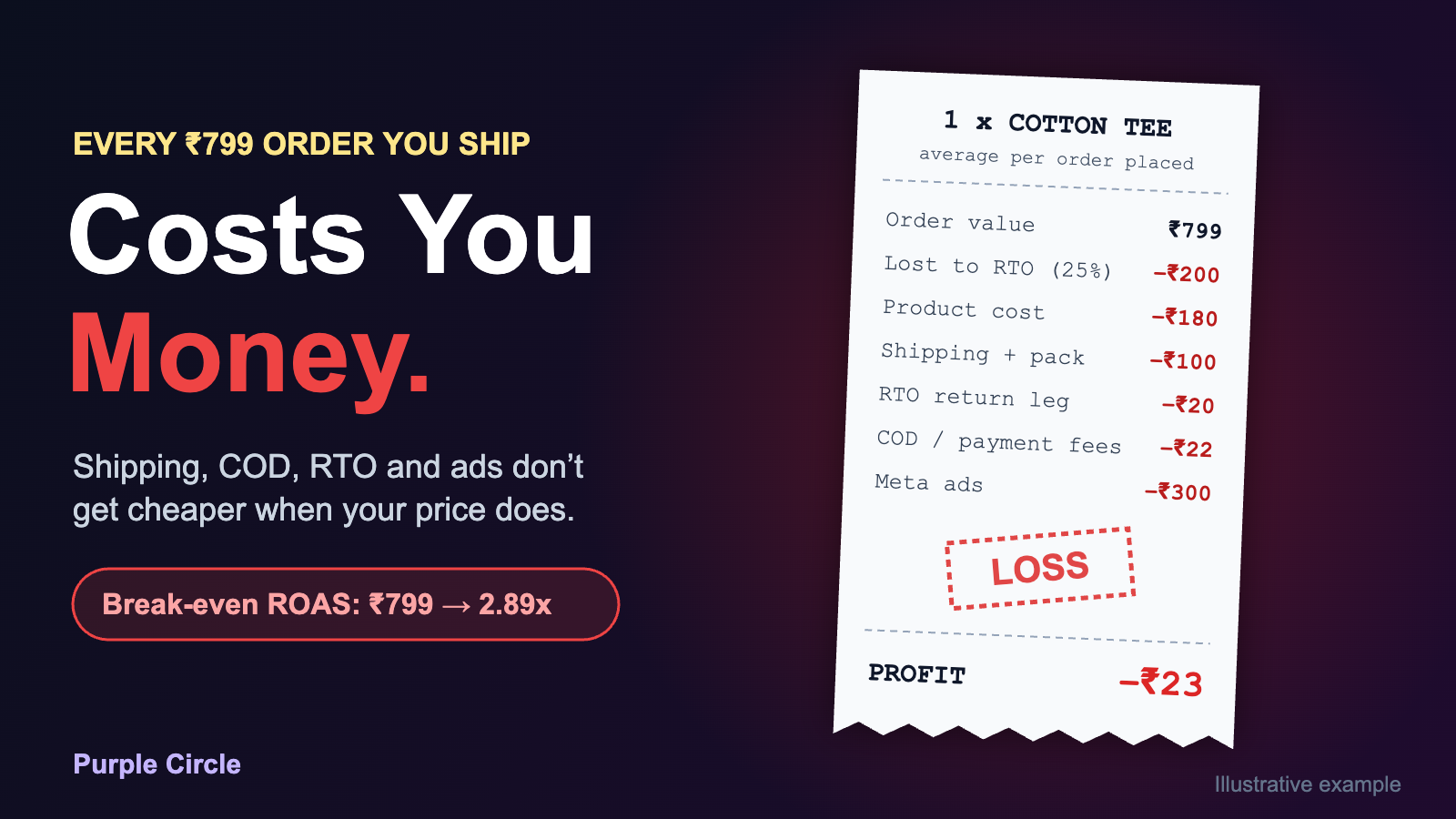
You lose money on orders under ₹999 because most of your per-order costs don’t shrink when your price does. Shipping, packaging, COD fees, the return leg on RTO and the ad cost to win the order are roughly the same on a ₹799 tee as on a ₹1,499 two-pack. On a small order they eat a much bigger share, so your break-even ROAS climbs. In the example below, a ₹799 order needs 2.89x ROAS just to break even, and at 2.66x it loses ₹23 on every order placed.
This is one of the most common traps for T-shirt, basics and accessory brands. The price looks attractive, the conversion rate looks great, orders pour in, and the bank balance doesn’t move.
The costs that don’t care about your price
Some costs scale with the price of what you sell, like product cost and gateway fees. Most of the painful ones don’t. They’re charged per parcel or per order, whatever is inside it.
Now see what those fixed costs look like as a share of the order. This uses the assumptions from the example below: ₹100 forward shipping, a 25% RTO rate on lower-value orders, ₹80 return leg, and blended payment/COD fees.
Per-order fixed costs as a % of order value
Shipping + RTO return leg + payment/COD fees, per order placed. Illustrative.
On a ₹499 order, more than a quarter of the price is gone before you’ve paid for the product or the ad. That’s why “affordable pricing” so often turns into “busy but broke”. We saw the same pattern in why most T-shirt brands fail in India.
The math: a ₹799 tee vs a ₹1,499 two-pack
Take a basics brand selling cotton tees. This is an illustrative example, not client data. Product cost is ₹240 per tee. Shipping and packing is ₹100 for one tee and ₹110 for two. The RTO return leg is ₹80. We assume 25% RTO on single-tee orders and 20% on two-packs, because a bigger basket usually signals more intent. Check that against your own courier data. Average COD RTO in India commonly runs 28–35%, according to Amazon Shipping India, so these are not harsh assumptions.
Per order placed
| Line | ₹799 single tee | ₹1,499 two-pack |
|---|---|---|
| RTO rate | 25% | 20% |
| Revenue actually delivered | ₹599 | ₹1,199 |
| Product cost | ₹180 | ₹384 |
| Shipping and packing | ₹100 | ₹110 |
| RTO return leg | ₹20 | ₹16 |
| Payment / COD fees | ₹22 | ₹28 |
| Left before ads | ₹277 | ₹661 |
| Meta ad cost per order | ₹300 | ₹380 |
| Meta ROAS | 2.66x | 3.94x |
| Profit per order placed | −₹23 | +₹281 |
| Break-even ROAS | 2.89x | 2.27x |
The two-pack costs ₹80 more to acquire. It also leaves ₹384 more before ads. So one order loses money and the other makes ₹281, from the same product, the same customer type and the same ad account.
Look at the ₹799 order’s ROAS: 2.66x. Plenty of founders would call that healthy. It’s below break-even. The dashboard can’t tell you that, because ROAS doesn’t know your per-order costs. This is the same blind spot we covered in how RTO changes your break-even ROAS.
Your break-even ROAS depends on your order value
Break-even ROAS by order value (same brand, same costs)
Illustrative. Bars scaled to 4.5x. ₹499 assumes ₹150 product cost.
A ₹499 product needs over 4x ROAS just to break even. Very few cold Meta campaigns hold that at scale. So if your cheapest product is your main ad product, your account is being asked to do something it almost never can.
Work out your own number, per order placed
Left before ads = (delivery rate × (order value − product cost − payment fee)) − shipping − (RTO rate × return leg)
Break-even ROAS = order value ÷ left before ads
Run it for your three most common order values. If the cheapest one needs a ROAS your account has never sustained, that’s your answer.
How to stop losing money on small orders
The fix is almost never “spend less on ads”. It’s making each order big enough to carry its own fixed costs.
- Set free shipping above your AOV, not below it. If your average order is ₹850 and free shipping starts at ₹499, you’re paying shipping on almost every order. Move the threshold just above your AOV, like ₹999, and charge ₹49–79 below it.
- Sell bundles, not discounts. “Any 2 for ₹1,499” protects your margin better than 20% off one tee, and it doubles the order the shipping cost is spread over. See why a 25% discount can cut your margin by 66%.
- Make small COD orders pay for their risk. Add a COD fee or go prepaid-only below a value like ₹699. Those are the orders where one RTO wipes out the most profit.
- Test a higher price on the hero. Moving a tee from ₹799 to ₹899 adds ₹75 per order placed at 75% delivery. In this example that alone takes the order from a loss to profit.
- Add to the cart before checkout. Socks, a second colour or a matching item at the cart stage raises order value without touching ad cost.
- Stop advertising products that can’t break even alone. Use the cheapest products as add-ons in the cart, not as the product your ads lead with. The exception is when your repeat data shows these buyers come back. Check it before you assume it.
Mistakes that keep small orders unprofitable
| Mistake | Why it hurts |
|---|---|
| One ROAS target for every product | A ₹499 order and a ₹1,499 order have very different break-evens. |
| Free shipping on everything | You pay ₹100 to deliver a ₹499 order and call it customer experience. |
| Discounting single units to boost conversion | Lower order value, same fixed costs. The loss gets bigger. |
| Celebrating conversion rate | Cheap products convert well. That’s not the same as making money. |
| Leading ads with the cheapest product | It asks Meta for a ROAS it almost never delivers. |
If one product is doing most of the damage, read why your best-selling product may not be making any profit to find it.
FAQ
Why do I lose money on orders under ₹999?
Because shipping, packaging, COD fees, RTO costs and the ad cost to win an order stay roughly the same whatever the order value. On a small order they take a much bigger share, so the order often can’t cover them.
What is the break-even ROAS for a low-price product?
It depends on your costs, but it rises sharply as order value falls. In our example it’s 2.27x for a ₹1,499 order, 2.89x for ₹799 and over 4x for ₹499.
Should I offer free shipping on all orders?
Usually not. Set the free shipping threshold just above your average order value so it nudges customers to add more, and charge a small fee below it.
How can I increase AOV without giving discounts?
Use bundles like “any 2 for ₹1,499”, a free shipping threshold above your current AOV, cart add-ons and a small price increase on products with strong demand.
Is it worth selling low-price products at all?
Yes, as add-ons or as an entry point if your data shows those customers come back and buy more. As the main product your ads depend on, they rarely work.
If your orders keep growing but your profit doesn’t, Purple Circle can review your order-level unit economics with you. You can also see how we work in our case studies.
— Ashish Rai, CEO, Purple Circle