

Why Australian Ecommerce Shipping Costs Are Eating Your Margin
By Ashish Rai, CEO, Purple Circle · September 2026 · 7 min read
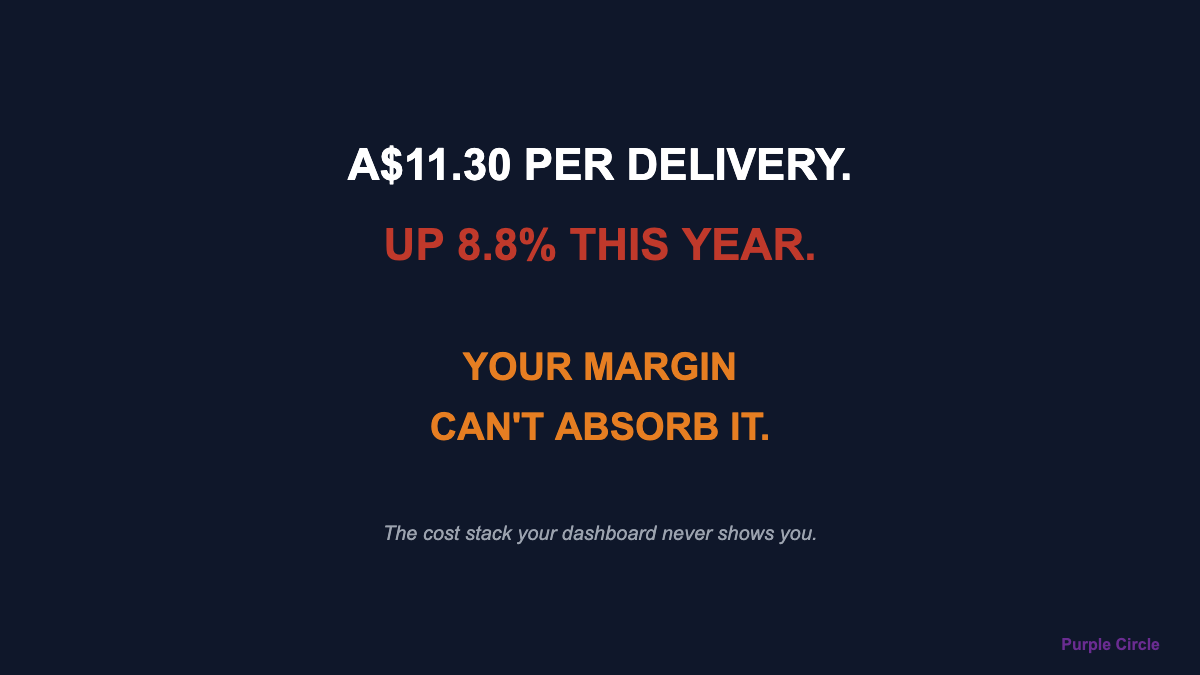
The average cost to ship a single ecommerce order in Australia hit A$11.30 in 2026 — up 8.8% from A$10.39 a year ago. That’s not a line item you can optimise away with a better 3PL contract. It’s a structural load on your contribution margin that compounds with every order. Fuel surcharges now hit 40%+ of carrier invoices. Last-mile infrastructure across regional Australia remains fragmented. And your customers — trained by Amazon’s automated fulfilment pipeline — expect free delivery as a baseline, not a perk. Shipping is now the second-largest variable cost in your P&L stack after COGS, and for most Australian D2C operators, it’s the leak they haven’t properly instrumented.
A$11.30 per delivery. Up 8.8% YoY.
71% of carriers hit by fuel volatility.
Your “free shipping” costs A$11.30 per order.
Source: Shippit State of Shipping Report 2026
The shipping cost stack most operators don’t fully instrument
When Australian founders think “shipping cost,” they think of the carrier invoice. That’s roughly 60% of the actual cost. The full cost-stack includes five layers:
| Cost layer | Per-order cost | Visibility |
|---|---|---|
| Carrier rate (base + fuel surcharge) | A$8.50–12.00 | Tracked by most |
| Packaging (materials + inserts) | A$1.50–3.00 | Sometimes tracked |
| Pick & pack labour | A$2.00–4.00 | Rarely isolated |
| Return logistics (inbound + restock) | A$8.00–15.00 | Almost never tracked |
| Failed delivery retry | A$5.00–9.00 | Almost never tracked |
| True all-in fulfilment cost | A$14–22 per order | Rarely computed |
On an average AU AOV of A$95–150, that fulfilment stack represents 10–23% of gross revenue. If your gross margin is 40%, fulfilment alone consumes a quarter to over half your margin before ad spend. This is why brands with healthy-looking ROAS still bleed cash.
Why the “free shipping” threshold is a margin trap
What “free shipping over A$100” actually costs you
| Metric | Shipping charged | “Free” shipping |
|---|---|---|
| AOV | A$110 | A$118 |
| Gross margin (42%) | A$46.20 | A$49.56 |
| Shipping absorbed | A$0 | –A$11.30 |
| Net margin after shipping | A$46.20 | A$38.26 |
| Margin erosion | — | –17.2% |
The A$8 AOV lift doesn’t offset the A$11.30 absorbed. “Free” shipping cost you 17% of your margin.
The AOV lift from free shipping thresholds averages 7–12% in Australia. But if incremental AOV doesn’t exceed the shipping cost absorbed, you’ve traded margin for conversion volume. Same trap behind D2C brands that sell but don’t profit.
The Amazon-Temu delivery expectation gap
36%
AU ecommerce revenue
Amazon + Temu + Shein combined 2026
68%
Won’t return
After one bad delivery experience
82%
Retailers worried
Marketplace giants gaining share
A$11.30
Avg delivery cost
Up 8.8% YoY
Amazon’s automated fulfilment pipeline delivers precise ETA countdowns. Temu normalised free cross-border shipping on sub-A$30 orders. 57% of Millennials say Amazon raised their expectations of every retailer. You’re not competing with Amazon’s products — you’re competing with Amazon’s logistics stack.
How to architect your fulfilment for margin
1. Instrument the full cost-stack. If your analytics only track carrier invoices, you’re measuring 60% of the problem. Build a per-order fulfilment cost model including pick and pack, packaging, return logistics, and failed delivery retries. Same principle as tracking MER instead of platform ROAS.
2. Re-architect your free shipping threshold. Set it where incremental AOV exceeds absorbed shipping by 2x minimum. If shipping is A$11.30, your threshold should drive A$22+ in incremental AOV. Test tiered shipping (free over A$150, flat A$6.95 under) against blanket free and measure contribution margin, not just conversion rate.
3. Reduce failed delivery rate. Every failed first-attempt costs A$5–9 in re-dispatch. Implement API-level address validation at checkout, SMS delivery-window confirmation, and authority-to-leave defaults for low-risk postcodes. A 15% reduction at 2,000 orders/month saves A$1,500–2,700/month in pure margin recovery.
4. Implement zone-based carrier routing. Don’t route every order through one carrier. Use multi-carrier allocation based on destination zone, parcel weight, and SLA requirement. Carrier-agnostic routing APIs (Shippit, Starshipit) can cut 8–15% off your blended carrier cost.
5. Prioritise delivery certainty over speed. The 2026 Australia Post report found shoppers over 40 — the fastest-growing segment, biggest baskets — prefer delivery certainty over speed by 87–90%. You don’t need same-day. You need a reliable ETA you actually hit. Cheaper to deliver and more valuable to the customer.
Fulfilment margin audit: what we check before scaling AU ad spend
CHECK 1
All-in fulfilment cost
CHECK 2
Free shipping ROI
CHECK 3
Failed delivery rate
CHECK 4
Return logistics cost
THEN
Scale ad spend
The takeaway
Shipping isn’t a fixed cost you negotiate once a year. It’s a variable cost that scales with every order and compounds against your margin. In the Australian market — where delivery costs rise faster than AOV, carriers pass fuel volatility directly to merchants, and customer expectations are benchmarked against Amazon’s infrastructure — your fulfilment architecture is a profit lever, not a logistics detail.
Shipping is your second-largest cost.
Most operators only measure 60% of it.
We audit the full stack before scaling a dollar of ad spend.
Get a Free Fulfilment Margin Audit →
Purple Circle — Profit-First Performance Marketing
FAQ
What is the average ecommerce shipping cost in Australia in 2026?
A$11.30 per delivery on average, up 8.8% from A$10.39 in 2025. Fuel surcharges affect 40%+ of carrier invoices.
Does free shipping hurt ecommerce margins?
It can. If incremental AOV lift doesn’t exceed the shipping cost absorbed, free shipping erodes contribution margin. On a 42% margin product, free shipping costs 17% of margin per order.
How much does a failed delivery cost in Australia?
A$5–9 per re-dispatch attempt, on top of the original shipping cost. At scale, failed deliveries are one of the most under-tracked cost leaks.
How can I reduce ecommerce shipping costs in Australia?
Instrument the full cost-stack, implement zone-based multi-carrier routing, reduce failed deliveries with address validation, and set free shipping thresholds where AOV lift exceeds absorbed cost by 2x.
Related reads
- Why your store has great ROAS but still loses money
- Why your agency’s ROAS screenshot means nothing
- Why your D2C brand is selling but not making money
- ROAS vs MER vs Blended ROAS
- Why your breakeven ROAS is higher than you think
Why Australian Ecommerce Shipping Costs Are Eating Your Margin
Trusted by 235+ brands