

Why Do My Ads Stop Working Every Time I Increase the Budget?
By Ashish Rai, CEO, Purple Circle · September 2026 · 6 min read
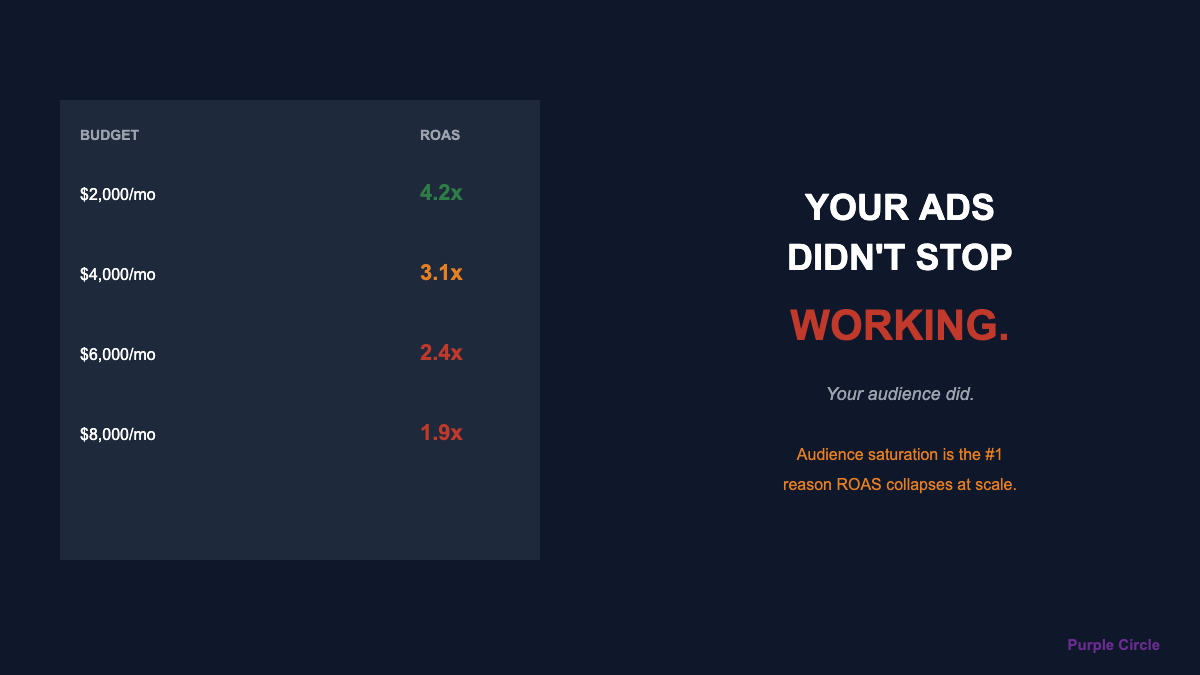
Short answer: your ads didn’t stop working — your audience did. When you double your Meta budget, you don’t double your results. You exhaust your best-performing audience, force the algorithm into a broader and less qualified pool, and watch CPMs climb while conversion rates drop. The ROAS that looked healthy at $2,000/month becomes unprofitable at $8,000/month — not because the creative changed, but because the economics of audience saturation kicked in. This is one of the most predictable patterns in paid media, and almost every D2C brand hits it without understanding why.
At $2K/month: ROAS 4.2x
At $4K/month: ROAS 3.1x
At $8K/month: ROAS 1.9x
Same creative. Same product. Different audience economics.
What actually happens when you scale ad spend
Your Meta ad account targets people in order of how likely they are to convert. The algorithm starts with your highest-intent audience — people who’ve visited your site, people similar to past buyers, warm interest segments. These convert at the lowest CPM and highest rate.
When you double your budget, you’ve exhausted that pool faster. The algorithm expands outward — into colder audiences with lower purchase intent, higher CPMs, and lower conversion rates. You’re buying worse traffic at a higher price. ROAS drops. CAC rises. And your agency tells you it’s a creative problem.
LOW BUDGET
Warm audience
Low CPM. High intent. High CVR. Strong ROAS.
MID BUDGET
Mixed audience
CPM rising. CVR softening. ROAS declining.
HIGH BUDGET
Cold audience
High CPM. Low intent. Low CVR. ROAS collapses.
The audience saturation curve
| Monthly spend | Blended CPM | CVR | ROAS | Profitable? |
|---|---|---|---|---|
| $2,000 | $8.40 | 3.2% | 4.2x | ✅ Yes |
| $4,000 | $11.20 | 2.6% | 3.1x | ⚠️ Marginal |
| $6,000 | $14.80 | 2.1% | 2.4x | ❌ Below breakeven |
| $8,000 | $18.50 | 1.7% | 1.9x | ❌ Losing money |
This isn’t a creative problem. It’s an audience economics problem. And the solution isn’t a new ad — it’s knowing your real breakeven ROAS before you push spend, so you know exactly when to stop scaling and when it’s safe to keep going.
3 reasons your agency tells you it’s a creative problem
1. It’s easier to test new creative than admit the budget ceiling. Creative testing gives the agency something visible to do. Diagnosing audience saturation requires understanding your unit economics, your market size, and your breakeven ROAS — which most agencies never calculated. If they haven’t asked for your margins, they literally cannot tell you when your spend is unprofitable. That’s exactly why your agency’s ROAS screenshot means nothing.
2. Platform ROAS hides the saturation. Meta’s reported ROAS doesn’t show you the incremental impact of each extra dollar. A 3.1x blended ROAS at $4K/month tells you the average, not the marginal. The last $1,000 of that budget might be running at 1.4x. You’re subsidising losing spend with profitable spend and calling the average a success. Good ROAS can still mean losing money.
3. % of spend billing creates the wrong incentive. When your agency makes more money the more you spend, they will never tell you to stop scaling. The incentive structure pushes spend upward regardless of marginal return. Meanwhile your revenue grows while profit falls and nobody flags it.
What your spend ceiling actually looks like
How to calculate your profitable spend ceiling
STEP 1
Find breakeven ROAS
Revenue ÷ ad spend where profit = $0
STEP 2
Track MER weekly
Net revenue ÷ total spend, all channels
STEP 3
Run holdout tests
Pause spend segments to measure true incrementality
RESULT
Scale with confidence
Only push spend while MER stays above breakeven
How to scale profitably past the saturation ceiling
Fix the unit economics first, then scale. If your contribution margin is too thin, scaling spend just scales losses. A 10% improvement in margin means your breakeven ROAS drops, which means you can profitably run at higher spend levels before hitting the saturation ceiling.
Increase retention before increasing acquisition spend. Every customer who buys twice halves your effective CAC. Better repeat rate means the economics of new customer acquisition improve — so you can afford to pay more per new customer, which means you can bid higher and reach colder audiences profitably. The CAC payback period shrinks when repeat rate improves.
Diversify channels before maximising one. Meta saturation is real. Google, TikTok, and email have different audience pools. MER-based measurement across all channels tells you which channel has room to scale and which has hit its ceiling — something platform ROAS can never show you.
WRONG SCALING APPROACH
- ROAS drops → test new creative
- New creative performs → scale budget again
- ROAS drops again → test more creative
- CAC climbs → agency says “just a learning phase”
- Profit disappears → you blame the algorithm
RIGHT SCALING APPROACH
- Know breakeven ROAS before scaling
- Track MER weekly, not platform ROAS
- Fix contribution margin before pushing spend
- Improve repeat rate to lower effective CAC
- Scale only when MER holds above breakeven
Your ads aren’t broken.
Your spend ceiling is.
We calculate your profitable spend ceiling before touching your budget.
Purple Circle — Profit-First Performance Marketing for D2C Brands
FAQ
Why does my ROAS drop when I increase my ad budget?
Because you exhaust your highest-intent audience first. As budget grows, Meta reaches colder, less qualified audiences at higher CPMs. The same spend efficiency that worked at lower budgets physically cannot hold at higher spend levels without new audience pools or improved unit economics.
What is audience saturation in Meta Ads?
Audience saturation happens when your ad campaign has reached most of the highest-intent people in your target audience. Further spending reaches lower-intent users, driving up CPMs and dropping conversion rates and ROAS.
How do I know if I’ve hit my profitable ad spend ceiling?
Track your MER (total revenue ÷ total ad spend) weekly and compare it to your breakeven ROAS. When MER approaches or drops below breakeven, you’ve reached your ceiling. Run holdout tests to measure true incremental revenue from spend increases.
How can I scale ads profitably past the saturation point?
Improve your contribution margin (so your breakeven ROAS drops), increase repeat purchase rate (so effective CAC falls), and diversify to new channels (new audience pools). Fix the economics first, then scale the spend.
Related reads
- $50K/month in revenue but no cash in the bank? Here’s where it goes
- My Shopify store is growing but I’m making less money every month
- Why your store has great ROAS but still loses money
- Why your agency’s ROAS screenshot means nothing
- ROAS vs MER vs Blended ROAS: Which one predicts your bank balance
- Why your breakeven ROAS is higher than you think
Why Do My Ads Stop Working Every Time I Increase the Budget?
Trusted by 235+ brands