

Why a 25% Sitewide Discount Cuts Your Profit Margin by 66%, Not 25%
A 25% sitewide discount does not cut your profit by 25%. It cuts it by roughly 66%. The discount comes out of contribution margin, and contribution margin is usually under 30% of the order, not 100% of it. In the US apparel example below, margin per order falls from $27.80 to $9.52. Revenue rises $35,000 on the week. Contribution margin falls $6,132. Once a 28% return rate is applied, the sale week finishes at minus $7,260 while the ordinary week finishes at plus $4,407.
This is the single most common way we see a profitable store turn unprofitable in one week. Here is the arithmetic, step by step, so you can run it on your own numbers.
Key takeaways
- A discount is deducted from contribution margin, not from revenue, so the percentage impact is always larger than the discount itself.
- At a $100 AOV with $27.80 of contribution margin, a 25% discount removes 90% of the margin the discount touches and leaves $9.52 per order.
- Doubling order volume did not compensate: revenue rose 50% and contribution margin fell about a third.
- Returns are charged on the discounted order at full cost, because ad spend and outbound shipping are already spent.
- The maximum discount most US apparel stores can survive is contribution margin divided by AOV, which in this example is 27.8%.
Why does a 25% discount cut margin by more than 25%?
Because the discount is taken out of the only part of the order you actually keep. Take a US apparel store with a $100 average order value. On a normal week, here is what leaves on every order:
| Line | Full price | 25% off sitewide |
|---|---|---|
| Average order value | $100.00 | $75.00 |
| Product cost | -$32.00 | -$32.00 |
| Shipping and packaging | -$12.00 | -$12.00 |
| Payment processing | -$3.20 | -$2.48 |
| Customer acquisition cost | -$25.00 | -$19.00 |
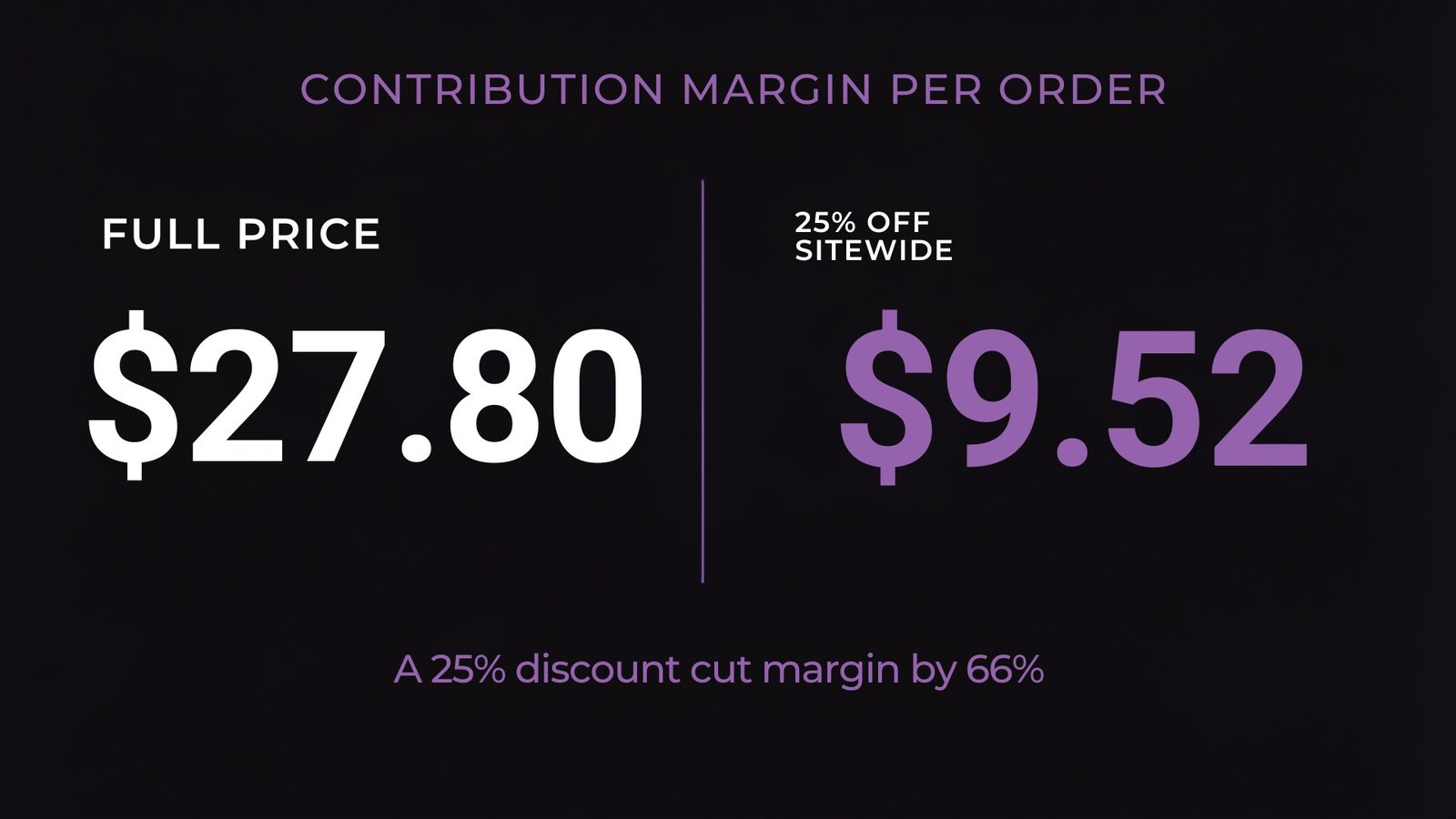
| Contribution margin per order | $27.80 | $9.52 |
Two things do not move when you discount. Product cost stays at $32, because you already paid $32 for the shirt. Shipping and packaging stays at $12, because the parcel is the same size. Processing falls slightly because it is a percentage of a smaller order, and acquisition cost falls to $19 because a discount converts better and the ads work harder.
The result is $9.52 instead of $27.80. A 25% discount produced a 66% cut in margin.
Does higher volume make up for the lower margin?
In this example the sale worked exactly as intended. Orders doubled from 700 to 1,400 for the week.
- No sale: 700 orders x $100 = $70,000 revenue, and 700 x $27.80 = $19,460 contribution margin.
- With the sale: 1,400 orders x $75 = $105,000 revenue, and 1,400 x $9.52 = $13,328 contribution margin.
Revenue rose $35,000. Contribution margin fell $6,132. The store sold 50% more and made about a third less. This is the point at which most founders start looking for a problem in the ad account, when the problem is in the price.
What do returns do to a discounted sale week?
This is apparel, so returns are not optional. At a 28% return rate, 392 of those 1,400 sale orders come back. On a returned order you do not recover the money that already left the business:
- Ad spend already paid to acquire the order: $19
- Outbound shipping already paid: $12
- Return shipping: roughly $9
- Processing and restocking labour: about $3
That is $43 lost on every returned order, before any markdown loss on units that cannot go back out at full price.
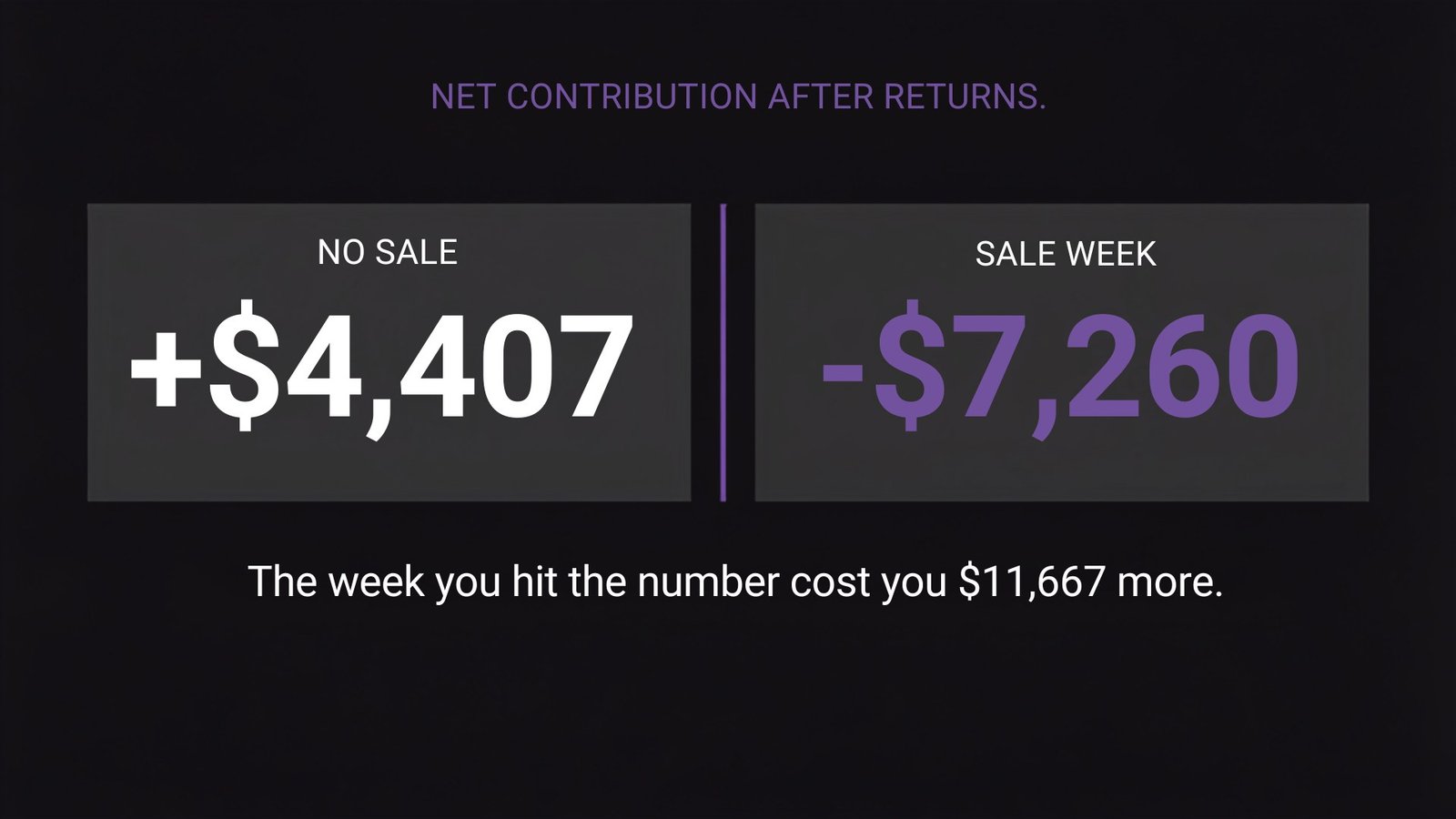
- Sale week: 1,008 kept orders x $9.52 = $9,596. 392 returns x $43 = $16,856. Net: minus $7,260.
- No-sale week: 504 kept orders x $27.80 = $14,011. 196 returns x $49 = $9,604. Net: plus $4,407.
The week the store hit its revenue target cost $11,667 more than the week it missed. And that is before rent, salaries, software, or the owner getting paid.
What is the maximum discount your store can survive?
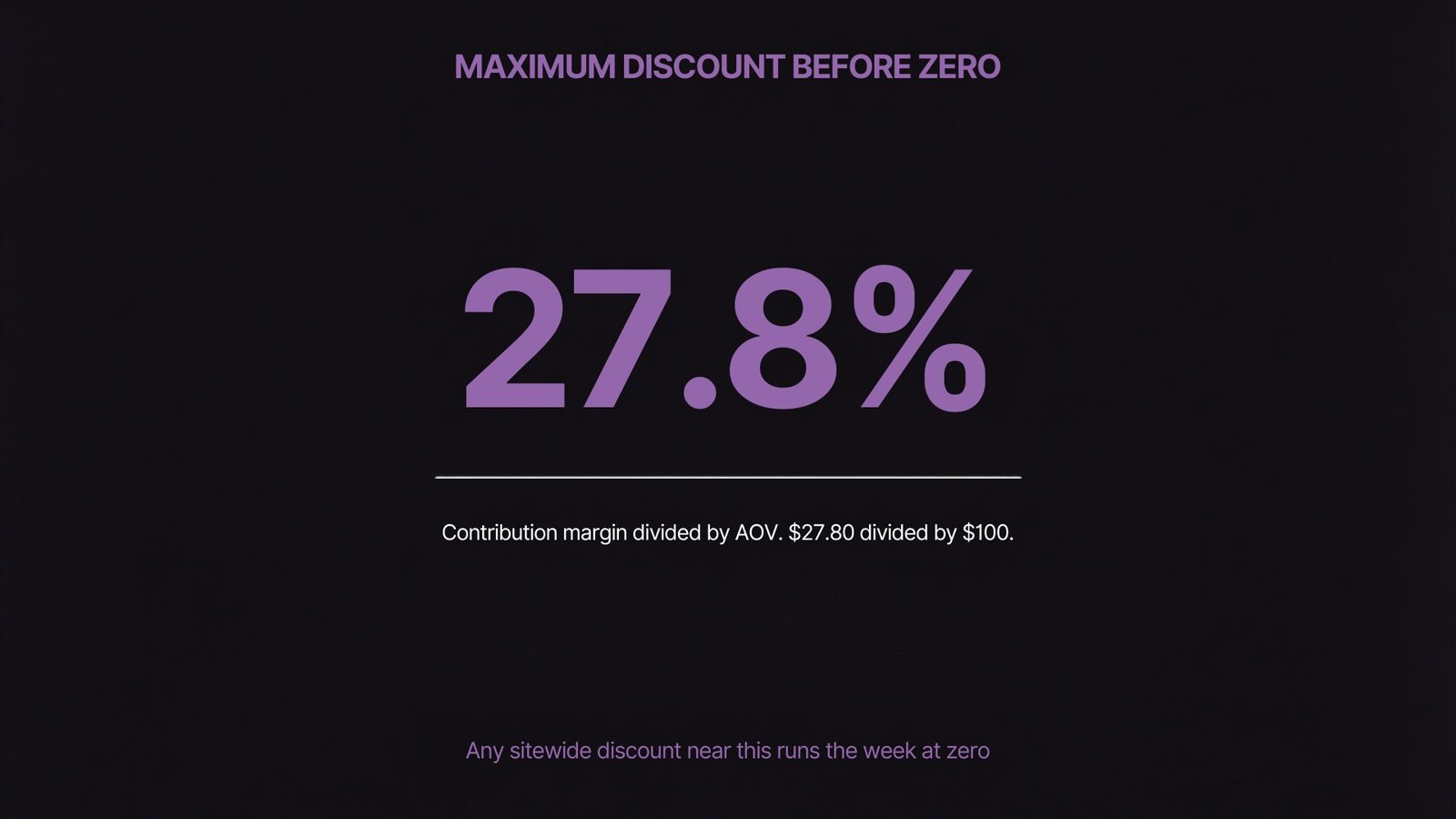
Divide contribution margin per order by average order value. In this example that is $27.80 divided by $100, which is 27.8%. Any sitewide discount approaching that number is running the week at zero, and anything past it is paying customers to order.
Run this number before you schedule the promotion, not after you read the P&L. Most stores discover their ceiling is far lower than the discount they have been running out of habit.
Why a discount is not a marketing cost
Ad spend at least buys you a customer you might keep. A sitewide discount buys you the customer you were already going to get, at a worse price. It is a direct withdrawal from the only pool of money the business has to cover fixed costs.
It also does something slower and more expensive. It trains your list. Once buyers learn a sale is coming, full-price weeks get thinner, and the next sale has to be deeper to produce the same lift. Two seasons of that and the discount is no longer a promotion, it is your pricing.
And discounted orders come back at the same rate as full-price orders, sometimes higher. You refund the discounted price, but you already paid the full cost to acquire, pick, pack and ship.
What to do instead of a sitewide sale
1. Set your discount ceiling from the margin, not from the calendar
Contribution margin per order divided by AOV is your ceiling. Publish it internally so nobody schedules a 30% promotion on a 27.8% business.
2. Discount the SKUs that are stuck, not the catalogue
Mark down the styles that are genuinely aging or carrying a high return rate, and hold price on what is selling. A 40% markdown on 12% of the catalogue costs a fraction of 25% off everything, and it clears the stock that is actually blocking cash.
3. If you need volume, buy it with ad spend rather than price
Ad spend is a variable you can switch off next week. A price expectation is not. Buying volume through media keeps the decision reversible; buying it through price does not.
Frequently asked questions
Does discounting increase customer lifetime value?
Usually not in the way founders hope. Discount-acquired customers tend to repurchase on discount, so the second order carries the same compressed margin as the first. Measure contribution-margin LTV rather than revenue LTV before crediting a sale with long-term value.
Is a sitewide discount ever worth running?
Yes, when the goal is cash conversion rather than profit: clearing end-of-season stock, freeing warehouse space, or funding an inventory buy. The mistake is running one to hit a revenue number while believing it is profitable.
How do I calculate contribution margin per order?
Take average order value and subtract product cost, shipping and fulfilment, payment processing, average discount, and customer acquisition cost. Then subtract the cost of the orders that come back. What remains is the number your fixed costs are paid from.
Do discounted orders get returned more often?
In apparel they are at least as likely to come back, and often more so, because lower prices encourage bracketing across sizes. The damage is worse on a discounted order because the cost side is unchanged while the revenue side is smaller.
The revenue goal is not the goal
Nobody ever paid a supplier with revenue. If you are running promotions to hit a monthly number, the number worth checking first is contribution margin per order after returns, not the total on the dashboard.
Related reading: Why Your Store Has Great ROAS But Still Loses Money, ROAS vs MER vs Blended ROAS, and Why Your Breakeven ROAS Is Higher Than Your US Competitors.
If you want someone to run this math on your store, see how we work on contribution margin before the ad account.
Written by Ashish Rai, CEO of Purple Circle, a performance marketing company for US ecommerce and D2C brands.
Why a 25% Sitewide Discount Cuts Your Profit Margin by 66%, Not 25%
Trusted by 235+ brands