

How Does RTO Change Your Break-Even ROAS During Diwali?
By Ashish Rai, CEO, Purple Circle · September 2026 · 8 min read
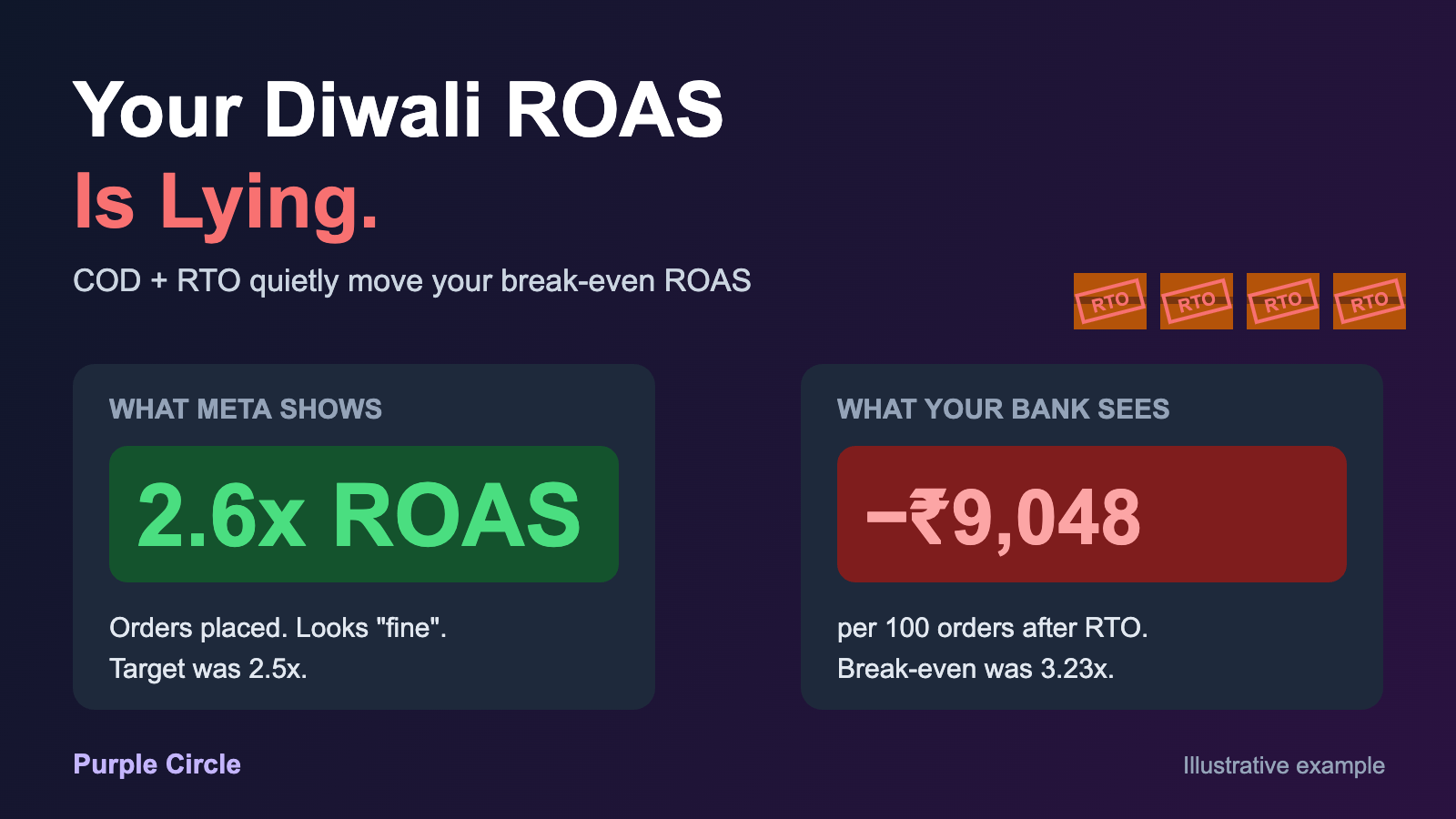
During Diwali, your break-even ROAS goes up because a bigger share of orders comes in as COD, and COD orders get refused at the door far more often than prepaid ones. Meta reports ROAS on orders placed, but your P&L runs on orders delivered. In the example below, the same brand’s break-even ROAS moves from 2.63x to 3.23x in festive season, so a campaign showing a “healthy” 2.6x is actually losing about ₹9,000 per 100 orders.
Every October, the same thing happens in D2C accounts. Orders go up and Meta ROAS looks fine. Then December arrives, the COD remittances settle, and the founder can’t find the profit. The ads didn’t lie. They measured a different thing.
Why festive season widens the gap
Three things happen at once in October and November: order volume rises, more first-time buyers enter your funnel, and a bigger share of checkouts are cash on delivery. First-time COD buyers are the hardest orders to verify and the easiest to refuse.
Here is what last festive season looked like across 6,000+ Indian D2C brands, from the Unicommerce India D2C Report 2026:
Outside festive season, COD is still structurally worse. According to Amazon Shipping India, the average RTO rate in India sits near 23%, with prepaid usually at 4–8% and COD at 28–35%. And each failed parcel costs real money: ClickPost estimates ₹150–300 in direct shipping, rising to ₹450–900 once wasted ad spend and handling are counted.
If RTO is new to you as a margin problem, start with how RTO is silently killing ecommerce businesses in India. This post goes one step further: what RTO does to your ROAS target.
The part most founders miss: Meta learns from the wrong buyers
Meta’s algorithm finds more people like the ones who fire your Purchase event. On most Shopify setups, that event fires when the order is placed, COD or prepaid. A buyer who places a COD order and refuses the parcel looks exactly like a good customer to Meta.
(what Meta counts)
(still counted by Meta)
(what your bank counts)
Festive-peak scenario from the example below, rounded.
So your “best” campaigns by Meta ROAS can be the ones with the worst delivery rate. And you scale them, because the dashboard tells you to. This is the same trap covered in why your store has great ROAS but still loses money, just louder in festive season.
The math: same product, different payment mix
Take a women’s apparel brand with an AOV of ₹1,200. This is an illustrative example, not client data. Assumptions: product cost ₹420, forward shipping ₹80 on every order, return shipping ₹80 on every RTO, packaging ₹20, COD fee ₹40 on delivered COD orders, 2% gateway fee on prepaid, and RTO stock comes back resellable (a generous assumption).
Per 100 orders placed
| Line | Normal month | Festive peak |
|---|---|---|
| COD share | 60% | 70% |
| COD RTO / prepaid RTO | 35% / 5% | 45% / 6% |
| Orders delivered | 77 | 66.7 |
| Meta ROAS (placed orders) | 3.0x | 2.6x |
| Ad spend | ₹40,000 | ₹46,150 |
| Revenue actually delivered | ₹92,400 | ₹80,040 |
| Product, shipping, returns, fees | ₹46,700 | ₹42,938 |
| Contribution after ads | +₹5,700 | −₹9,048 |
| Delivered ROAS | 2.31x | 1.73x |
| Break-even ROAS (placed orders) | 2.63x | 3.23x |
Look at the last row. Break-even ROAS moved from 2.63x to 3.23x, and nothing changed in the ads. Only the payment mix shifted. A founder still using “2.5x is our target” from August would call 2.6x in October fine. In reality, every 100 orders loses about ₹9,000.
Where your ROAS floor sits
Bars scaled to 4.0x.
This example also leaves out three things that make the real picture worse: festive discounts (see why a 25% sitewide discount cuts your margin by 66%), size and fit returns after delivery, and fixed costs.
How to calculate your own festive break-even ROAS
Step 1: Contribution before ads, per order placed
= Delivery rate × (AOV − product cost − payment fee) − forward shipping − packaging − (RTO rate × return shipping)
Step 2: Break-even ROAS on placed orders
= AOV ÷ contribution before ads
Do it separately for COD and prepaid, then blend at your expected festive mix. Use last year’s October and November delivery data, not September’s. If you track blended numbers already, this sits alongside your MER and blended ROAS.
The festive action plan
- Reset ROAS targets before spend ramps up. Recalculate break-even at your festive COD share and RTO rate, and give the team the new number in writing. Any campaign between the old floor and the new one is losing money while looking profitable.
- Report delivered ROAS weekly, by campaign. Tag orders by UTM or campaign and match them to courier status. The campaign with the best Meta ROAS and the worst delivery rate is the first one to cut.
- Push COD buyers to prepaid at checkout. Unicommerce found the brands that brought RTO down ran three fixes together: a prepaid incentive at checkout, pin-code-level courier routing, and address verification before dispatch. It also notes that brands keeping COD profitable have a prepaid incentive converting 20–30% of COD intenders. Price the incentive against your RTO cost, not your margin.
- Treat pin codes differently. Use your own delivery history to decide where COD stays on, where you add a COD fee, and where you go partial-prepaid only. Don’t switch COD off everywhere; you’ll lose good buyers with the bad ones.
- Verify before you ship. Confirm high-risk COD orders on WhatsApp or by call before dispatch. An order you never ship costs you nothing on the courier side.
- Stop teaching Meta to find refusers. Build lookalikes and value audiences from delivered customers, not everyone who placed an order, and exclude known RTO customers from retargeting. Where your stack allows, send Delivered and RTO outcomes back through the Conversions API. Test it as a secondary signal first: delivery happens days after the click, and Meta needs roughly 50 optimisation events per ad set per week to exit learning.
- Plan cash, not just spend. Festive ad spend leaves your account today. COD money comes back later, minus the RTO. Model that gap before you set a daily budget.
Amazon Shipping India recommends starting prepaid incentives, pin-code risk segmentation and courier bookings at least three to four weeks before the main sale. With Diwali on 8 November, that window is now.
Mistakes that cost the most in festive season
| Mistake | Why it hurts |
|---|---|
| Judging campaigns only on Meta ROAS | Platform ROAS shows direction. Delivered revenue shows the truth. |
| One flat ROAS target all year | Your floor moves with your COD share. |
| Scaling the top-ROAS campaign blindly | High ROAS with high RTO is a trap. |
| Blaming the courier | Most festive RTO starts at checkout and in targeting. |
| Deep discounts on COD orders | Lower AOV raises break-even ROAS on top of the RTO effect. |
FAQ
What is a normal RTO rate in India?
It depends on category and payment mix. Industry data puts the average near 23%, with prepaid at 4–8% and COD at 28–35%. Festive peaks run well above that.
Should I stop COD during Diwali?
Usually no. Selective COD works better than a blanket switch-off: prepaid incentives, COD fees on risky pin codes, and verification before dispatch.
How do I calculate break-even ROAS when I have RTO?
Work out contribution per order placed after delivery rate, shipping both ways and payment fees, then divide AOV by that number. Do it separately for COD and prepaid.
Will sending Delivered events to Meta reduce RTO?
It can help Meta learn which buyers actually accept parcels. Delivery lag and event volume are real limits, so run it as a test alongside checkout and verification fixes, not instead of them.
When should D2C brands start preparing for the festive sale?
At least three to four weeks before the main sale, so prepaid incentives, pin-code rules and courier capacity are in place before volume peaks.
If you’re not sure what your festive break-even ROAS is, that’s the number to find before you raise budgets. Purple Circle is happy to review your unit economics with you. You can also see how we work in our case studies.
— Ashish Rai, CEO, Purple Circle