

How RTO Is Silently Killing Ecommerce Businesses in India
By Ashish Rai, CEO, Purple Circle · Updated August 2026 · 6 min read
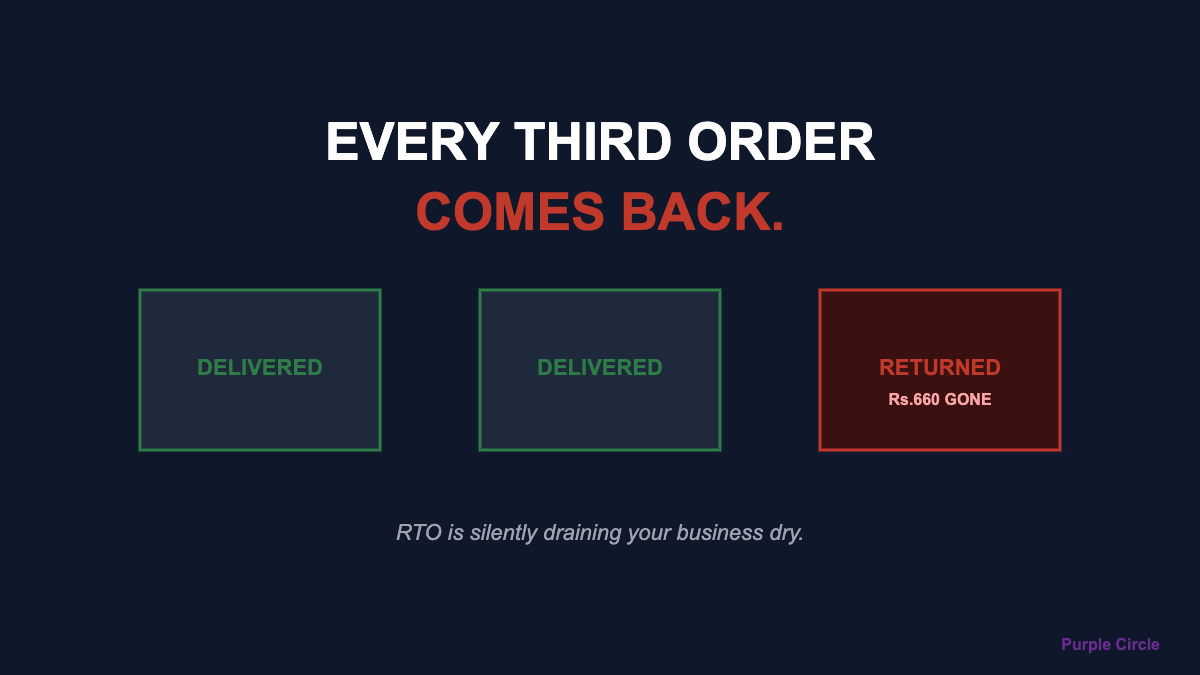
RTO (Return to Origin) is the single biggest profit killer for Indian ecommerce businesses in 2026. India’s average RTO rate runs between 25% and 40%, depending on category — meaning one in every three or four orders you ship comes right back to your warehouse. Each RTO order doesn’t just lose the sale. It costs you the ad spend, outbound shipping, return shipping, packaging, and often the product itself. On a ₹1,000 order, a single RTO can cost you ₹660 or more. The root cause isn’t bad logistics. It’s COD dependency.
You spend ₹500 on ads. Ship the order.
Customer refuses at the door.
₹660 gone. Every third order.
Brands don’t die loudly. They bleed quietly until the cash runs out.
The number no one talks about at D2C events
Every D2C event in India has a founder on stage sharing their revenue number. ₹50 lakhs a month. ₹2 crore. ₹5 crore. What they don’t share is how much of that revenue actually stays.
You spend ₹5 lakhs on Meta ads. You generate 1,000 orders. You ship all 1,000. Then 300 to 400 come back. The customer wasn’t home. Wrong address. Changed their mind. Never intended to buy — it was a COD impulse order placed at 2 AM. You just funded a logistics round trip for nothing. And you need to spend more on ads to replace the lost revenue. That’s the spiral — and it’s the same pattern we see in stores with great ROAS that still lose money.
What does one RTO order actually cost you?
| Cost item (₹1,000 product) | Amount |
|---|---|
| Ad spend to acquire customer | ₹400–500 |
| Outbound shipping | ₹70–80 |
| Return shipping | ₹70–80 |
| Packaging materials | ₹25–30 |
| Product damage / devaluation | ₹100–200 |
| Opportunity cost (inventory tied up 2–3 weeks) | ₹~150 |
| Total loss per RTO order | ₹660+ |
You didn’t just make zero on that order — you went deeply negative. And if your RTO rate is 30%, that means roughly one in three orders is doing this to your P&L. Understanding your real breakeven ROAS becomes impossible when a third of shipped orders come back.
Why is RTO so high in India?
1
COD Dependency
Zero commitment at checkout. 25–30% RTO on COD vs 3–4% on prepaid.
2
Fake Orders
Competitors, bots, repeat offenders. 8–12% of fashion volume.
3
Bad Addresses
No standard format. Undeliverable = same cost as refusal.
4
Late Delivery
Promise 3 days, deliver in 7. Customer already bought elsewhere.
COD vs Prepaid: the gap that explains everything
30%
RTO on COD orders
4%
RTO on prepaid orders
Moving 20% of your COD orders to prepaid can cut your overall RTO rate in half.
RTO rates by category in India
| Category | RTO rate | Risk |
|---|---|---|
| Fashion & Apparel | 30–40% | ⚠️ Critical |
| Electronics & Accessories | 25–30% | ⚠️ High |
| Beauty & Personal Care | 18–22% | Medium |
| Home & Kitchen | 15–20% | Medium |
| Health & Wellness | 10–15% | ✅ Lower |
If you’re in fashion, you’re fighting the hardest version of this problem. This is exactly why most t-shirt brands in India fail — high RTO on top of already thin margins.
How RTO kills a business slowly
Month 1–3: Revenue looks great. ROAS looks healthy. But 30% of shipped orders are coming back. Your Shopify dashboard shows revenue; it doesn’t show the ₹660 you lost on every returned order.
Month 4–6: Cash gets tight. You’re spending more on ads because a third of your “sales” are round trips. You blame rising CAC. The real problem is in your warehouse.
Month 7–12: You cut ad spend because cash is low. Revenue drops. You discount to move old stock — which attracts more impulse COD buyers who are even more likely to RTO. The spiral tightens.
How to fix your RTO rate: 7 things that actually work
1. Move COD to prepaid aggressively. Offer partial prepaid (₹50–100 advance), prepaid discounts (₹30–50 off), or free shipping for prepaid only. A 20% shift from COD to prepaid can cut your overall RTO rate in half.
2. Run order verification on every COD order. Automated WhatsApp or IVR confirmation within 30 minutes. Orders that don’t confirm in 12–24 hours get cancelled before you spend a rupee on shipping. This alone filters 40–60% of junk orders.
3. Blacklist repeat RTO customers. Anyone with 2+ RTOs in 90 days goes to prepaid-only or blocked. Stop treating repeat offenders like first-time buyers.
4. Fix address validation at checkout. Pin-code verification, Google Maps autofill, phone number verification. A wrong address costs you the same as a refusal — but it’s preventable.
5. Set delivery expectations honestly. If delivery takes 7 days, say 7 days. Late deliveries are one of the top controllable RTO causes.
6. NDR management. When a first delivery fails, trigger an immediate WhatsApp message for rescheduling. Brands that handle NDR aggressively recover 25–40% of otherwise-RTO orders.
7. Treat RTO as a P&L metric. Put a rupee cost on every RTO. Track it weekly. Once the founder sees 300 RTOs = ₹2 lakh in actual loss, the urgency changes. It’s the same principle behind tracking MER instead of platform ROAS — measure what the bank sees, not what the dashboard shows.
RTO isn’t a logistics problem.
It’s the most expensive line item you’re not measuring.
We fix the leak first. Then we scale.
Purple Circle — Profit-First Performance Marketing for D2C Brands
FAQ
What is RTO in ecommerce?
RTO stands for Return to Origin — the shipped order was not delivered and came back to the seller’s warehouse, either because the customer refused, wasn’t available, or the address was wrong.
What is the average RTO rate in India?
Between 25% and 40%, depending on category. Fashion and apparel have the highest rates (30–40%). COD orders drive most of the RTO volume.
How much does one RTO order cost?
On a ₹1,000 product, a single RTO can cost ₹660+ when you add up ad spend, outbound shipping, return shipping, packaging, and product damage.
How can I reduce RTO in my ecommerce store?
Move customers from COD to prepaid, run automated order confirmation on COD orders, blacklist repeat RTO offenders, and manage NDR aggressively to recover failed deliveries.
Why is COD the main cause of high RTO?
COD means zero financial commitment at checkout. Impulse orders, fake addresses, and “I’ll decide when it arrives” behavior are all COD problems. COD carries 25–30% RTO versus 3–4% for prepaid.
Related reads
- Why most t-shirt brands fail in India (the unit economics nobody talks about)
- Why your store has great ROAS but still loses money
- ROAS vs MER vs Blended ROAS: Which one actually predicts your bank balance
- Why your breakeven ROAS is higher than your US competitors’
How RTO Is Silently Killing Ecommerce Businesses in India
Trusted by 235+ brands