

I’m Getting Sales But My Profit Margin Keeps Shrinking — Why?
By Ashish Rai, CEO, Purple Circle · September 2026 · 6 min read
You’re making more sales than ever. But every month, the number left after paying for everything keeps getting smaller. This isn’t bad luck — it’s margin compression, and it’s caused by four very specific leaks that widen as you grow. The cruel irony of scaling without fixing these leaks: the more you sell, the worse the problem gets. Here’s exactly what’s happening, and how to reverse it.
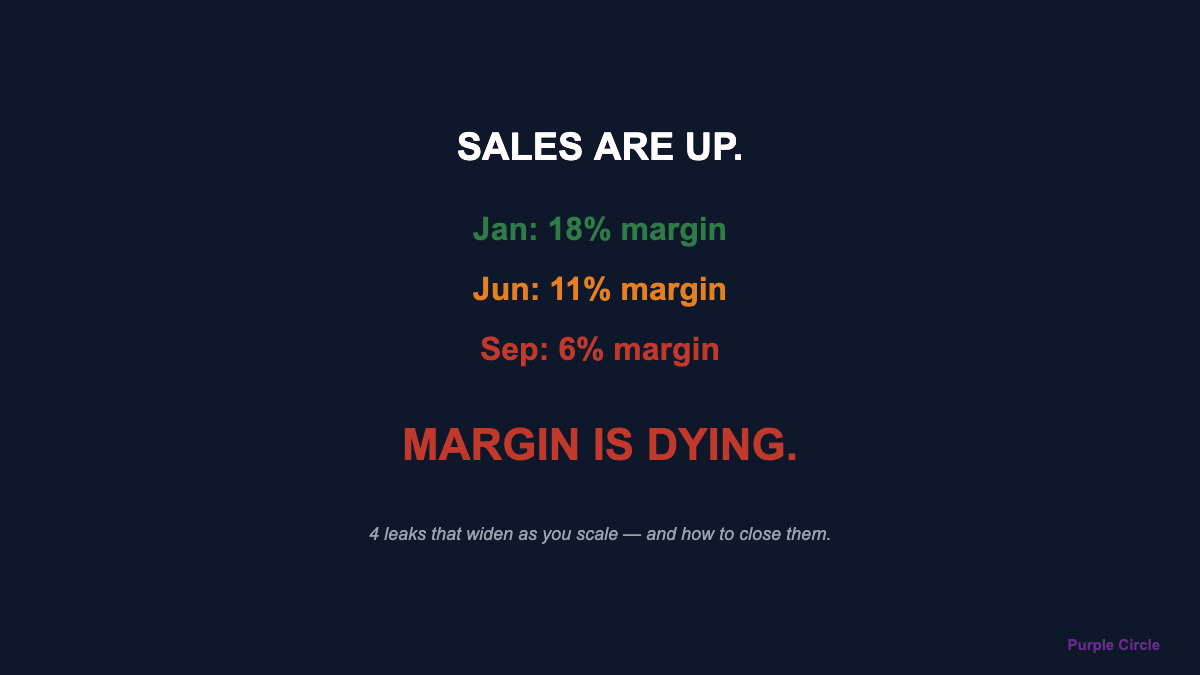
January: 500 orders. 18% margin.
June: 900 orders. 11% margin.
September: 1,200 orders. 6% margin.
More sales. Less margin. The classic D2C trap.
What margin compression actually means
Margin compression is when your net margin percentage falls even as your revenue grows. You’re not making less money in absolute terms — you might even be making slightly more. But each dollar of revenue is generating less and less profit. At some point, costs catch up and you’re in the red.
It’s different from just “losing money.” It’s a slow squeeze that happens across 6–12 months, usually invisible on a Shopify dashboard that only shows revenue and orders. By the time most founders notice it, the margin has already collapsed.
18%
Jan margin
500 orders. Sustainable.
11%
Jun margin
900 orders. Warning signs.
6%
Sep margin
1,200 orders. Danger zone.
0%
Next?
If nothing changes.
The 4 leaks that compress your margin as you scale
Leak 1: CAC inflation. As you scale ad spend, you exhaust your best-converting audiences first. The algorithm reaches colder, less qualified buyers at higher CPMs. CAC that started at $22 becomes $38, then $52. Your margin equation assumed $22 CAC. At $52, it doesn’t work. This is exactly why ads stop working when you increase the budget — it’s not the creative, it’s the economics of audience saturation.
Leak 2: Discount depth creep. Month 1: 10% off welcome popup. Month 3: 15% off to hit revenue target. Month 6: 20% off flash sale, 15% loyalty discount, 10% bundle deal running simultaneously. You’ve quietly moved from 10% average discount depth to 18%. On a 42% gross margin, that extra 8% discount eats nearly a fifth of your margin on every order. And the worst part: customers are now trained to never pay full price again.
Leak 3: Return rate rise. More volume means broader audience. Broader audience means more impulse buyers. More impulse buyers means higher return rates. A 12% return rate at launch becomes 19% at scale. Each return costs you the outbound shipping, return shipping, and product devaluation. At 19%, you’re losing 3–6 points of margin per month purely in return logistics. This compounds with every other cost in your stack.
Leak 4: Fixed cost dilution reversal. Early on, fixed costs (team, software, warehouse) are spread across fewer orders — you scale into them. But past a certain point, you hire ahead of growth. Headcount, new tools, larger warehouse space. Fixed costs jump, but orders don’t scale proportionally. The math that worked at 500 orders breaks at 1,200 orders when fixed costs have doubled.
How to find which leak is hitting you hardest
| Metric to pull | What it tells you | Healthy range |
|---|---|---|
| Blended CAC (ad spend ÷ new customers) | CAC inflation speed | <25% of AOV |
| Avg discount depth (discount ÷ gross revenue) | Discount creep | <10% |
| Return rate (returns ÷ orders shipped) | Return cost impact | <15% apparel |
| Fixed cost per order (overhead ÷ orders) | Fixed cost leverage | Falling over time |
Track all four monthly. The one rising fastest is your primary leak. Fix that first, then the next. If you’ve been growing revenue while profit falls, it’s almost always two or more of these compounding simultaneously.
The margin compression reversal playbook
WHAT MOST BRANDS DO
- Run more sales to hit revenue targets
- Increase ad spend to acquire more customers
- Add SKUs to increase AOV
- Hire more team to handle volume
- Margin continues to compress
WHAT ACTUALLY WORKS
- Cap discount depth and hold it
- Fix return rate before scaling SKUs
- Know breakeven ROAS before raising spend
- Build repeat rate to lower effective CAC
- Scale only when margin is stable
The real fix: stop measuring revenue, start measuring margin per order
The metric that kills margin compression is contribution margin per order, tracked weekly. Not revenue. Not ROAS. Not order count. What does each order leave after COGS, shipping, fees, your blended CAC, and your average discount? That number, tracked weekly, will show you exactly when a leak opens and where it’s coming from.
If contribution margin per order is rising — you’re winning. If it’s flat while revenue grows — watch closely. If it’s falling — stop scaling and find the leak. Your agency’s ROAS screenshot won’t show you any of this. It’s the number your dashboard was never built to show.
Sales fix your revenue.
Margin fixes your business.
We find the leak before it becomes a collapse.
Purple Circle — Profit-First Performance Marketing for D2C Brands
FAQ
Why is my profit margin shrinking even though sales are growing?
Because scaling amplifies cost leaks — CAC inflation, discount depth creep, rising return rates, and fixed cost jumps. Each leak is small at low volume; at high volume they compound and squeeze margin faster than revenue grows.
What is a good profit margin for an ecommerce store?
15–20% net margin is healthy for D2C. Below 10%, one bad month eliminates profit entirely. Below 5%, scaling is dangerous — you’re paying for growth that doesn’t survive a cost shock.
How do I stop my ecommerce margins from shrinking?
Track contribution margin per order weekly. Identify which of the four leaks is rising fastest: CAC, discount depth, return rate, or fixed cost per order. Cap the worst leak first, then scale.
What is contribution margin in ecommerce?
Revenue minus variable costs per order — COGS, shipping, payment fees, ad cost, and discounts. It’s what each order actually leaves before fixed costs. The only number that tells you if growth is adding or destroying value.
Related reads
- $50K/month in revenue but no cash in the bank? Here’s where it goes
- My Shopify store is growing but I’m making less money every month
- Why do my ads stop working every time I increase the budget?
- Why your store has great ROAS but still loses money
- Why your agency’s ROAS screenshot means nothing
- ROAS vs MER vs Blended ROAS
I’m Getting Sales But My Profit Margin Keeps Shrinking — Why?
Trusted by 235+ brands