

Why Most T-Shirt Brands Fail in India (The Unit Economics Nobody Talks About)
By Ashish Rai, CEO, Purple Circle · Updated August 2026 · 5 min read
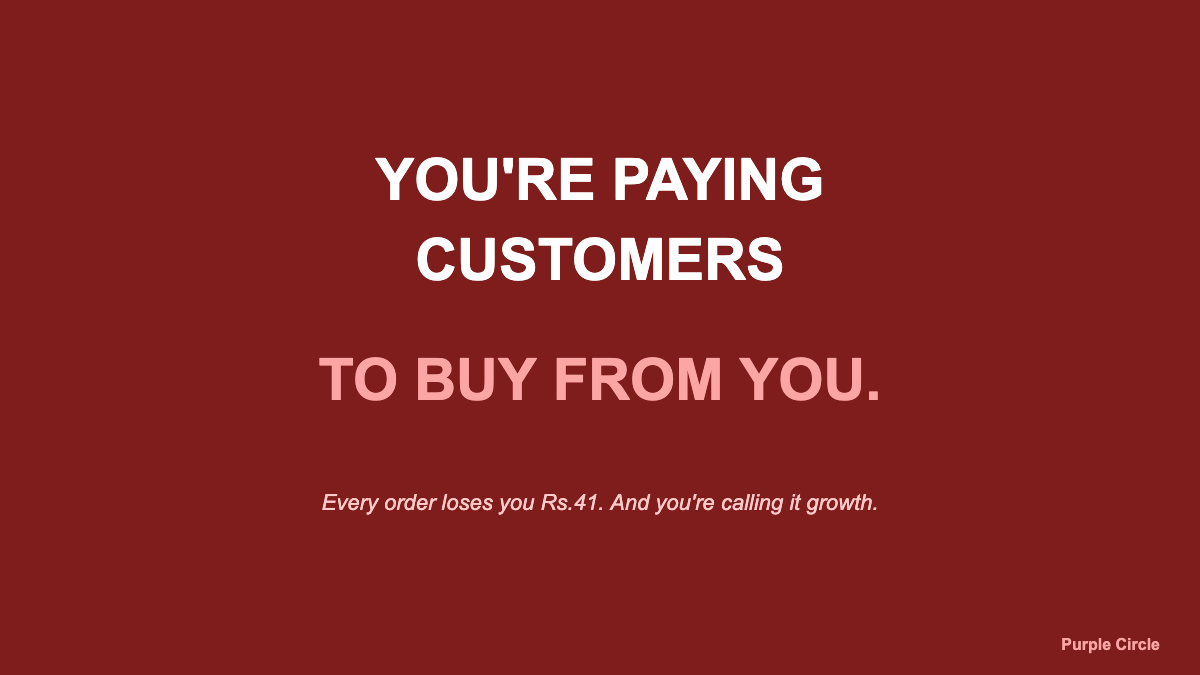
You sell a t-shirt for ₹499. It costs you ₹520 to sell it. Every single order. You’re not building a brand. You’re funding a logistics company. And this is exactly why most Indian t-shirt brands die within 18 months — not because of bad designs or weak marketing, but because the unit economics were broken before the first order shipped.
You sell a t-shirt for ₹499.
It costs you ₹540 to sell it.
Every. Single. Order.
This is why 90% of Indian t-shirt brands die within 18 months.
The ₹499 t-shirt that loses money on every order
Let’s run the actual P&L on a ₹499 t-shirt. Not theory. The real numbers most founders skip before launching.
| Cost item | Amount |
|---|---|
| Product cost (COGS) | ₹160 |
| Shipping outbound | ₹75 |
| Meta ads / CAC | ₹120 |
| Packaging | ₹20 |
| Payment gateway + GST | ₹40 |
| RTO cost (30% of orders) | ₹65 |
| Marketplace commission | ₹60 |
| Total cost per order | ₹540 |
| Loss per order | -₹41 |
Now scale that. 2,000 orders a month at a ₹41 loss = ₹82,000 lost every month. And the founder thinks they’re “growing.” The Shopify dashboard shows ₹10 lakh revenue. The bank account shows something very different. This is the same pattern we see in brands with great ROAS that still lose money — the dashboard lies when you don’t count all costs.
Why scaling makes it worse, not better
| Monthly orders | Revenue | Actual loss |
|---|---|---|
| 100 | ₹49,900 | -₹4,100 |
| 500 | ₹2,49,500 | -₹20,500 |
| 1,000 | ₹4,99,000 | -₹41,000 |
| 2,000 | ₹9,98,000 | -₹82,000 |
| 5,000 | ₹24,95,000 | -₹2,05,000 |
The faster you grow, the faster you bleed. Revenue doubles. Loss doubles with it.
Most founders believe scale will fix the economics. “Once we hit 5,000 orders, we’ll negotiate better shipping rates.” The shipping rate drops ₹5–10. The loss per order is ₹41. You’re still underwater. Scaling a broken unit economics model doesn’t fix it — it accelerates the death.
The 3 things killing Indian t-shirt brands
1
ASP Too Low
You can’t run a profitable D2C brand at ₹499. Bewakoof and marketplace labels can — you can’t.
2
Zero Repeat
T-shirts are commodity. No loyalty at ₹499. Every sale costs full CAC. No payback ever.
3
30% RTO
1 in 3 orders comes back. Each RTO costs ₹150+. This alone kills your margins.
ASP is too low. You cannot run a profitable D2C brand at ₹499 in India. Not with current ad costs, not with current shipping costs, not with 30% RTO rates. The math physically doesn’t work.
Zero repeat purchases. T-shirts are commodity products. Customers have almost no brand loyalty at the ₹499 price point. So every single sale costs you full CAC. There’s no second order to recover the acquisition cost. Your CAC payback period is infinite because there’s no payback.
30% RTO. One in three orders comes back. Each RTO costs you ₹150+ in wasted shipping, packaging, and product damage. On top of the ad spend you already burned. RTO alone turns a thin-margin business into a negative-margin business.
So what actually works?
The brands that survive aren’t the ones with the best designs. They’re the ones that fix the math before scaling.
Raise your ASP. You need to be at ₹799–999 minimum. That means building a brand worth paying for — better fabric, better design, better positioning. Not competing on price with funded marketplaces.
Build repeat before you scale. A customer who buys twice halves your effective CAC. Drops, limited editions, subscription models, WhatsApp community — whatever gets a second purchase in month one.
Fix RTO before spending on ads. COD verification, address validation, prepaid incentives. Cut RTO from 30% to 12% and that alone can swing your per-order math from negative to positive.
Stop scaling losses. If your contribution margin is negative, no amount of ad spend fixes it. Fix the economics at 500 orders. Then scale to 5,000. This is the same principle behind understanding your real breakeven ROAS — you can’t outspend bad math.
What changes when the math is fixed
BEFORE
| ASP | ₹499 |
| CAC | ₹120 |
| RTO rate | 30% |
| Repeat rate | 8% |
| Contribution margin | -₹41 |
| Monthly P&L | -₹82,000 |
AFTER
| ASP | ₹899 |
| CAC | ₹95 |
| RTO rate | 12% |
| Repeat rate | 22% |
| Contribution margin | +₹180 |
| Monthly P&L | +₹3.6L |
Same brand. Same products. Same team. Different math. We’ve seen this pattern at Purple Circle — t-shirt brands come spending ₹3–5 lakh on ads, posting ₹10–15 lakh revenue, and bleeding cash. The fix is never “better ads.” It’s fixing the gap between platform ROAS and real MER first.
Your t-shirt brand doesn’t have a marketing problem.
It has a unit economics problem.
We fix the math first. Then we scale.
Purple Circle — Profit-First Performance Marketing for D2C Brands
FAQ
Why do t-shirt brands fail in India?
Most fail because the unit economics don’t work at Indian price points (₹399–499). By the time you subtract COGS, shipping, ads, RTO, and fees, you lose money on every order. Scaling just scales the loss.
What is a good ASP for a D2C t-shirt brand in India?
You need ₹799–999 minimum to have positive contribution margin after all costs including RTO. Below ₹699, the math is nearly impossible without funded marketplace-level scale.
How much does RTO cost a t-shirt brand?
Each RTO costs ₹150+ in wasted shipping, packaging, and product damage — on top of the ad spend already burned. At a 30% RTO rate, this alone can turn a thin-margin business into a money-losing one.
Can a t-shirt brand be profitable in India?
Yes — but only if unit economics are fixed first. That means ASP above ₹799, RTO below 15%, repeat purchase rate above 20%, and CAC under ₹100. Fix these four numbers and the business works.
Related reads
- How RTO is silently killing ecommerce businesses in India
- Why your store has great ROAS but still loses money
- ROAS vs MER vs Blended ROAS: Which one actually predicts your bank balance
- Why your breakeven ROAS is higher than your US competitors’
Why Most T-Shirt Brands Fail in India (The Unit Economics Nobody Talks About)
Trusted by 235+ brands