

Is Quick Commerce Profitable for My D2C Brand?
By Ashish Rai, CEO, Purple Circle · October 2026 · 10 min read
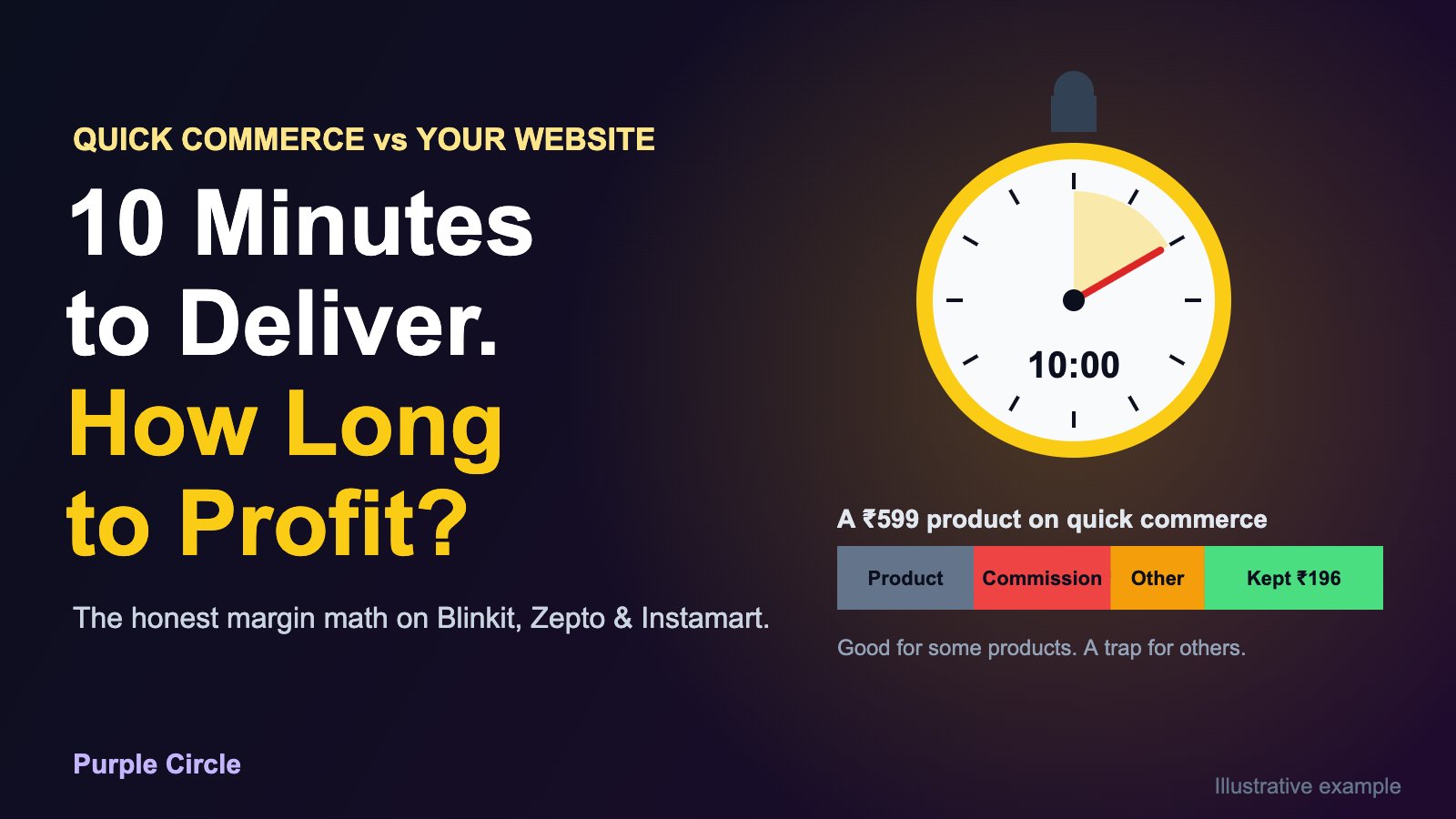
Quick commerce can be profitable for a D2C brand, but usually only for products with a high gross margin, roughly 70% or more, and a low price that customers buy often. After commission, in-app ads, freight and stock write-offs, a ₹599 product can keep about a third of its price on Blinkit, Zepto or Instamart. That works for a high-margin skincare product and barely works for a lower-margin apparel basics pack. Your own website usually makes less on the first order but far more on every repeat. Quick commerce is a strong channel. It’s rarely a complete strategy.
⚡ The 30-second version
- Commission is only the first line. Ads, listing fees, freight and unsold stock sit on top.
- Quick commerce works best for high-margin, frequently bought products. It’s tough for low-margin ones.
- Quick commerce often wins the first order. Your website wins on repeat orders, because you own the customer.
- The smartest brands use both: quick commerce for reach and trial, the website for margin and loyalty.
Every D2C founder in India has had this conversation in the last year. A category manager calls. Ten-minute delivery. Hundreds of dark stores. Lakhs of shoppers who already have the app open. It sounds like the answer to rising Meta costs.
Sometimes it is. Sometimes it’s a very fast way to sell a lot and keep very little. The delivery takes ten minutes. Understanding the fee statement takes a bit longer.
What quick commerce actually costs
The commission rate is what everyone negotiates. It’s also, as StartupTalky puts it, the smallest number in the deal. Platforms commonly quote 15–25% commission, and the rest of the cost stack sits on top. Reported practices include a per-SKU listing fee on Blinkit that is credited back as ad-wallet money rather than cash, according to eChai. Terms vary by platform, category and negotiation, so treat every number below as something to check against your own contract.
Here’s an illustrative ₹599 skincare product on quick commerce, net of GST, with a product cost of ₹150 (75% gross margin). This is not client data.
Where ₹599 goes on quick commerce
25% commission ₹150 · in-app ads at 10% of sales ₹60 · freight to warehouses and dark stores ₹25 · damages, expiry and unsold returns ₹18 · ₹196 kept (33%)
GST charged on commission is usually claimable as input credit if you’re GST-registered, so it’s left out here, but it still ties up cash until you claim it. Check with your CA. Illustrative.
The 70% rule: why category decides everything
Run the same ₹599 price and the same platform costs on a lower-margin product, and the picture changes fast.
This is why the brands that do well on quick commerce cluster in categories with pricing power and high per-unit margins, like beauty, personal care and premium snacking. Industry commentary often puts the comfort zone at around 70% gross margin or more. Below that, quick commerce tends to bring revenue without much profit.
Quick commerce vs your website: a fair comparison
Neither channel is the hero or the villain. Each one is good at different things.
| What matters | ⚡ Quick commerce | 🌐 Your website |
|---|---|---|
| Speed to customer | ✓ Minutes. Unbeatable for impulse and urgent needs. | ✗ Days, depending on courier and pin code. |
| Reach and discovery | ✓ Shoppers already in the app, ready to buy. | ✗ You pay to bring every new visitor. |
| COD and RTO | ✓ Customer pays the platform. No RTO for you. | ✗ COD refusals and shipping both ways. |
| Margin per order | ✗ Commission, ads, fees and write-offs on every sale. | ✓ You keep the full price, minus your own costs. |
| Customer data | ✗ The platform owns it. You see little. | ✓ Name, number, email, purchase history. Yours. |
| Repeat purchases | ✗ Customers come back to the platform, not to you. | ✓ You can bring them back yourself, for nearly nothing. |
| Range and order value | ✗ Limited SKUs per dark store, mostly single units. | ✓ Full catalogue, bundles, free-shipping thresholds. |
| Pricing control | ✗ Platform promotions and discount pressure. | ✓ You set prices and offers. |
| Inventory and cash | ✗ Stock spread across cities, unsold stock can come back. | ✓ One or a few warehouses you control. |
| Upfront cost to start | ⚖️ No site or CRO needed, but listing fees, ad-wallet commitments and stock in dark stores can tie up lakhs. | ✗ Site, tracking, CRO and acquisition spend. |
First order vs repeat order: where the real difference is
To compare fairly, we need the website’s numbers for the same skincare brand. On the website, customers often add a second item to reach a free-shipping threshold, so say the average order is ₹1,099. Product cost is ₹300. Shipping and packing is ₹100, fees are about 3%, RTO is 20%, and Meta spends ₹380 to win each order.
| Per order | ⚡ Quick commerce | 🌐 Website |
|---|---|---|
| Order value | ₹599 | ₹1,099 |
| Product + platform or delivery costs | ₹403 | ₹488 |
| Ads to win the first order | incl. above | ₹475 |
| Profit on the first order | ₹196 | ₹136 |
| Cost to bring them back (WhatsApp, email) | in-app ads again | ~₹20 |
| Profit on each repeat order | ₹196 | ₹591 |
Website RTO and Meta cost are spread over delivered orders, as in our CM1 and CM2 guide. Illustrative.
Quick commerce wins the first order, fair and square. No ad battle, no RTO, no shipping. The website wins on every order after that, because the second purchase doesn’t need Meta at all. That one difference changes the whole picture over a year.
12-month profit per customer, by how often they buy again
₹196
₹136
₹225
₹225
₹294
₹432
₹392
₹727
Assumes the same repeat rate on both channels. Website: ₹136 + ₹591 per repeat. Quick commerce: ₹196 per order. Illustrative.
In this example, the website overtakes quick commerce as soon as about 15 in every 100 customers buy one more time. For a product people genuinely like, that’s a low bar. If your customers never buy again, quick commerce looks better, but then the problem isn’t the channel.
When quick commerce makes sense, and when it doesn’t
How to use quick commerce without hurting your profit
Why your website still matters for long-term sales
Quick commerce rents you customers. Your website lets you keep them. Over a year or two, that difference compounds.
The best setup for most Indian D2C brands isn’t either-or. Use quick commerce for reach, trial and urgent purchases on your highest-margin SKUs. Build your website as the place where customers come back, buy more, and become worth more every year. If you’re not sure your website already makes money on each order, start with why stores stay unprofitable.
FAQ
Is quick commerce profitable for D2C brands?
It can be, mainly for products with high gross margins, around 70% or more, that are bought often. After commission, ads, freight and write-offs, lower-margin products often keep very little.
How much commission do Blinkit, Zepto and Instamart charge?
Reported rates are commonly around 15–25% of selling price and can be higher depending on category, with listing fees, ads and other costs on top. Always check the exact terms for your category.
Should I sell on quick commerce or my own website?
Usually both. Quick commerce is strong for reach, trial and urgent purchases. Your website is better for margin, repeat orders and owning customer data.
Is quick commerce good for clothing brands?
It’s harder for most apparel, because sizes, variants and lower margins push up write-offs and squeeze profit. Simple, high-margin basics and accessories have a better chance than fitted styles.
Why is a D2C website important for long-term sales?
It lets you own customer data, bring buyers back cheaply, sell bigger baskets, control pricing and avoid dependence on a single platform, all of which compound over time.
Weighing quick commerce against your own website? Purple Circle can run the per-SKU math with you before you list. You can also see how we work in our case studies.
— Ashish Rai, CEO, Purple Circle