

How to Choose Apparel Products Using CM1 and CM2
By Ashish Rai, CEO, Purple Circle · October 2026 · 9 min read
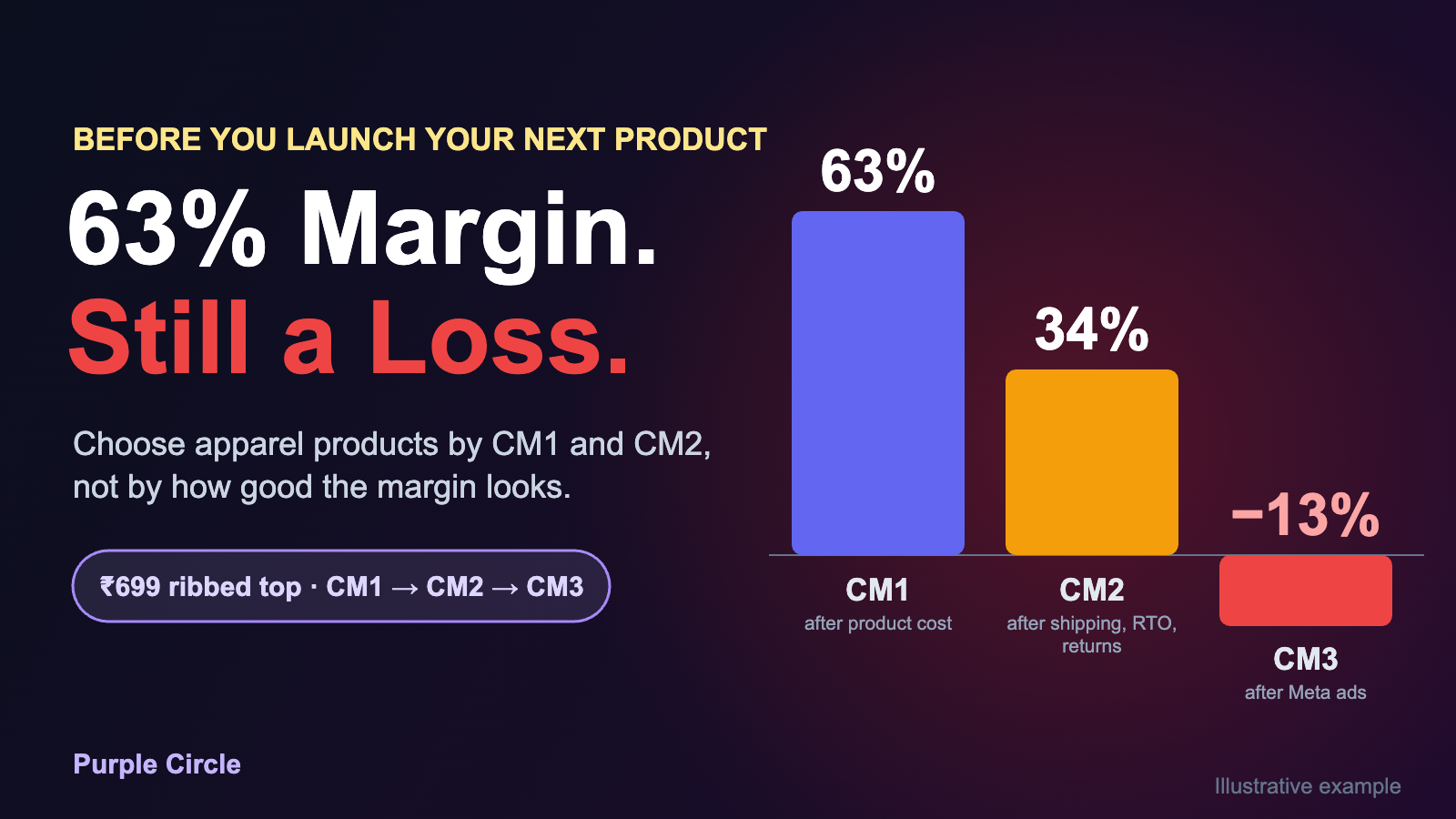
Choose apparel products by what they keep after every cost, not by their product margin. CM1 is what’s left after product cost. CM2 is what’s left after shipping, payment fees, RTO and returns. CM3 is what’s left after ads. Set a minimum CM2 your ads can live with, work backwards to a minimum CM1 for each price band, and only launch or scale products that clear both. In the example below, a ₹699 top with a 63% product margin ends up losing 13% of every order once everything is counted.
Most apparel founders pick products the way they’d pick for their own wardrobe: what looks good, what’s trending, what the factory can make cheaply. Margin gets checked once, as “selling price minus product cost”, and if it looks healthy the product goes live. That one number is where a lot of loss-making catalogues start.
What CM1, CM2 and CM3 mean for an apparel brand
Contribution margin is simply what a sale contributes after the costs that sale caused. Breaking it into levels shows you exactly where money leaves.
Different brands draw these lines slightly differently. Some put packaging in CM1, some put returns in CM3. That’s fine. What matters is that you use the same definitions every time, so products are compared fairly.
Why CM1 alone picks the wrong products
Here’s an illustrative example of a women’s western wear store choosing between three products. This is not client data. All prices are net of GST. Every product pays ₹100 for shipping and packing, about 3% in payment and COD fees, and ₹180 in shipping both ways on each RTO. That RTO cost is spread over the orders that do get delivered. Size exchanges cost ₹220 each, for reverse pickup plus re-shipping.
| Per delivered order | Ribbed top | Co-ord set | Bodycon dress |
|---|---|---|---|
| Net selling price | ₹699 | ₹1,799 | ₹1,499 |
| Landed product cost | ₹260 | ₹560 | ₹420 |
| CM1 | ₹439 (63%) | ₹1,239 (69%) | ₹1,079 (72%) |
| Shipping & packing | ₹100 | ₹100 | ₹100 |
| Payment / COD fees | ₹21 | ₹54 | ₹45 |
| RTO cost (25% / 18% / 25% RTO) | ₹60 | ₹40 | ₹60 |
| Exchanges (8% / 10% / 22%) | ₹18 | ₹22 | ₹48 |
| CM2 | ₹240 (34%) | ₹1,023 (57%) | ₹826 (55%) |
| Meta ads per delivered order | ₹333 | ₹549 | ₹533 |
| CM3 | −₹93 (−13%) | +₹474 (26%) | +₹293 (20%) |
On CM1, the bodycon dress wins and the ribbed top looks perfectly respectable at 63%. On CM2, the order changes. The dress’s fitted cut drives 22% exchanges, and the top’s low price can’t carry the fixed ₹100 shipping and ₹60 of RTO cost. On CM3, the top loses ₹93 on every delivered order.
Same three products, ranked three ways
63%
34%
−13%
69%
57%
26%
72%
55%
20%
Best on CM1: the dress. Best on CM2 and CM3: the co-ord set. Illustrative.
Notice the gap between CM1 and CM2 for each product. It’s about 29 points on the ₹699 top, 12 on the co-ord set and 17 on the dress. Low-priced products and products that fit badly lose the most between CM1 and CM2. We broke down the low-price side of this in why you lose money on orders under ₹999.
How to set your CM1 and CM2 floors
Don’t copy a margin target from someone else’s brand. Work backwards from what your ads cost you.
Step 1: Pick your CM3 target. The share of each order you need left after ads. Say 15%.
Step 2: Find your ad cost as a % of net revenue on delivered orders. Say 30% (roughly 3.3x ROAS on delivered revenue).
CM2 floor = CM3 target + ad cost % = 15% + 30% = 45%
Step 3: Add the CM1 → CM2 gap for that price band and fit.
CM1 floor = CM2 floor + (shipping + fees + RTO + returns, as % of price)
| Product | CM1 → CM2 gap | CM1 floor needed | Actual CM1 |
|---|---|---|---|
| Ribbed top · ₹699 | 29 pts | 74% | 63% ✗ |
| Bodycon dress · ₹1,499 | 17 pts | 62% | 72% ✓ |
| Co-ord set · ₹1,799 | 12 pts | 57% | 69% ✓ |
This is the key idea: there is no single “good margin” for a clothing brand. The cheaper the product and the riskier the fit, the higher the CM1 it needs. A 63% product margin is excellent on a ₹1,800 co-ord set and a loss on a ₹699 top.
Use your own numbers for RTO and returns by category. If you’re not sure where yours sit, our breakdown of how RTO eats ecommerce margins shows where to find them. National averages are only a starting point: Amazon Shipping India puts COD RTO at 28–35% on average.
Give every product a role
Once you have CM2 and CM3 for each product, you don’t have to treat them all the same. Decide what each one is for.
This is the same thinking behind why your best-selling product may not be making any profit. A product’s job should match its margin.
A pre-launch checklist for new apparel products
Run every new style through this before you place the production order, not after the stock arrives.
Mistakes that make good-looking products lose money
| Mistake | Why it hurts |
|---|---|
| Calculating margin on MRP | Most units sell after a discount. CM1 must use the real selling price. |
| One margin target for every product | A ₹699 top and a ₹1,799 set need very different CM1 floors. |
| Ignoring fit when choosing products | In our example, exchanges cost the fitted dress more than twice what they cost the co-ord set. |
| Leaving RTO out of product costs | RTO is a per-product cost, not a logistics overhead. |
| Picking the ad hero by CM1 | The highest product margin is not always the highest margin after delivery. |
If you want to see these numbers at store level first, start with how to know if your D2C business is actually profitable.
FAQ
What are CM1 and CM2 in ecommerce?
CM1 is net selling price minus product cost. CM2 is CM1 minus the cost to deliver and keep the sale: shipping, packaging, payment and COD fees, RTO and returns. CM3 then takes off marketing.
What is a good CM1 for a clothing brand?
There’s no single number. Work backwards from your ad cost and target profit. Cheaper and fitted products need a higher CM1. In our example the floor ranges from 57% for a ₹1,799 co-ord set to 74% for a ₹699 top.
Which costs go into CM2 for apparel?
Forward shipping, packaging, payment gateway and COD fees, the cost of RTO orders spread over delivered orders, and the cost of returns and size exchanges.
Should I launch a product with a low CM2 if it sells well?
Not as an ad hero. Use it as an add-on or in bundles, where it doesn’t need to carry its own ad cost, or re-price it until CM2 clears your floor.
How often should I recalculate CM1 and CM2?
Whenever prices, discounts, shipping rates or return rates change, and at least before every new collection and every festive season.
If you’d like help setting CM1 and CM2 floors for your catalogue before your next launch, Purple Circle can work through the numbers with you. You can also see how we work in our case studies.
— Ashish Rai, CEO, Purple Circle