

Why Is My Store Still Not Profitable After One Year?
By Ashish Rai, CEO, Purple Circle · October 2026 · 10 min read
Most stores aren’t profitable after a year because the profit each order leaves after ads (CM3) doesn’t cover the fixed costs that grew alongside them: team, warehouse, tools and agency. The fix is rarely “more orders”. It’s usually better orders: bigger baskets, less RTO, the right products in your ads and fewer discounts. In the example below, a store doing 1,500 orders a month loses ₹1.8 lakh every month. Raising profit per order from ₹180 to ₹318 turns that into a profit, without a single extra order.
⏳ The 30-second version
- Profit = (profit per order after ads × orders) − fixed costs. Most founders only watch the middle bit.
- Break-even orders = monthly fixed costs ÷ profit per order. Work this out today.
- Growing orders is the expensive way out. Growing profit per order is usually the faster one.
- The usual leaks: ROAS mistaken for profit, wrong products in ads, small orders, discounts, RTO, and fixed costs that crept up.
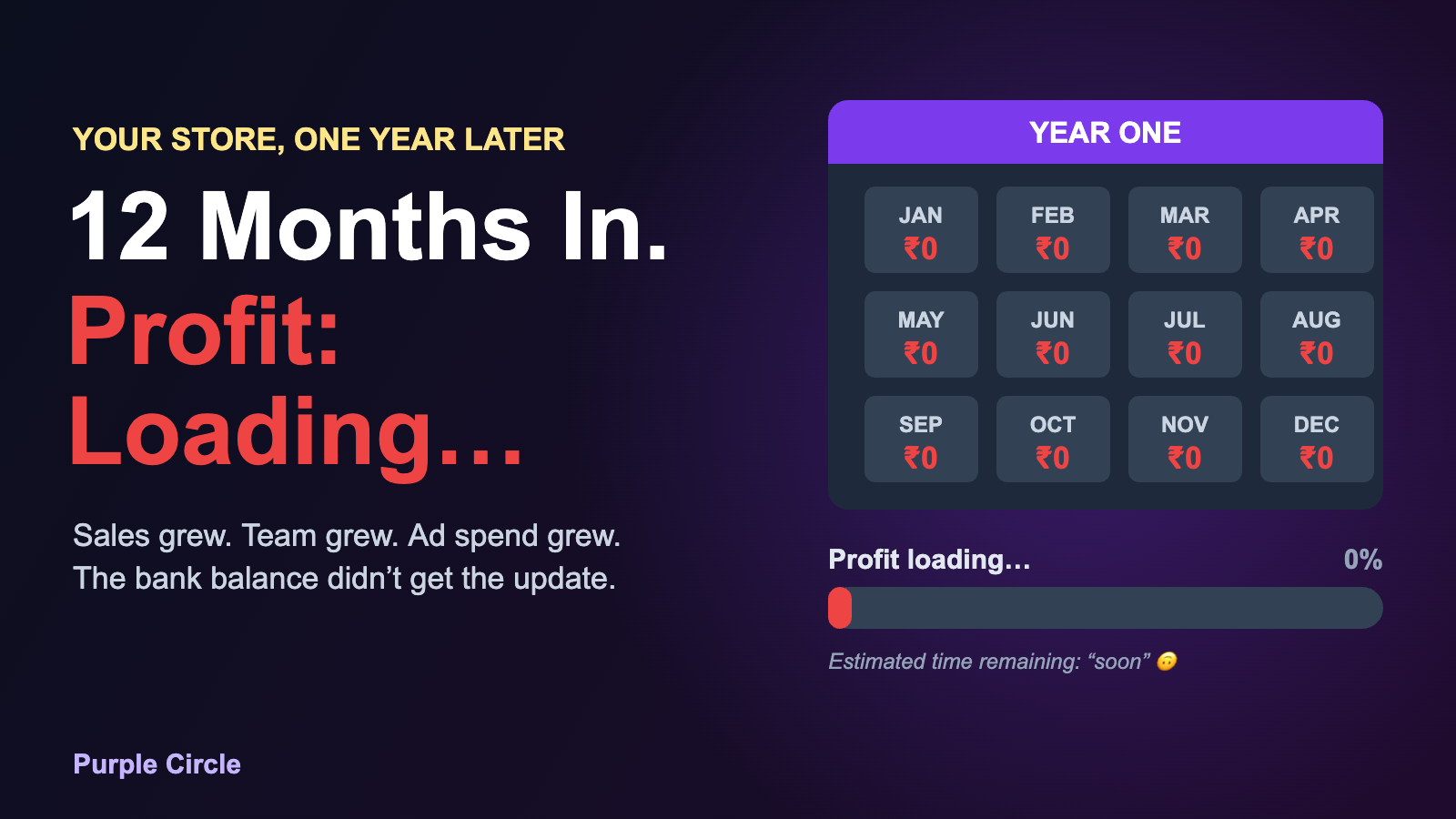
Year one was a lot. You learned Shopify, survived at least one courier meltdown, became fluent in Meta Ads Manager, and can now explain RTO to your family at dinner. Sales grew. The team grew. The ad budget definitely grew.
And yet every month, the money that comes in leaves again, with a little extra for company. Profit has been “next quarter” for four quarters.
The real reason: your orders don’t cover your fixed costs
Every order leaves something after product cost, delivery, RTO, returns and ads. That’s CM3, explained in CM1, CM2 and CM3 for apparel brands. All those orders together have to pay for everything that doesn’t change with orders: salaries, rent, apps, agencies, shoots.
Here’s an illustrative D2C apparel store, 12 months in. This is not client data.
Monthly fixed costs: ₹4.5 lakh
What orders bring in: 1,500 delivered × ₹180 profit per order = ₹2.7 lakh
−₹1.8 lakh a month is −₹21.6 lakh a year. Illustrative.
Your break-even number
Break-even orders per month = monthly fixed costs ÷ CM3 per order
₹4,50,000 ÷ ₹180 = 2,500 delivered orders a month. This store does 1,500.
Two ways out, and why one is much harder
Path B isn’t glamorous. Nobody posts “we fixed our size chart” on LinkedIn. It’s also the one that works.
The six leaks that keep stores unprofitable
Use this as a health check. Any “no” is a leak, and each one has its own deep dive.
| Ask yourself | If the answer is no |
|---|---|
| 1. Do I know my profit per delivered order, not just ROAS? | Break-even ROAS with RTO |
| 2. Are my ad heroes the products with the best CM2, not the best sales? | Your bestseller may be losing money |
| 3. Is my average order big enough to carry shipping, RTO and ads? | Why orders under ₹999 lose money |
| 4. Does every product clear my CM1 and CM2 floors? | Choose products using CM1 and CM2 |
| 5. Do I sell mostly at full price, not on a permanent sale? | What discounts really cost · Diwali sale math |
| 6. Have my fixed costs grown slower than my CM3? | Read on. |
Leak six is the quiet one. In year one, costs creep up one sensible decision at a time: a new hire here, an app there, a better agency, a bigger warehouse “for the festive season”. Each one makes sense. Together they push your break-even number up faster than your orders can keep up.
How ₹180 per order becomes ₹318
Same store, same 1,500 orders, same ad budget. Four fixes, each worth a realistic amount per order. These figures are illustrative. Your own numbers will differ, but the shape usually holds.
₹180
+₹50
+₹43
+₹25
+₹20
₹318
1,500 × ₹318 = ₹4.77 lakh against ₹4.5 lakh fixed costs. From −₹1.8 lakh a month to +₹27,000, with zero extra orders.
The RTO fix is worth more than it looks, because it works twice. You stop paying shipping both ways on fewer parcels, and the same ad spend now produces more delivered orders. For pricing, the next lever after these, read why profit doesn’t always rise after a price increase.
A 90-day plan to get out of the loop
Mistakes that keep year two looking like year one
| Mistake | What actually happens |
|---|---|
| “We’ll be profitable once we scale” | If each order makes too little, scaling multiplies the problem. |
| Celebrating revenue milestones | ₹1 crore in sales sounds great. So does ₹0 in profit, apparently. |
| Hiring ahead of profit per order | Every new salary raises your break-even number permanently. |
| Treating RTO as a logistics problem | It starts in your ads and checkout, and it costs you twice. |
| Never revisiting app and tool costs | Fifteen apps at ₹3,000 each is a junior salary. |
FAQ
Why is my online store still not profitable after one year?
Usually because profit per order after ads doesn’t cover monthly fixed costs like salaries, rent, apps and agencies. Revenue can grow while that gap stays the same or gets bigger.
How do I calculate how many orders I need to break even?
Divide your monthly fixed costs by your profit per delivered order after ads (CM3). For example, ₹4.5 lakh ÷ ₹180 = 2,500 delivered orders a month.
Should I increase ad spend to become profitable?
Only if each order already makes enough profit. If profit per order is thin, more spend usually brings more orders at a higher cost each, and losses grow.
What is the fastest way to improve profitability?
Raise profit per order: bigger baskets through bundles, lower RTO, the right products in your ads, and fewer stacked discounts. These pay off without needing more orders.
How long should it take a D2C brand to become profitable?
There’s no fixed timeline. It depends on margins, order value and fixed costs. What matters is knowing your break-even number and whether the gap to it is shrinking every month.
If your store has been “almost profitable” for a while, Purple Circle can help you find your break-even number and the leaks between you and it. You can also see how we work in our case studies.
— Ashish Rai, CEO, Purple Circle