
Why Is My Customer Acquisition Cost Going Up Every Month?’—’
By Ashish Rai, CEO, Purple Circle · September 2026 · 6 min read
Rising CAC isn’t bad luck. It’s one of three predictable problems — and each one has a different fix. Most founders see CAC climbing and immediately blame Meta’s algorithm, iOS updates, or their creative. Sometimes those are factors. But the more common causes are audience saturation as you scale, discount dependency that attracts low-quality buyers, and a deteriorating return rate that inflates the true cost of every kept customer. Here’s how to diagnose which one is driving your CAC up — and what to do about it.
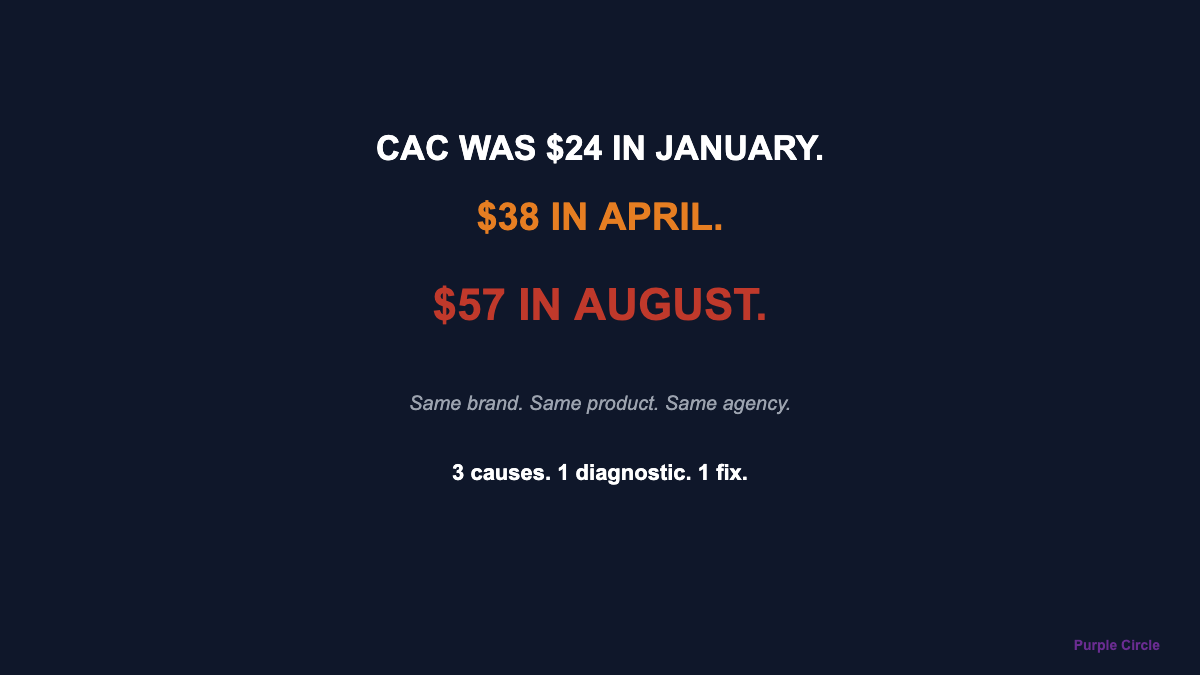
January: CAC $24. ROAS 4.1x.
April: CAC $38. ROAS 3.2x.
August: CAC $57. ROAS 2.1x.
Same brand. Same product. Same agency. The audience changed.
First: understand what CAC is actually measuring
Blended CAC = total ad spend ÷ total new customers acquired. Simple. But most brands track reported CAC from the ad platform, which double-counts customers claimed by multiple channels and ignores returns. The CAC that matters for profitability is:
Real CAC = total ad spend ÷ net new customers who kept their order
If 100 customers ordered and 18 returned, you acquired 82 kept customers. Your real CAC is spend ÷ 82, not spend ÷ 100. The gap compounds fast at scale.
If you’ve been tracking the wrong CAC, your real number is already higher than you think. And it’s directly connected to why $50K in revenue leaves almost nothing in the bank.
The 3 causes of rising CAC — and how to diagnose yours
1
Audience saturation
You’ve exhausted warm audiences. Algorithm expands to cold, low-intent buyers. CPMs climb, CVR drops.
2
Discount-trained buyers
Discounts attract impulse buyers with low LTV and high return rates. True CAC per profitable customer skyrockets.
3
No repeat purchases
When customers never buy again, every order requires full CAC. Effective CAC never comes down.
The CAC Diagnostic: 3 questions to find your cause
Is CPM rising?
If CPM is up 30%+ while your budget held steady — audience saturation. Your ads hit the spend ceiling.
Is return rate rising?
If returns climbed from 12% to 20% as you scaled — discount-trained or low-intent buyers. Real CAC is being understated.
Is repeat rate flat?
If repeat purchase rate is below 15% and hasn’t moved — every customer is a full-CAC acquisition forever. Effective CAC can never improve.
The CAC waterfall: what rising CAC actually costs you
| Scenario | CAC | Contribution margin | Profit per order |
|---|---|---|---|
| January (healthy) | $24 | $42 | $18 |
| April (warning) | $38 | $42 | $4 |
| August (danger) | $57 | $42 | –$15 |
Same contribution margin. CAC alone moved the business from profitable to loss-making.
This is the same pattern behind every brand that shows growing revenue but shrinking margins. CAC is the variable cost most founders don’t track weekly — and the one that quietly breaks the model.
How to bring CAC down — by cause
If it’s audience saturation: Don’t just test new creative — open new audience pools. New geographies, new interest clusters, new lookalike seeds from your highest-LTV customers (not just all buyers). Also fix the unit economics so you can profitably bid into colder audiences. A 10% price increase lowers your breakeven ROAS and expands your profitable spend range before saturation kicks in.
If it’s discount-trained buyers: Cap discount depth and hold it. Remove the blanket 15% off welcome popup and replace with a smaller, one-time offer tied to email capture only. Then measure what happens to return rate and repeat rate over 60 days. Discount-dependent buyers are your most expensive customers — not your best.
If it’s no repeat purchases: Effective CAC only falls when customers come back. A second purchase in month one halves your effective CAC. Build a post-purchase sequence — email, SMS, or WhatsApp — focused entirely on getting order 2 within 30 days. Track repeat rate monthly. If it’s below 15%, this is your highest-leverage fix. It’s also the fastest way to improve your real profitability picture.
The CAC fix order that actually works
WRONG ORDER
- CAC rising → test new creative
- Creative not working → increase budget
- Budget increase → CAC rises further
- Switch agencies
- Repeat until cash runs out
RIGHT ORDER
- Diagnose: CPM, return rate, or repeat rate?
- Fix the biggest leak first
- Track real CAC (net kept customers)
- Build repeat — halves effective CAC
- Scale only when CAC is stable
Rising CAC is a symptom.
Diagnosing the cause is the fix.
We find your real CAC and the leak driving it before touching your budget.
Purple Circle — Profit-First Performance Marketing for D2C Brands
FAQ
Why is my customer acquisition cost going up?
Usually one of three causes: audience saturation (CPM rising as you exhaust warm audiences), discount-trained buyers (discounts attracting low-LTV, high-return customers), or zero repeat purchases (every sale requires full CAC with no payback). Diagnose which before changing creative or budget.
What is a good CAC for a D2C brand?
CAC should be below 25% of AOV and the payback period should be under 3–6 months. If CAC exceeds 30% of AOV or payback stretches past 6 months, your unit economics can’t support profitable scaling.
How do I lower my customer acquisition cost?
Fix the cause, not the symptom. If CPM is rising — address saturation. If return rate is climbing — fix discount depth. If repeat rate is flat — build a post-purchase sequence. Reducing effective CAC through repeat rate is faster and cheaper than fighting CPM inflation.
Related reads
- Why do my ads stop working when I increase the budget?
- I’m getting sales but my profit margin keeps shrinking
- Should I raise prices or spend more on ads?
- How do I know if my D2C business is actually profitable?
- $50K/month in revenue but no cash in the bank
- Why your store has great ROAS but still loses money
Why Is My Customer Acquisition Cost Going Up Every Month?’—’
Trusted by 235+ brands