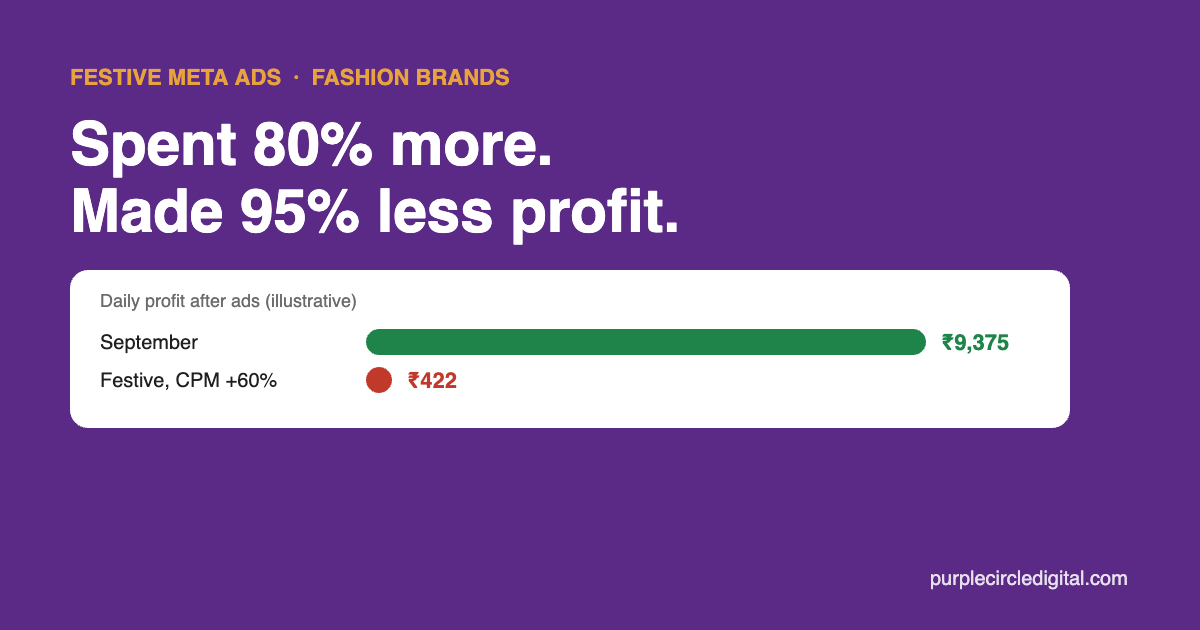

Meta Ads CPM Up in Festive Season? Protect Your Profit
Short answer: Meta ads get expensive in festive season. CPMs for Indian fashion brands usually climb 40–70% in the weeks before Diwali. If your conversion rate doesn’t rise with them, your cost per order rises by the same amount. So the right festive budget isn’t “whatever holds my reach”. It’s the most you can spend before your cost per order crosses your profit per order. Work out your maximum affordable CPM first, then scale.
Every October I see the same pattern in fashion accounts. The founder raises the Meta budget 70–80% because “it’s festive season, everyone is scaling”. Orders go up. The dashboard looks busy. Then the November numbers come in and the brand made less money than it did in September on almost half the spend.
The ads didn’t fail. The math did.
The problem: you’re paying festive prices for September results
Here’s what founders tell us around this time of year:
If two of these sound familiar, your festive budget is set by the calendar, not by your margins.
Most festive advice this month says the same thing: CPMs will rise, so raise your budget to keep your reach steady. One widely shared festive budget guide estimates a 40–70% CPM rise by the final week before Diwali (8 November this year) and suggests a brand spending ₹15,000 a day may need ₹25,000–30,000 a day just to hold reach.
That’s a fair read of the auction. But reach is not the goal. Profit is. And nobody is asking whether the extra reach is worth buying at that price.
Why it happens
Festive season doesn’t make your ads worse. It makes every impression more expensive, because far more advertisers are bidding for the same buyers: marketplaces, big fashion labels, jewellery, electronics, and every other D2C brand chasing gifting intent.
CPM is only half of your cost per order. The other half is how many impressions it takes to get one sale.
Your cost per purchase comes from two things: what you pay for 1,000 impressions (CPM) and how many purchases those 1,000 impressions produce. If CPM goes up 60% and purchases per 1,000 impressions stay the same, CAC goes up 60%. Simple.
Three things make it worse for fashion brands:
- Your profit per order doesn’t grow. Festive discounts often shrink it. We covered how much in why a sitewide discount cuts your profit margin so hard.
- More COD, more RTO. A bigger share of festive orders are COD, and more of them get refused. That raises the ROAS you need to break even. The full math is in how RTO changes your break-even ROAS during Diwali.
- Budget jumps reset learning. Tripling budgets overnight usually pushes CAC up even further. More on that in why ads stop working when you increase the budget.
What it’s really costing: a worked example
Illustrative example, not client data. A women’s kurti brand sells at an average order value of ₹1,400. After GST, product cost, shipping, payment fees and an allowance for RTO and returns, it keeps about ₹520 per order before ads. That ₹520 is its break-even CAC. Spend more than ₹520 to get an order and it loses money on that order.
In September the brand spends ₹15,000 a day at a ₹120 CPM, 1.5% click-through rate and 2.5% website conversion rate. For festive season it follows the usual advice: raise budget 80% to ₹27,000 a day and absorb a 60% CPM rise to ₹192.
| Per day | September | Festive, conversion flat | Festive, conversion 2.5% → 3% |
|---|---|---|---|
| Ad spend | ₹15,000 | ₹27,000 | ₹27,000 |
| CPM | ₹120 | ₹192 | ₹192 |
| CAC | ₹320 | ₹512 | ₹427 |
| Orders | 47 | 53 | 63 |
| Profit per order after ads | ₹200 | ₹8 | ₹93 |
| Profit per day after ads | ₹9,375 | ₹422 | ₹5,906 |
Illustrative example. ₹520 profit per order before ads, 1.5% CTR. Orders rounded.
Read the last row again. The brand spends 80% more and gets 6 more orders a day. Its daily profit falls from ₹9,375 to ₹422. Even if festive shoppers convert better (the green column), it still makes 37% less profit per day than in September, on nearly double the spend.
More spend, less profit. Scaling to “hold reach” only works if your margins can pay festive CPMs.
This is the same trap as a great ROAS that still loses money. The dashboard shows more orders. The P&L shows less profit.
The solution: set your festive budget from your margins, not the calendar
Start with one number: the highest CPM your business can afford.
Use your own last-30-day CTR and conversion rate. Recalculate if your festive offer changes profit per order.
In the example, a ₹192 CPM is just below the ₹195 ceiling. That’s why profit per order fell to ₹8. The brand wasn’t scaling. It was running at break-even and calling it growth.
Once you know your ceiling, use this five-step plan:
You get the festive upside without buying orders at a loss.
For the example brand, the zones look like this:
Illustrative example at 1.5% CTR and 2.5% conversion rate. Put your own numbers in writing before October peaks.
Notice what step 3 does. If festive creative and a bundle offer raise the conversion rate from 2.5% to 3%, the CPM ceiling rises from ₹195 to ₹234. That’s how good brands scale through Diwali profitably. They buy the higher CPM by getting more sales from each 1,000 impressions, not by hoping.
Judge the result on blended numbers, not only on what Meta reports. Track total revenue ÷ total ad spend each day as well as platform ROAS. If you’re unsure which one to trust, read ROAS vs MER vs blended ROAS.
Common mistakes
- Budgeting to hold reach. Reach is a cost, not a result. Budget to your CPM ceiling.
- Using September’s break-even CAC in October. Discounts and COD shrink festive profit per order, so your ceiling is lower than you think.
- Launching untested creative in peak week. Learning at ₹190 CPMs is the most expensive testing you’ll ever do. Test in September and early October.
- Cutting everything when CPM spikes. Pull back cold prospecting only. Retargeting and past buyers usually still pay.
- Checking numbers weekly. Festive CPMs move every few days. A week at a loss is a lot of money.
Your checklist for this week
FAQ
How much do Meta ad CPMs increase during Diwali in India?
Planning guides for 2026 put the rise at roughly 40–70% above normal by the final week before Diwali, with fashion and beauty at the higher end. Your own account can differ, so track the weekly CPM in Ads Manager rather than relying on an industry figure.
Should I increase my Meta ads budget for the festive season?
Only while your CPM stays below your maximum affordable CPM. Increase in 20–30% steps and stop adding budget when cost per order gets close to your profit per order.
What is a maximum affordable CPM?
It’s the highest CPM at which an order still breaks even. Formula: break-even CAC × CTR × conversion rate × 1,000. With ₹520 break-even CAC, 1.5% CTR and 2.5% conversion rate, it’s ₹195.
Why is my ROAS dropping during festive season when my ads are the same?
Because every impression costs more while your conversion rate and order value stay about the same. Higher COD share and RTO add to it, since Meta counts orders placed, not orders delivered.
When should fashion brands start festive Meta ads?
Test creative and offers in September and early October, while CPMs are still normal. Then scale in steps as intent rises and keep spending through the week after Diwali, as long as CPM stays in your green zone.
Not sure what your festive CPM ceiling is? That’s the number to find before you raise budgets. Book a free call and Purple Circle will review your unit economics with you, or see how we handle Meta ads for fashion brands and the case study on fashion brands that hit ROAS targets and still lose money.
— Ashish Rai, CEO, Purple Circle