

Why Am I Not Making Profit After Increasing My Prices?
By Ashish Rai, CEO, Purple Circle · October 2026 · 8 min read
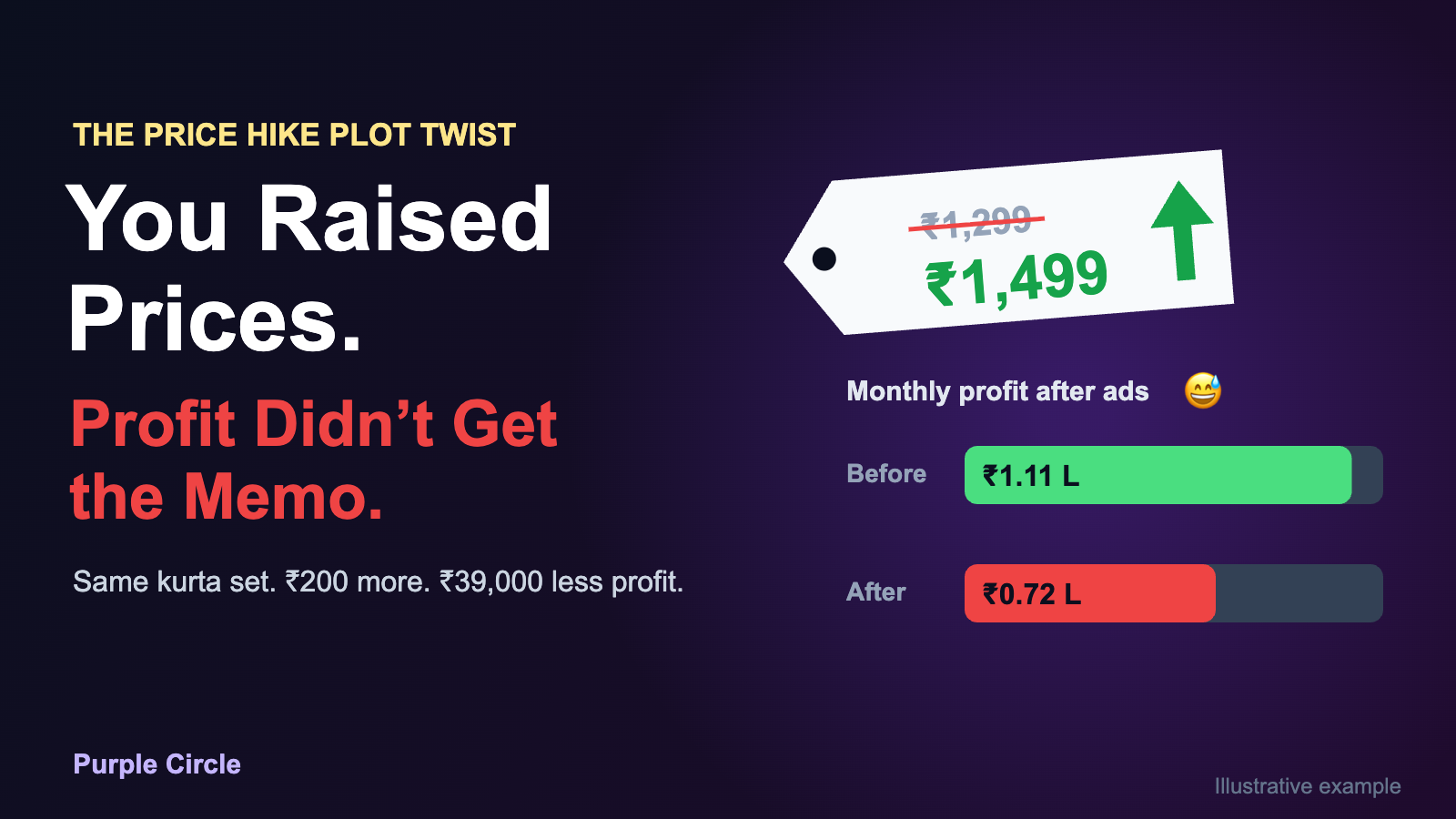
You’re not making more profit after raising prices because a price increase only works if conversion doesn’t fall too far, and most brands accidentally undo it. They add a coupon to “recover volume”, or let conversion crash because nothing on the page justifies the new price, or attract more COD orders that never get accepted. Meta then charges more for each order. In the example below, a kurta set goes from ₹1,299 to ₹1,499 and monthly profit falls from ₹1.11 lakh to ₹0.72 lakh. Done properly, the same increase takes profit to ₹1.76 lakh.
⚡ The 30-second version
- A higher price raises margin per order, but usually lowers conversion. Your profit depends on which one wins.
- In the example, a ₹200 increase pays off as long as you lose less than about 22% of conversions.
- Adding a coupon after a price hike usually leaves you below your old price.
- Higher prices on COD can bring more “let’s just see it” orders that end up as RTO.
- The price only sticks if the product page earns it.
Raising prices feels like the most grown-up decision a founder can make. You’ve read the posts. You’ve done the margin math. You change ₹1,299 to ₹1,499, sit back, and wait for the money.
Then the month closes and profit has gone down. Not flat. Down. Like a cat that does the opposite of whatever you just asked it to do.
Meet the four founders
Same kurta set. Same ₹3 lakh monthly Meta budget. Same factory, same courier, same everything. Four different ways of handling one price change. This is an illustrative example, not client data, and all prices are net of GST.
Conversion: baseline
Profit per order: ₹180
Monthly profit: ₹1.11 lakh
Conversion: about the same
Profit per order: ₹156
Monthly profit: ₹0.96 lakh
Conversion: −25%
Profit per order: ₹164
Monthly profit: ₹0.72 lakh
Conversion: −8%
Profit per order: ₹311
Monthly profit: ₹1.76 lakh
Monthly profit after ads, same ₹3 lakh ad budget
Illustrative. Two of the three founders who raised prices ended up worse off than if they’d done nothing.
The Panic Couponer raised the price to ₹1,499, watched orders dip for three days, and added a 15% coupon. Congratulations: they now sell at ₹1,274, which is ₹25 less than before, with extra steps. Every order makes less money than the original.
The Brave-Then-Broke held the line at ₹1,499, respect. But nothing on the product page changed, so the new price felt random. Conversion fell 25%, Meta started charging more per order, and the “let’s just see it” COD crowd pushed RTO from 22% to 26%. A ₹200 increase, and ₹39,000 less profit for the month.
The Grown-Up raised the price to ₹1,499 too, but gave customers a reason: fabric close-ups, a proper fit guide, real reviews near the price. No coupon. A small prepaid incentive. Conversion slipped 8%, and monthly profit went up by 59%.
The math behind it, per delivered order
This uses the same CM1, CM2 and CM3 levels from how to choose apparel products using CM1 and CM2. Product cost is ₹420. Shipping and packing is ₹100. Payment fees are about 3%. Each RTO costs ₹180 in shipping both ways, spread over delivered orders. Size exchanges cost ₹22 per delivered order. Meta spends ₹380 to win an order at the original conversion rate.
| Per delivered order | 😌 Original | 😰 Couponer | 😬 Brave | 😎 Grown-Up |
|---|---|---|---|---|
| Price the customer pays | ₹1,299 | ₹1,274 | ₹1,499 | ₹1,499 |
| Conversion vs before | — | about same | −25% | −8% |
| RTO rate | 22% | 22% | 26% | 22% |
| CM1 | ₹879 | ₹854 | ₹1,079 | ₹1,079 |
| Shipping, fees, RTO, exchanges | ₹212 | ₹211 | ₹230 | ₹238* |
| CM2 | ₹667 | ₹643 | ₹849 | ₹841 |
| Meta ads per delivered order | ₹487 | ₹487 | ₹685 | ₹530 |
| CM3 (profit per order) | ₹180 | ₹156 | ₹164 | ₹311 |
| Monthly profit (₹3L ad spend) | ₹1.11 L | ₹0.96 L | ₹0.72 L | ₹1.76 L |
*Includes ₹20 per delivered order for a ₹50 prepaid incentive used on about 40% of orders.
Look at the Brave-Then-Broke column. CM2 went up by ₹182 per order, a genuinely better product margin. Then ads ate it. When conversion drops, the same daily budget buys fewer orders, so each one costs more. Meta does not give you a discount for being expensive.
Why price increases backfire
How much conversion can you afford to lose?
This is the one number to work out before touching any price. If your monthly ad budget stays the same, a price increase pays off only if your conversion drop is smaller than this:
Max conversion drop = 1 − (old CM2 per order placed ÷ new CM2 per order placed)
CM2 per order placed = CM2 per delivered order × delivery rate
Example, ₹1,299 → ₹1,499 with RTO unchanged at 22%: old = ₹667 × 0.78 = ₹520. New = ₹861 × 0.78 = ₹672. Max drop = 1 − 520 ÷ 672 ≈ 22%.
Your conversion “allowance” for a ₹200 increase
Green zone: the increase pays. Red zone: you’d have been better off at ₹1,299. Illustrative.
Run this before the change, then watch conversion for two to three weeks after it. If you’re drifting toward the limit, fix the product page before you even think about a coupon.
How to raise prices without the drama
Mistakes that turn a price rise into a price fall
| Mistake | What actually happens |
|---|---|
| Raising prices on Friday, launching a sale on Monday | Customers notice. So does your margin. |
| Judging the increase on order count | Orders always dip. The question is whether CM3 went up. |
| Raising every price at once | You can’t tell which products took it well and which didn’t. |
| Changing the price but not the page | Same photos, higher number. Customers do the math and leave. |
| Ignoring RTO after the change | Pricier COD orders can come back more often. Check by pin code. |
FAQ
Why am I not making more profit after increasing my prices?
Usually because conversion fell further than the extra margin could cover, because a coupon undid the increase, or because more COD orders turned into RTO. With the same ad budget, fewer orders means a higher ad cost per order.
How much can conversion drop before a price increase stops paying?
Work out 1 − (old CM2 per order placed ÷ new CM2 per order placed). In our example, a ₹1,299 to ₹1,499 increase pays as long as conversion falls by less than about 22%.
Should I offer a discount after raising prices?
Not straight away. A 15% coupon on a ₹1,499 price leaves you at ₹1,274, below the old ₹1,299. Give the new price at least 60 days, and use bundles if you need a sales push.
Will raising prices increase RTO?
It can on COD orders, because more people order to “see it first”. A small prepaid incentive and order verification before dispatch help keep RTO in check.
How do I raise prices without losing customers?
Start with products that already sell well, improve the product page so the price makes sense, test one product first, avoid coupons for a while, and judge the result on profit per order, not order count.
Thinking about a price increase and want to know your real conversion allowance first? Purple Circle can run the numbers with you before you change a single price. You can also see how we work in our case studies.
— Ashish Rai, CEO, Purple Circle